
The jeep cj cj5 collector market has done something few of us appraisers predicted twenty years ago: it took a vehicle nobody once bothered to preserve and turned it into a line item that gets tracked with the same seriousness as a muscle car. That shift did not happen overnight, and it did not happen evenly across the model run. Understanding why requires separating nostalgia from documentation, because those two forces move the CJ-5 market in different directions, and only one of them actually protects your money.
Car Features
7 min read
Collecting the CJ-5: From Cheap Trail Toy to Blue Chip
The CJ-5 spent decades as a disposable farm tool before the collector market caught on. An appraiser's read on what actually drives value, and what buyers should watch for.
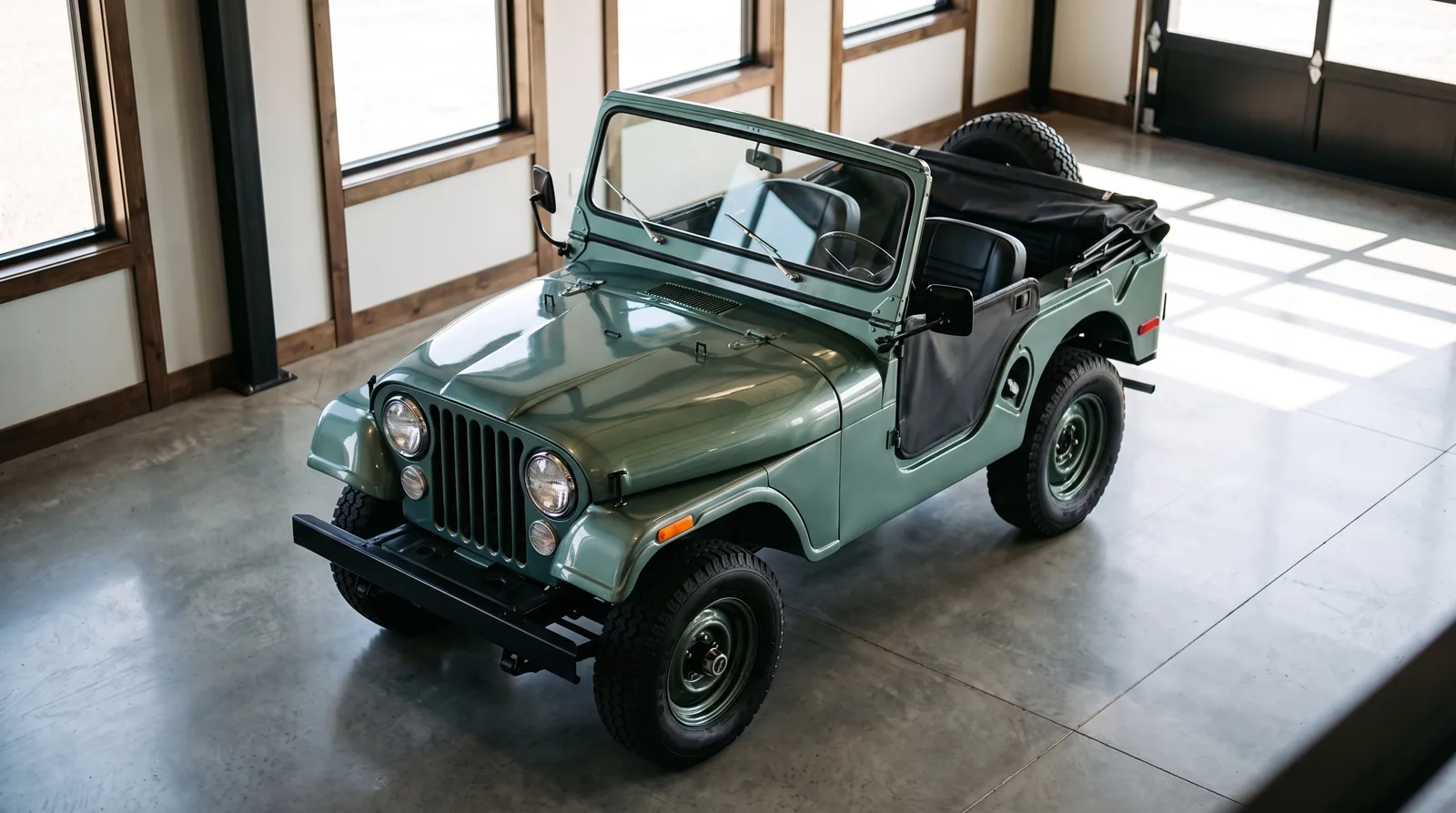
From disposable to desirable
For most of its life the CJ-5 was treated as a tool, not an asset. Owners drove them until something broke, fixed what was cheap, replaced what wasn't, and rarely kept a body panel or a set of gauges original if a swap solved a problem faster. That utilitarian attitude is exactly why unmolested, factory-correct examples are scarce now. Scarcity created by neglect is a different animal than scarcity created by low production, and it is the reason CJ-5 values climbed later and less predictably than more overtly collectible cars from the same decades. There was no cohort of buyers protecting these things in the 1970s. The market had to wait for the survivors to become rare on their own.
The turn happened gradually through the 2000s and accelerated once general interest in vintage 4x4s picked up, driven partly by buyers priced out of muscle cars looking for something with a lower entry point and genuine period character. A CJ-5 offered both: real mechanical simplicity and an honest connection to a working American past. That combination is what pulled the CJ-5 out of the beater category and into the collector conversation, but the market has never fully shed its utilitarian roots, and pricing still reflects that split personality.
What actually moves a number
Condition matters, obviously, but with a CJ-5 it matters differently than it would with a car built for the show circuit. A rust-free frame and tub carry more weight than a flawless paint job, because rust repair on a CJ-5 chassis is invasive and expensive relative to the vehicle's overall value, while a repaint is comparatively routine. Documentation matters too, though genuine build sheets and original titles are rarer here than with higher-volume passenger cars, since nobody expected a farm jeep to need a paper trail. And originality of drivetrain carries a real premium now, ironically, on a vehicle whose owners spent five decades swapping engines and transmissions without a second thought.
The risk side of the ledger
Buyers coming from other collector segments sometimes underestimate the CJ-5's risk profile. Liquidity is thinner than it looks. A clean CJ-5 will sell, but the buyer pool skews toward enthusiasts who know the model well enough to spot a bad repair, which means an overpriced or poorly documented example can sit for months while a comparable muscle car of similar value moves in weeks. Parts interchange across the long production run also creates a documentation problem: a seller's claim of "matching numbers" is harder to verify on a CJ-5 than on a car with a more rigorous factory paper trail, and buyers should treat that claim with more skepticism here than they would elsewhere.
| Risk factor | Why it matters on a CJ-5 |
|---|---|
| Frame and tub rust | Repair cost often exceeds the value gain, unlike cosmetic issues |
| Drivetrain originality claims | Decades of casual swaps make verification difficult |
| Buyer pool depth | Thinner and more knowledgeable than mainstream muscle car buyers |
| Documentation scarcity | Working vehicles rarely kept the paperwork collector cars did |
"A CJ-5 is not a bad asset. It's a misunderstood one. The mistake I see most often is a buyer pricing it like a show car when the market actually pays for honest condition and a clean frame, not for a trailer queen with a repaint hiding old rust."
- Marcus Feld
How the CJ-5 compares to its own siblings
It is worth situating the CJ-5 against the rest of its own family, because appraisers get asked constantly whether a CJ-5 or a CJ-7 is the smarter purchase, and the honest answer depends on what the buyer actually wants. The CJ-5's shorter wheelbase and longer overall production run give it a more purely traditional character that a certain type of buyer will always pay for, while the CJ-7's added comfort options broaden its appeal to buyers who never plan to take the vehicle seriously off-road. Neither vehicle reliably outperforms the other across the board. What matters more than which model a buyer chooses is whether they understand which submarket they are actually buying into, because pricing one CJ-5 variant against a CJ-7 result, or vice versa, is a common and avoidable appraisal mistake.
Reading the trend line without overreacting
Auction results over the past several years show steady, unspectacular appreciation for solid CJ-5s, punctuated by occasional spikes for unusually original or early examples that draw competitive bidding. That pattern is healthy. A market that climbs slowly, backed by genuine scarcity of unmolested examples rather than speculative hype, tends to hold its gains better than one driven by a single viral sale. Buyers should be wary of treating one headline auction result as the new baseline for an entire model run; a six-figure CJ-5 sale usually reflects an exceptional, well-documented example, not the value of an average survivor pulled out of a barn.
If you want the full background on how the CJ-5 got here, from its 1955 introduction through the decades of running changes that now complicate every appraisal, our jeep cj5 retrospective covers the whole arc in detail and is worth reading before you evaluate any specific example against it.
The bottom line for a buyer today
My advice has not changed much over the years: buy the frame and the documentation first, the cosmetics second. A CJ-5 with honest wear, a solid tub, and a plausible ownership history will outperform a flashy repaint with an unverifiable engine claim every time the market gets tested by a downturn. The category still has room to grow as more buyers discover it, but growth rewards patience and diligence here more than it rewards chasing the last headline sale. If you are ready to start looking with that discipline in mind, CJs for sale now is a reasonable place to begin comparing what is actually on the market against what the trend lines suggest it should be worth.
One last point I make to every client entering the jeep cj cj5 collector market for the first time: patience is a strategy, not a weakness, in this segment. Unlike faster-moving collector categories where hesitation costs you the deal, a genuinely solid CJ-5 with clean documentation rarely disappears overnight. Taking the extra week to verify a frame, confirm a title history, or get a second opinion on an engine's originality claim costs you very little in this market and can save you from a purchase that looks fine in photographs but does not hold up under inspection. The buyers who do best here are consistently the ones willing to walk away from a deal that feels rushed, and that discipline matters more in a thinly traded category like this one than it would in a market with a deeper, faster-moving buyer pool.
Sources and notes
Related Reading
#collector car values
#classic car buying
#jeep cj-5
#classic Jeep market
#vintage 4x4 investing
#Jeep appraisal

About the author
Marcus Feld
Accredited collector-car appraiser who reads the market through hammer prices, condition tiers and risk.
Related Listings - Jeep CJ





Comments
Be the first to comment on this article.