
The jeep cj cj5 postal and fleet story rarely gets told alongside the trail pictures and the desert-racing lore, and that is an oversight, because for a large share of its production run the CJ-5 spent its working life not on a mountain pass but on a rural route, a municipal yard, or a farm lane. Examined as an artifact rather than a legend, the CJ-5 is as much a piece of American infrastructure history as it is a piece of recreational vehicle history, and the fleet record tells a different, more useful story than the marketing brochures ever did.
Car Features
8 min read
Mail, Farms and Fleets: The Working-Class CJ-5
Long before it was a collector's icon, the CJ-5 was institutional equipment, sold to postal routes, farms, utilities, and municipalities that cared about cost and durability above all else.
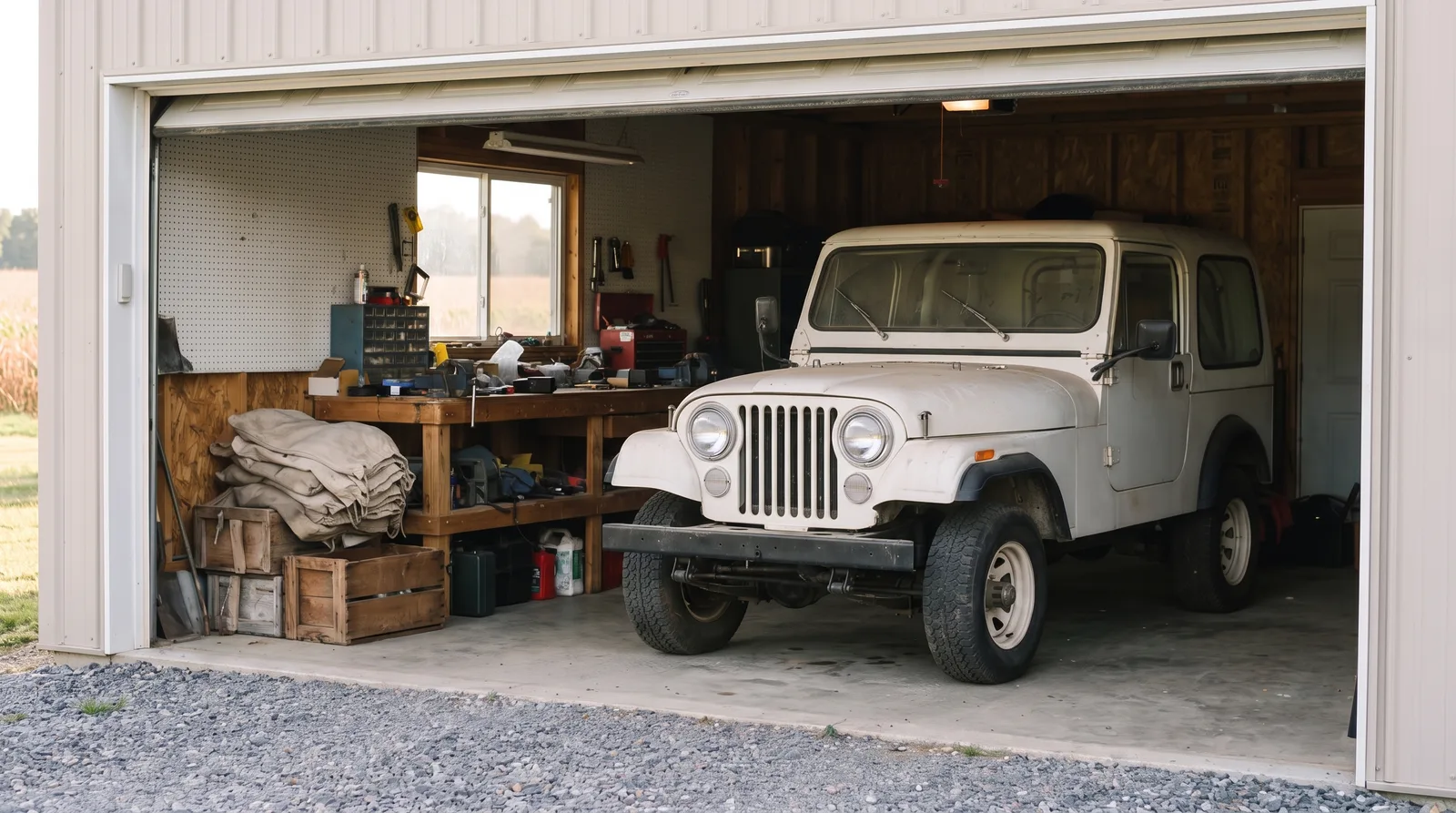
A chassis built for institutional buyers
Willys, and later Kaiser Jeep, never pretended the CJ-5 existed solely for private weekend use. From the outset the vehicle was pitched to municipalities, utilities, and government agencies as a low-cost, easily maintained platform that could be specified with a power takeoff, a front-mounted winch, or a bed for light hauling. Fleet buyers cared about total cost of ownership long before that phrase existed as marketing language, and the CJ-5's simple mechanicals, part-swappable across model years, made it cheap to keep running across a large vehicle roster. A county road department did not need a dedicated parts warehouse for a fleet of CJ-5s the way it might for a mixed fleet of brand-name trucks; one set of common components covered most of what broke.
The United States Postal Service is the most visible of these institutional users, though its relationship with the CJ platform is often misremembered. Right-hand-drive Jeep variants, built specifically for curbside mail delivery, saw wide use on rural and suburban routes for decades, and the CJ-5 shared enough underpinnings with those postal Jeeps that the two are frequently and incorrectly treated as identical. The DJ Dispatcher, as that postal variant was known, was built by Willys and Kaiser from 1955 and then by AMC into the 1980s, a run that essentially bracketed the CJ-5's own 1955-1983 production, but it was a two-wheel-drive vehicle built around mail delivery, not a four-wheel-drive CJ-5 with a different steering column. What is documented is that Jeep's fleet and postal contracts kept the company's basic 4x4 architecture in continuous production and refinement well past the point where a purely recreational vehicle would have been redesigned or discontinued.
Farms treated it as equipment, not a vehicle
On agricultural land, the CJ-5 was purchased the way a farmer purchases a tractor attachment: for a specific job, at a price that made sense against the return. A CJ-5 with a rear power takeoff could run a post-hole digger, a small mower, or a pump, freeing up a larger tractor for field work. Its narrow track let it move between rows and through gates a full-size truck could not clear. None of this required the vehicle to be comfortable, and period farm CJ-5s were rarely optioned with much beyond the basics: a hard top if the buyer was generous, a heater if the climate demanded it, otherwise a bench seat and whatever tool rack the owner welded on themselves.
Utilities and municipalities kept the design honest
Power companies, water districts, and forestry departments valued the CJ-5 for access more than speed. A narrow, short-wheelbase 4x4 could reach a downed line or a fire access road that a full-size service truck could not, and it could be parked in tight quarters at a substation or maintenance yard without dedicating disproportionate space to it. These buyers were unsentimental. A CJ-5 that failed to start reliably in cold weather or that demanded specialized service was a liability, not a curiosity, and Jeep's fleet reputation depended on the vehicle simply working, day after day, in the hands of a driver who had no particular affection for it and no patience for downtime.
| Fleet buyer type | Typical CJ-5 application | Common spec preference |
|---|---|---|
| Municipal / county | Road maintenance, park patrol | Hard top, tow package |
| Utility company | Line access, substation runabout | Front winch, work lights |
| Agricultural | Post-hole digging, light hauling, pumping | Rear PTO, minimal trim |
| Postal / rural delivery-adjacent | Route support, mail relay | Basic trim, high mileage tolerance |
"When you catalog a fleet-spec CJ-5, you're really cataloging a set of decisions an institutional buyer made about durability and cost, not about style. That's what makes the surviving examples interesting as artifacts. They tell you what actually mattered to someone signing a purchase order in 1968."
- Sarah Whitfield
The paperwork that fleet buyers actually kept
Institutional purchasing generates its own kind of documentation, distinct from the ownership records a private buyer accumulates. Purchase orders, maintenance logs, and depreciation schedules were standard practice for a municipality or utility company managing a vehicle roster, and a handful of these records have survived in archives and historical societies even when the vehicles themselves did not. Piecing together a specific CJ-5's institutional history from those surviving documents is painstaking work, closer to archival research than to typical automotive provenance chasing, but it produces a more reliable picture than relying on an owner's secondhand recollection of where a jeep supposedly came from. A serious researcher treats a county purchasing record with the same weight a passenger car historian gives a factory build sheet, because in the fleet world, that purchasing record often is the closest thing to a build sheet that exists.
Why so few fleet examples survive intact
Institutional vehicles are used until they are no longer economical, then sold at auction or scrapped, and almost none were preserved with their original service records intact. A CJ-5 pulled from a county surplus lot in the 1980s typically arrived stripped of any identifying municipal markings and resold into private hands with no documentation connecting it to its working past. That erasure is precisely why fleet history matters to a careful researcher today: what looks like an unremarkable, thoroughly average CJ-5 in a driveway may in fact carry an equipment history, a PTO mount, a reinforced frame section, that a purely recreational example never needed. Reading those details correctly requires understanding what fleet buyers actually specified, not assuming every CJ-5 left the factory identically equipped.
For readers who want the full arc behind this working history, from the CJ-5's 1955 launch through the design choices that made it so adaptable to institutional use, you can read the background in the complete retrospective. The fleet and postal chapter is a footnote there, but it deserves to be read as its own document, because it explains why so many CJ-5s that survive today still carry the unglamorous scars of honest, unrecorded labor.
What this means for today's buyer
A collector evaluating a CJ-5 with an uncertain past should look for the marks fleet use leaves behind: welded mounting points, non-factory reinforcement, mismatched hardware from field repairs done with whatever was on the shelf. These are not flaws in the traditional collector sense. They are documentation, evidence of a working life that a purely recreational example never had reason to acquire. If that kind of honest, working-class history appeals to you more than a garage queen with a spotless build sheet, you can browse classic CJ listings and start looking specifically for the signs a fleet past leaves behind. Not every CJ-5 was built to impress a judge at a show. A great many were built to be signed for on a delivery form, driven hard, and kept running, and that history is worth preserving just as carefully as any concours example.
The jeep cj cj5 postal and fleet record also offers a useful corrective to how the model gets discussed generally. Recreational and enthusiast use gets the attention because it photographs well and fits neatly into a nostalgia narrative, but institutional buyers were arguably more responsible for keeping the CJ-5 in continuous production and continuous refinement than weekend trail drivers ever were. A vehicle purchased by the thousands for utility and agricultural fleets represents steady, unglamorous revenue that a manufacturer can plan around in a way that recreational sales, more exposed to economic swings and changing consumer taste, cannot always guarantee. Treating that institutional history as central to the CJ-5 story, rather than incidental to it, gives a fuller and more accurate account of why the model survived as long as it did.
Sources and notes
Related Reading

About the author
Sarah Whitfield
Third-generation classic car collector specializing in pre-war American and European coachbuilt automobiles. Researcher and concours enthusiast.
Related Listings - Jeep CJ





Comments
Be the first to comment on this article.