
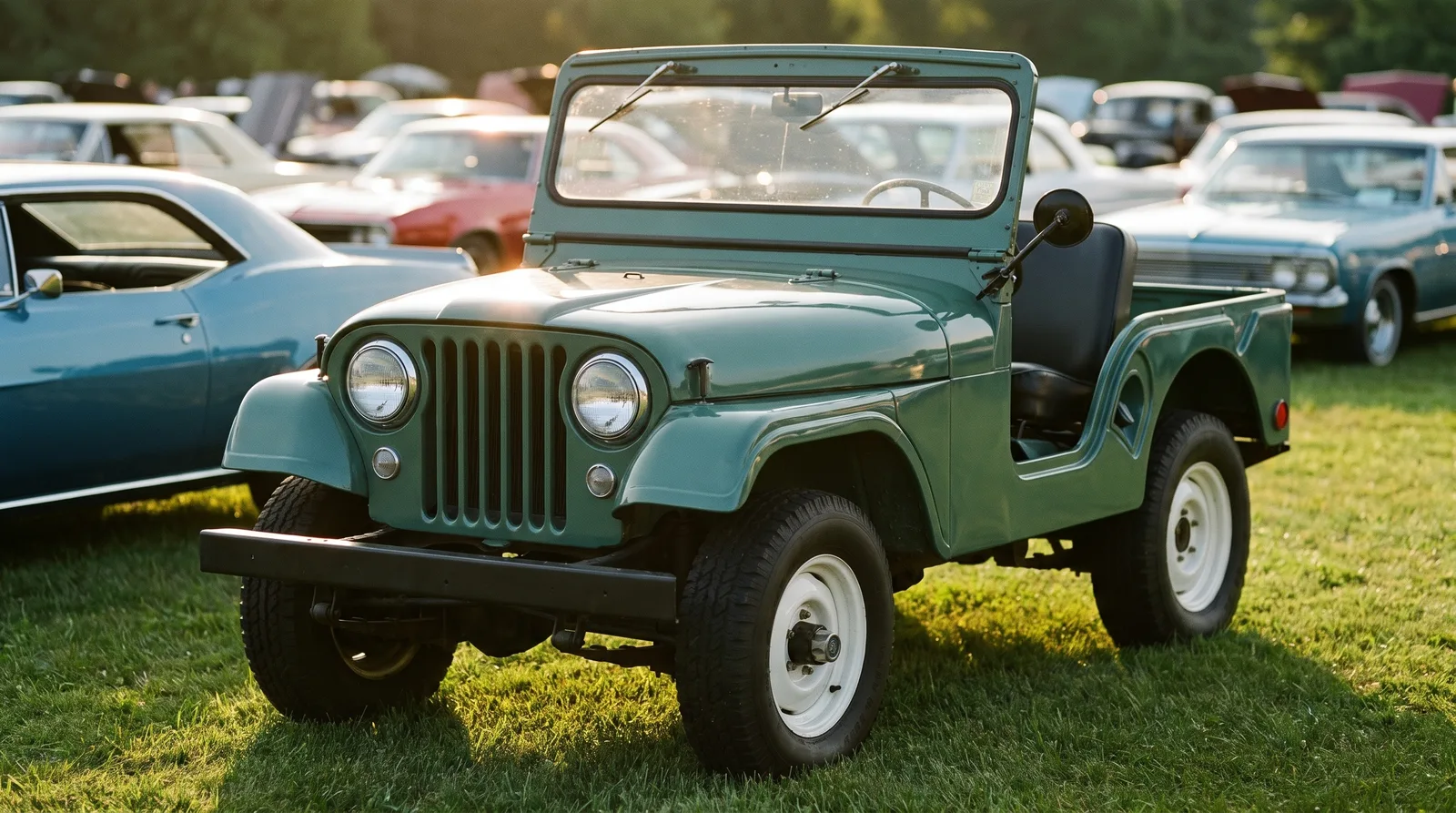
Run the numbers on the jeep cj cj5 dauntless v6 arrival and the story tells itself without much embellishment needed. Before 1966, a CJ-5 buyer had one engine choice, the 134-cubic-inch F-head Hurricane four-cylinder rated at 72 horsepower. Starting with the 1966 model year, that same buyer could order a 225-cubic-inch Dauntless V6 rated at roughly 155 horsepower. More than double the output, in the same basic chassis, without a redesign of the frame or body. That is not an incremental upgrade. That is a different vehicle wearing the same badge.
Car Features
7 min read
The Day the Dauntless V6 Woke Up the CJ-5
The 1965 arrival of the Buick-derived Dauntless V6 more than doubled the CJ-5's horsepower and changed what owners could realistically expect from the vehicle.
Where the engine actually came from
The Dauntless V6 did not start life as a Jeep engine. General Motors developed the basic architecture as the Buick 225, an odd-fire V6 used in Buick's own lineup starting in 1962, distinctive for an uneven firing order that produced a rougher idle than a conventional V6 but delivered strong low-end torque, exactly the trait that mattered most for a vehicle expected to pull stumps and climb rutted trails. Kaiser Jeep bought the tooling rights from Buick and rebranded the engine Dauntless for use across the Jeep lineup, starting with the CJ-5 and CJ-6 for the 1966 model year.
That odd-fire design is worth understanding on its own terms rather than dismissing as a quirk. A conventional V6 splits its cylinder banks at 90 degrees but fires evenly, while the Dauntless kept the 90-degree bank angle inherited from a V8 architecture GM had shortened by two cylinders, which produced uneven intervals between power pulses. The tradeoff was a rougher, more buzzy idle compared to a purpose-built even-fire V6, but the underlying torque characteristics, particularly at low RPM, suited a working vehicle better than a smoother, higher-revving design would have.
Reading the numbers straight
Horsepower is only half the story. Torque is where the Dauntless actually earned its keep in daily use. The 134-cubic-inch Hurricane four produced its peak torque at relatively low RPM but simply lacked displacement to generate large absolute numbers. The 225-cubic-inch Dauntless, with nearly 70 percent more displacement, delivered a meaningfully larger torque figure across a broader RPM band, generally cited at around 220 to 235 lb-ft depending on the model year and how the engine was tuned. For a vehicle regularly asked to tow, climb, or push through mud, that torque curve mattered more day to day than the horsepower number that made for better advertising copy.
| Spec | Hurricane four (pre-1966) | Dauntless V6 (1966 onward) |
|---|---|---|
| Displacement | 134 cubic inches | 225 cubic inches |
| Horsepower | 72 hp | 155 hp |
| Cylinder layout | Inline four, F-head | V6, odd-fire, overhead valve |
| Origin | Willys design | Adapted from Buick 225 |
What the upgrade actually cost the buyer
None of this power came free, and Kaiser priced the Dauntless option accordingly. The V6 carried a real price premium over the base four-cylinder CJ-5, and buyers weighing the option had to consider fuel economy alongside performance, since a larger-displacement engine burning more fuel at any given throttle position was simply a fact of the era's technology regardless of how the torque curve behaved. For buyers who primarily used their CJ-5 for light utility work rather than towing or aggressive off-road driving, the four-cylinder remained a rational, cheaper choice for years after the V6 became available, which is part of why plenty of Hurricane-engine CJ-5s continued rolling off dealer lots well into the late 1960s alongside their V6 siblings.
What the Dauntless V6 changed permanently was the CJ-5's ceiling. Before 1966, the model's performance was fundamentally capped by a four-cylinder engine design that traced back to the 1940s. After 1966, Jeep had a genuine mid-power option in its lineup, one capable of highway merging and grade climbing that the Hurricane four simply could not match without noticeably straining. That gap is the reason serious buyers today, when comparing a Kaiser-era CJ-5, treat the engine choice as the single most consequential spec on the sheet. For the complete arc of how this fits into the model's broader development, the full story covers every generation from the original 1955 launch through the AMC years.
"I've dyno-tested enough of these engines to say the horsepower number gets all the attention, but the torque curve is what actually made the Dauntless worth the extra money in 1965 and worth chasing in a survivor today."
- Emily Chen
How the V6 changed what owners expected from a CJ-5
There is a behavioral shift worth documenting alongside the raw specification numbers. Owners of the earlier four-cylinder CJ-5 planned trips around the engine's limitations almost instinctively, avoiding steep highway grades at speed or long-distance towing because the Hurricane simply did not have the reserve capacity to handle those tasks comfortably. Dauntless-equipped owners could plan differently. Period road tests and dealer literature from the late 1960s noted the V6 model's ability to maintain highway speeds on grades that would force a four-cylinder truck into a lower gear and a noticeably slower climb. That shift in what an owner could reasonably expect from daily use is arguably a bigger deal than the horsepower figure alone, because it changed the practical range of jobs a single CJ-5 could handle without a driver mentally subtracting capability before starting the trip.
The V6 also opened up towing scenarios that had been marginal at best with the four-cylinder. Boat trailers, small livestock trailers, and utility trailers loaded with farm equipment became realistic tasks rather than tasks technically possible but genuinely uncomfortable in practice. That expanded utility is part of why the Dauntless option sold well enough, despite its price premium, to remain in Jeep's engine lineup through the rest of the Kaiser era and into the early AMC years before a different engine sourcing arrangement replaced it.
Why the Dauntless matters to collectors now
The Dauntless V6's production run inside the CJ-5 was actually shorter than most people assume. AMC replaced the V6 with its own inline-six engines starting in the 1972 model year, which means the original Dauntless application in the CJ-5 spans roughly 1966 through 1971, a window of about six model years, before AMC eventually sold the V6 tooling back to General Motors in the mid-1970s. That relatively narrow production window has made original, numbers-matching Dauntless-equipped CJ-5s from this specific era a genuine collector target, distinct from both the earlier four-cylinder trucks and the later AMC-six-powered models that followed.
Anyone evaluating a Kaiser-era CJ-5 for purchase should verify the engine bay matches the paperwork before assuming a V6 badge or aftermarket decal tells the whole story, since engine swaps between eras were common enough over five decades of ownership that badging alone proves nothing. A confirmed, original Dauntless installation, backed by matching engine tags and period documentation, commands a real premium over an equivalent truck with a later replacement engine. Buyers who want to compare that specific spec across available inventory can browse classic CJ listings and filter for confirmed Kaiser-era Dauntless applications before committing to a purchase.
Sources and notes
Related Reading

About the author
Emily Chen
Bay Area engineer with a deep focus on vintage Japanese and European performance cars. Approaches classic car research and restoration with an analytical eye.
Related Listings - Jeep CJ







Comments
Be the first to comment on this article.