
You bring up "Tuxedo Park" at a Jeep swap meet and half the crowd looks at you sideways, like you invented the name to sound clever. I get it. It sounds like a golf resort, not a trim package. But the jeep cj cj5 tuxedo park was a real thing Kaiser Jeep put on dealer lots, and it's one of my favorite stories to tell precisely because nobody expects a utility Jeep to have ever tried on formal wear.
Car Features
7 min read
Tuxedo Park: The CJ-5 That Tried to Wear a Bow Tie
Kaiser Jeep's Tuxedo Park trim dressed the CJ-5 in chrome and upgraded upholstery, chasing suburban buyers who had never considered a Jeep before.
What Kaiser was actually chasing
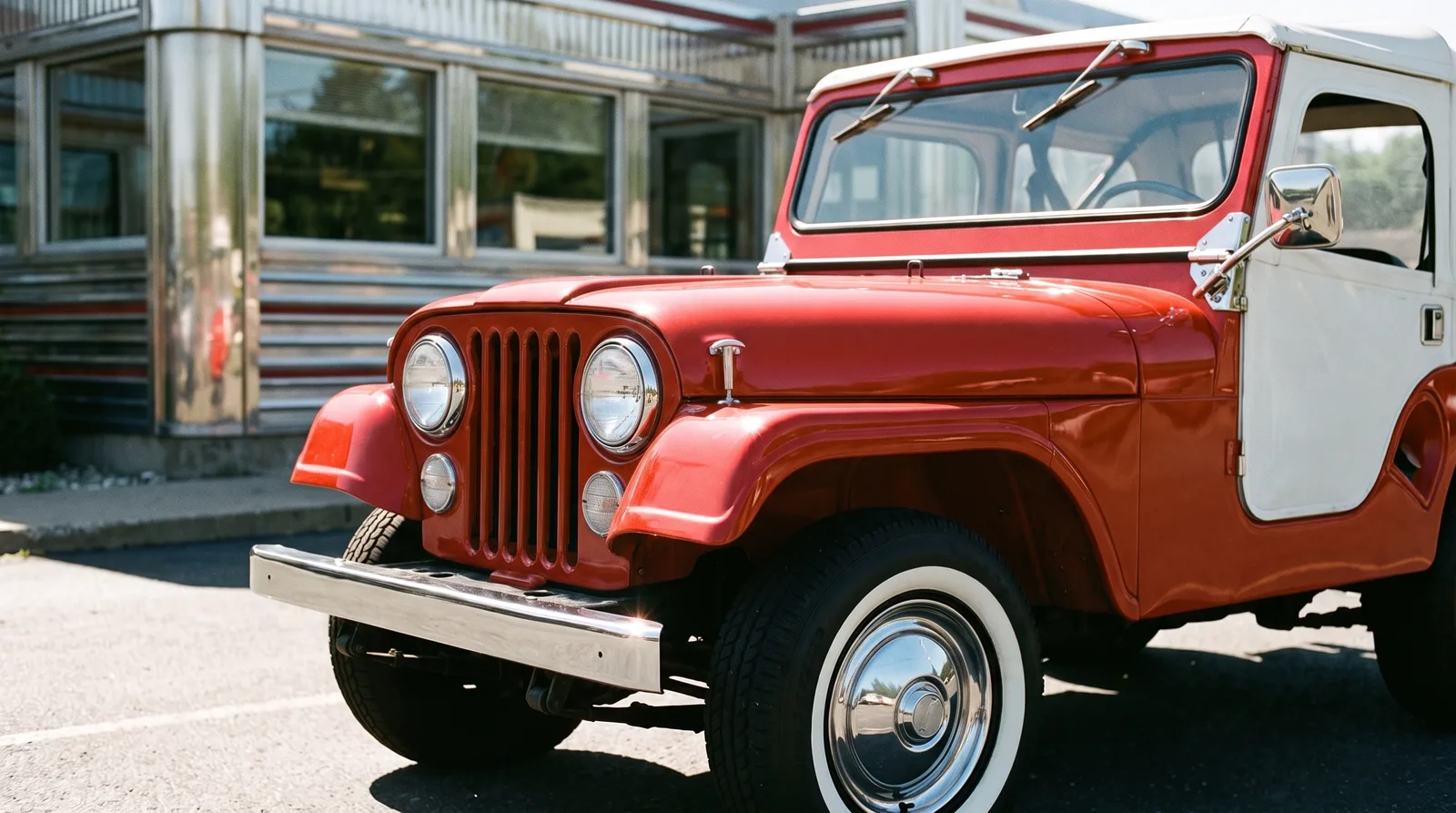
By the early 1960s, Kaiser Jeep Corporation had a problem that had nothing to do with the CJ-5's mechanical reputation. The truck worked fine. What Kaiser wanted was a bigger slice of a buyer who wasn't just hauling hay bales, the suburban customer with money for a second vehicle who might otherwise walk into a Ford or Chevrolet dealer and drive out with something dressed up rather than something purely functional. So Kaiser's marketing team dreamed up the Tuxedo Park package, essentially a chrome-and-comfort trim level layered onto the standard CJ-5, aimed squarely at buyers who wanted the Jeep image without giving up every creature comfort to get it.
The name itself tells you everything about the intended audience. Tuxedo Park is an actual village in New York, historically associated with old money and formal social clubs, and Kaiser borrowed that association shamelessly. This was not a Jeep for the working rancher. This was a Jeep aimed at the guy who wanted to look like he could rough it while parking outside a country club.
What actually came on the package
Kaiser introduced the Tuxedo Park package in 1961, running it through three trim tiers before folding it into a dedicated Tuxedo Park Mark IV model for the CJ-5A and CJ-6A starting in 1964. Buyers got chrome front bumpers, a chrome grille and hood badge, chrome tail lamps, and an "Indian Ceramic" steering wheel matched to seats trimmed in black vinyl with Indian Ceramic facings, along with a column shift and brighter exterior colors than the utilitarian palette most CJ-5s wore off the standard order sheet. The package stayed on the books, in one form or another, through about 1969. None of it touched the drivetrain. Under the chrome, a Tuxedo Park CJ-5 ran the same Hurricane four or, once it became available, the same Dauntless V6 as any other CJ-5 on the lot. This was cosmetics layered onto a working platform, not a mechanical variant.
That distinction matters for anyone chasing one today. A genuine Tuxedo Park CJ-5 is not faster, not stronger, not more capable off-road than a standard truck built the same year. What it offers is a specific slice of Kaiser-era marketing history, a snapshot of the company trying to reposition a farm-and-ranch vehicle as something a suburban family could park in the driveway without embarrassment. For the full lineup of trims and eras the CJ-5 went through across its production run, where this started lays out the complete picture from the 1955 launch onward.
Why the gamble didn't stick around long
Here's the part that makes the story worth telling around a campfire rather than just reading off a spec sheet. Tuxedo Park never became a mainstream, long-running trim the way later special editions like Renegade would. Kaiser's core buyers, the ranchers and hunters and rural mail carriers who had made the CJ-5 profitable in the first place, weren't exactly clamoring for chrome trim and fancier seats. And the suburban buyers Kaiser hoped to attract had plenty of other options for a stylish second vehicle that didn't come with a stiff ride and a canvas top. The package quietly faded from Kaiser's catalog, remembered today mostly by collectors and trivia enthusiasts rather than by the general public.
"Tuxedo Park is proof that Kaiser was willing to experiment even when the experiment didn't take. That's a more honest history than pretending every decision the company made was a hit."
- Wayne Coburn
How it fits into the CJ-5's wider identity crisis
Tuxedo Park wasn't Kaiser flailing in isolation. Almost every American automaker in the 1960s wrestled with the same question about how far a utility vehicle could stretch toward a lifestyle product without losing the customers who bought it to actually work. Kaiser's answer, in this one specific package, was to bet that chrome and comfort could pull in buyers who had never considered a Jeep before. It's a small, contained experiment compared to what later companies would try with four-wheel-drive vehicles once the recreational market matured through the 1970s and 1980s, but it's an early data point in that same broader trend. The CJ-5 was never going to become a luxury vehicle. Even dressed in Tuxedo Park trim, it still rode on leaf springs and still had a canvas top as a factory option. But the attempt itself tells you Kaiser understood the market was shifting even if the company's specific solution didn't stick.
I think that's why I like telling this story at swap meets more than some of the bigger, better documented CJ-5 chapters. Tuxedo Park isn't a triumph. It's a company trying something, watching it not quite land, and moving on to other strategies that eventually did work, like the Renegade package a few years later. History remembers the hits. The misses are usually more interesting, if you can find someone who still remembers them at all.
Finding one and knowing what you've got
Because Tuxedo Park was a trim package rather than a distinct model, documentation gets tricky. Original build sheets and dealer invoices are the only reliable way to confirm a genuine Tuxedo Park CJ-5 rather than a standard truck someone dressed up later with aftermarket chrome to mimic the look. Club members who chase these trucks specifically will tell you the same thing every time: chrome alone proves nothing, since reproduction trim pieces have been available for decades and any competent restorer can bolt them onto a plain CJ-5. What actually confirms the package is paperwork, ideally an original window sticker, dealer invoice, or factory build record naming the option by name.
What Tuxedo Park represents, more than any single feature, is a reminder that even a vehicle as straightforward as the CJ-5 spent decades chasing different buyers with different pitches. The core truck stayed honest and simple. The marketing around it, at least for one brief stretch in the mid-1960s, tried to convince a country club crowd that a farm implement belonged in their driveway. Whether or not it worked, it left behind a genuinely fun oddity for anyone browsing classic CJ for sale listings and hoping to stumble across a piece of Kaiser's more ambitious marketing swings.
Sources and notes
- Kaiser Willys Jeep Blog: A Brief History of the Tuxedo Park
- Curbside Classic: Vintage Ad, 1966 Jeep Tuxedo Park Mark IV
- RealTruck: From the Farm to the Office, the Luxury Jeep Tuxedo Park
- Kaiser Jeep - Wikipedia
- Hagerty: Your Handy 1955-83 Jeep CJ-5 Buyer's Guide
- Curbside Classic: Kaiser Jeep CJ-5, Transcendent Independent
Related Reading

About the author
Wayne Coburn
Longtime Corvette owner, judge and club figure who knows the cars, the records and the people behind them.
Related Listings - Jeep CJ





Comments
Be the first to comment on this article.