
The jeep cj cj5 golden eagle package is the reason half the CJ-5s you see at a cruise-in have a screaming bird stamped across the hood. It showed up on the options sheet in 1977, right when Jeep was figuring out that a stripe kit and a hood decal could move as many units as a new engine. I've had guys bring me Golden Eagles for service thinking they own something rare. They don't, not exactly, but they own something that tells you a lot about how Jeep sold trucks in the disco era.
Car Features
7 min read
Golden Eagle: The Hood Bird That Defined Seventies Jeep
The Golden Eagle decal turned a plain CJ-5 into a seventies icon, and it did it without changing a single bolt under the hood.
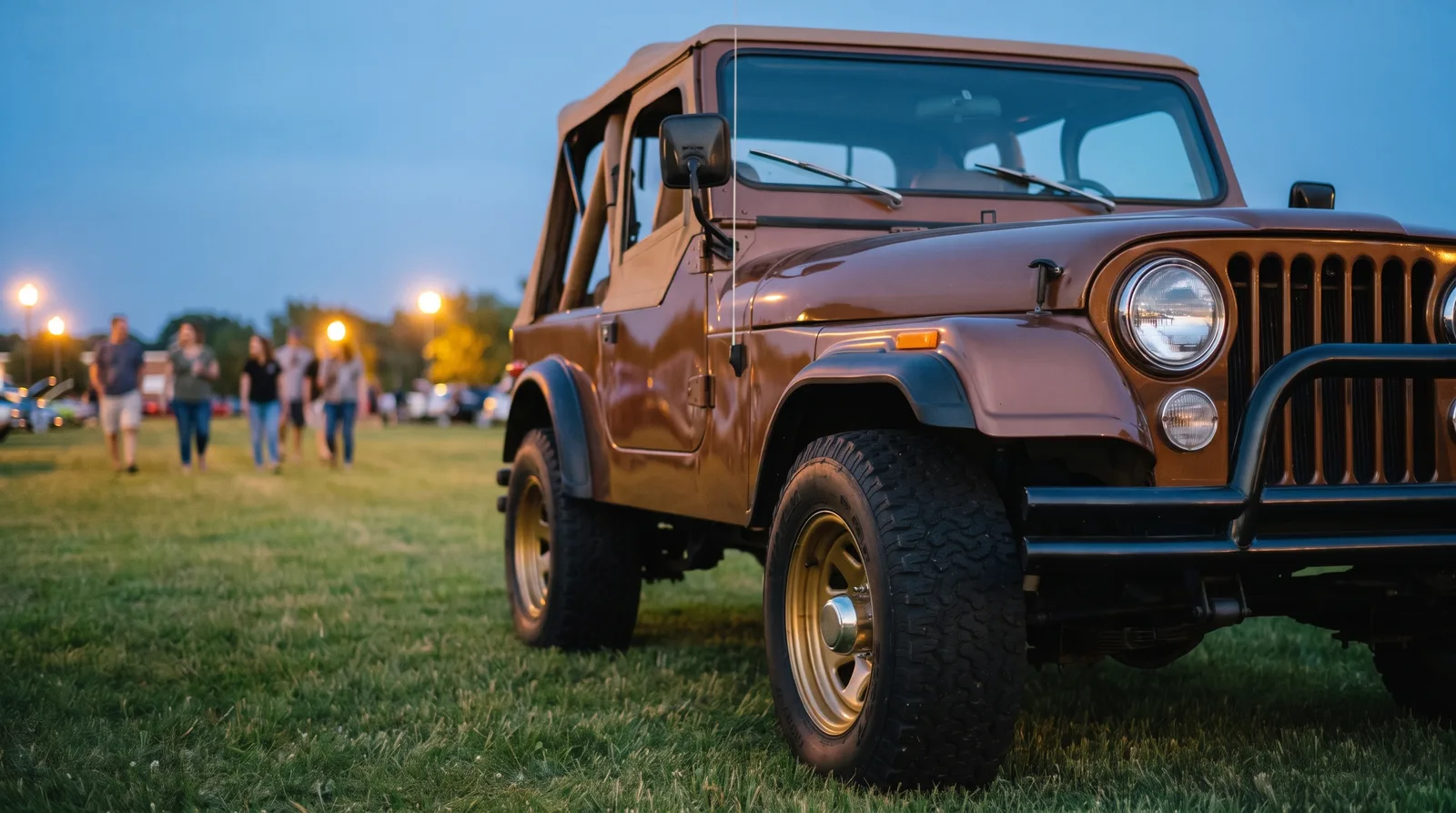
What the package actually was
Strip away the graphics and a Golden Eagle CJ-5 is a regular CJ-5 with an appearance group bolted on top. You got the big eagle decal spread across the hood, usually in gold and black or gold and white depending on the body color, plus wide bumpers, a rear step bumper, a rollbar, and a sport steering wheel. Some years added alloy wheels and Levi's-style seats, though the actual Levi's Edition was its own separate package that Jeep ran alongside it. Mechanically nothing changed. If you ordered a 304 V8 or the AMC 258 inline six, the Golden Eagle package didn't touch the driveline at all. It was pure sizzle, and Jeep wasn't shy about that. The Trans Am had a screaming chicken on the hood, and every truck maker in Detroit wanted their own version of that look. Jeep's answer was the eagle.
Why 1977 and not earlier
By the mid-1970s the CJ-5 needed a shot of relevance. The wheelbase stretch of 1972 had already modernized the chassis, and the AMC takeover of Kaiser Jeep in 1970 brought AMC engines and AMC marketing instincts into the mix. AMC knew stripe packages. They'd been slapping Go Package graphics on Javelins and AMXs for years, and the same playbook got applied to the CJ line. The Golden Eagle wasn't the first CJ appearance package (Renegade had already staked out its own identity), but it was the flashiest, and it landed at a moment when four-wheel drives were shifting from farm and job-site tools into lifestyle vehicles that suburban buyers wanted parked in the driveway on a Saturday.
How long it stuck around
The package ran through the end of CJ-5 production and carried over onto the CJ-7 as well, so you'll find Golden Eagles on both body styles well into the early 1980s. The exact color combinations shifted year to year, and Jeep wasn't always consistent about which colors got which trim, so two Golden Eagles from different model years can look surprisingly different under the paint code. That inconsistency is part of what makes them fun to track down now. There's no single "correct" Golden Eagle spec the way there is with a factory racing homologation package. It was a marketing decal package, adjusted on the fly as buyer taste moved.
What it means for value today
Here's where I have to be the wet blanket. A Golden Eagle CJ-5 is not inherently worth more than a plain CJ-5 in the same condition with the same drivetrain. What it is worth more of is attention. People recognize the eagle. It photographs well, it draws a crowd at a show, and buyers who grew up wanting one as a kid will pay a premium for the look even when the truck underneath is identical to a base model. That premium is real in the market, I'm not arguing against it, I'm just telling you it's a nostalgia premium, not a mechanical one. If you're shopping and see a "Golden Eagle" listed, check whether the decal is factory-correct reproduction or an aftermarket kit somebody slapped on later. A lot of plain CJ-5s got the eagle treatment decades after the fact because sellers know it moves trucks faster.
"I've pulled the hood off more than one 'Golden Eagle' and found a VIN that never came with the package from the factory. The decal doesn't lie about how good the truck looks, but it can absolutely lie about its history."
- Mike Sullivan
Buying one without getting fooled
If originality matters to you, pull the build sheet or check the broadcast codes where you can, because Jeep documentation from this era is spotty and dealers didn't always keep great records. Look at the bumpers and rollbar hardware for factory paint versus aftermarket paint, check whether the wheels match what was actually offered with the package that year, and don't take a seller's word that a truck is a numbers-matching Golden Eagle without some paperwork behind it. None of that means you shouldn't buy one. A well-kept Golden Eagle CJ-5 is a genuinely fun truck to own, and the graphics package has aged into its own kind of period charm, the kind that makes a plain white or tan CJ-5 look a little flat by comparison once you've seen the eagle spread across a hood in the sun.
For the whole picture on how the CJ-5 got to this point in its production run, the model's full history covers the engineering changes that the Golden Eagle package rode on top of. And if you're in the market for one, whether it's wearing the eagle or not, shop classic CJ listings to see what's actually out there right now.
The eagle in the wider stripe wars
Jeep wasn't operating in a vacuum when it rolled out the Golden Eagle. Every corner of the American auto industry in the mid-1970s was leaning on graphics packages to move product, and AMC in particular had a long history of doing it well. Look at the Hornet Hatchback with its own decal treatments, or the Gremlin X, and you can see the same design instinct that produced the CJ-5's eagle. What made the Golden Eagle stand out from the pack of era stripe packages was the sheer size of the bird itself. Most competitors were running racing stripes or geometric graphics down the hood and body. Jeep put an actual illustrated eagle, wings spread, dead center on the hood where nobody driving behind you could miss it. That's a bolder choice than it sounds, and it paid off in the way people still recognize the look decades later even if they can't name the year or the trim level underneath it.
It also helped that the timing lined up with a broader cultural moment. The mid to late 1970s saw a wave of patriotic and Americana-leaning imagery across consumer products, partly tied to the country's 1976 bicentennial. An eagle on the hood of an American-built truck fit that mood without Jeep having to say a word about it. Whether that was deliberate marketing calculation or just a graphic designer reaching for an obvious symbol, the effect was the same. The Golden Eagle became shorthand for a specific slice of American car culture, and that association is a big part of why the package still gets attention at shows that plenty of period-correct but plainer trim levels never receive.
The bottom line
The Golden Eagle package is a snapshot of what Jeep was selling in the late 1970s: attitude, not innovation. It didn't make the CJ-5 faster, tougher, or more capable off-road. It made it more visible, and in a decade obsessed with hood graphics, that was worth something to a lot of buyers. Judge it for what it is. A well-executed marketing decal on top of a genuinely good four-wheel drive chassis, and one that has aged better than most 1970s trends have any right to.
Sources and notes
Related Reading

About the author
Mike Sullivan
Detroit-area muscle car enthusiast and restoration specialist with three decades of hands-on experience working on American iron.
Related Listings - Jeep CJ





Comments
Be the first to comment on this article.