
Ask a room full of Jeep guys what the wildest CJ-5 special edition ever built was, and half of them will start listing Renegade variants before anyone even mentions the one that actually deserves the title. Half of them forget Super Jeep even existed. It gets overshadowed by Renegade, which is a shame, because the jeep cj cj5 super jeep package from 1973 was arguably the boldest visual statement AMC ever slapped on a stock CJ-5, and the story of why it happened, and why it didn't stick around, deserves more airtime than it usually gets at the meets I go to.
Car Features
6 min read
The Super Jeep: The 1973 CJ-5 Nobody Saw Coming
AMC's bold, one-year-only Super Jeep graphics package for 1973 is one of the rarest and least documented CJ-5 special editions ever built.
What AMC was reacting to
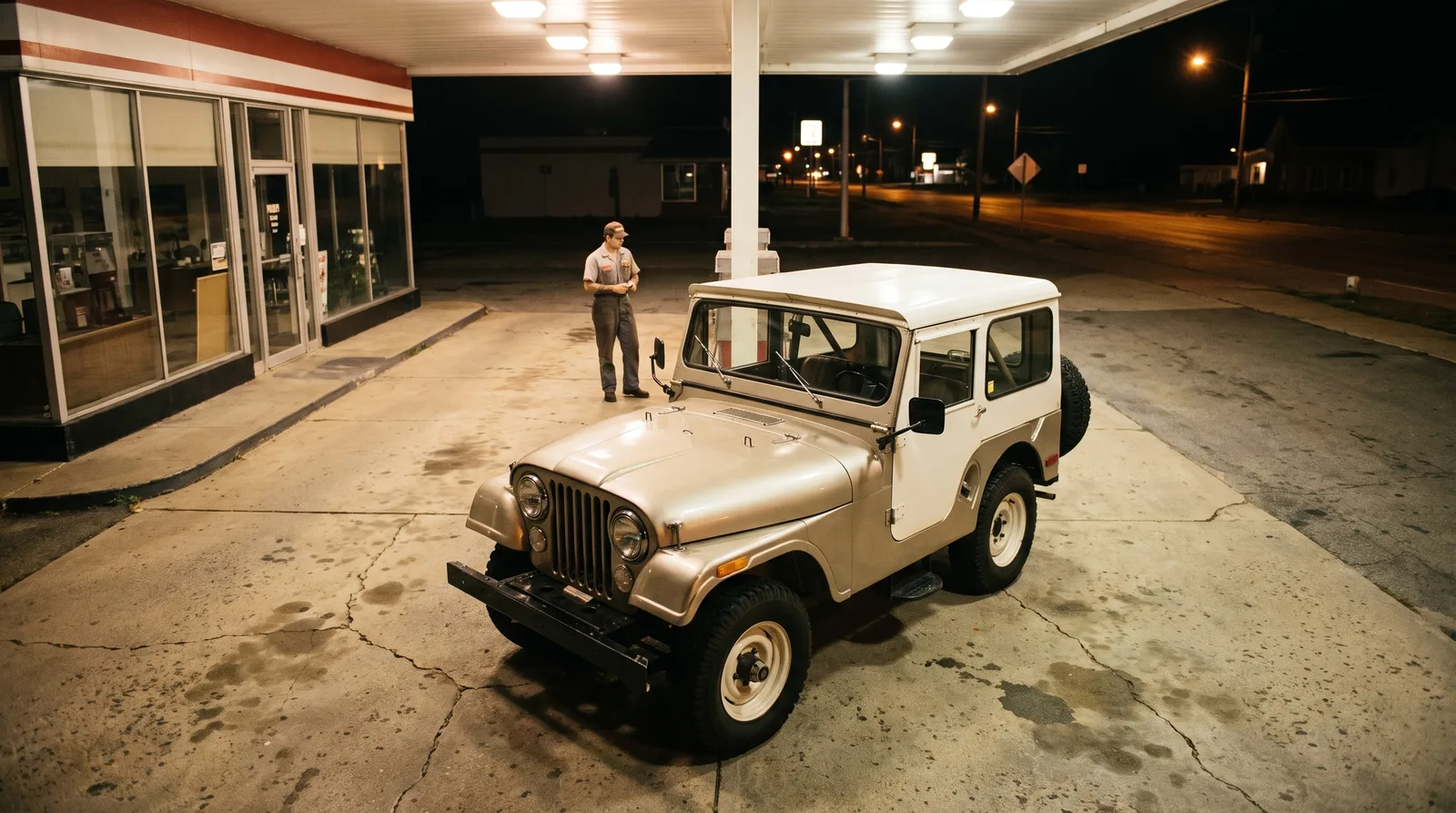
By 1973, AMC had already watched Renegade succeed, first as a Denver dealer special and then as an official factory trim starting in 1971. Renegade proved buyers wanted a CJ-5 that looked aggressive off the showroom floor rather than relying on aftermarket parts to get there. AMC's marketing team, riding that momentum, decided to swing even harder for 1973 with Super Jeep, a package built around graphics loud enough that you could spot one from across a parking lot without squinting. Where Renegade leaned on wider wheels and moderate striping, Super Jeep leaned on a massive hood decal and body graphics that left no room for subtlety.
The package arrived at a specific moment in American car culture when bold graphics packages were having a genuine cultural moment across multiple manufacturers, not just Jeep. Muscle cars of the era carried stripe packages and hood scoops meant to be seen from a distance, and AMC's own passenger car lineup experimented with similarly loud graphics treatments around the same years. Super Jeep, in that light, was less a Jeep-specific idea than AMC applying a broader early-1970s design trend to its four-wheel-drive lineup.
Why it only lasted one model year
Here's where the story gets interesting rather than just decorative. Super Jeep didn't return for 1974. The package was built for only a few months, roughly May through July of 1973, and total production is generally put at somewhere under 300 units. AMC reportedly created it in the first place as a way to use up leftover trim and to offer a dressed-up CJ-5 while a shortage of the aluminum wheels needed for Renegade was working itself out, which explains both the short window and why the package never got a proper second season. That short run is exactly what makes surviving examples a genuine rarity today, distinct from Renegade CJ-5s, which AMC kept building and refining across most of the following decade.
Club members who have chased documentation on this trim will tell you paperwork is thin compared to other special editions. Dealer records from a single model year package that didn't get carried forward simply were not preserved with the same institutional care that longer-running trims received. That makes verifying a genuine Super Jeep considerably harder than confirming a Renegade, since there is less standardized reference material for judges and appraisers to compare against.
| Detail | Renegade (1971 onward) | Super Jeep (1973 only) |
|---|---|---|
| Production span | Multiple years, refined over time | Single model year |
| Graphics intensity | Moderate striping | Large, bold hood and body graphics |
| Documentation availability | Well documented by clubs | Thin, harder to verify |
| Collector rarity today | Uncommon but findable | Genuinely scarce |
"I've owned a lot of CJ-5s over the years, and the one time I got to sit in a documented Super Jeep, it felt like finding a one-year-only muscle car option nobody talks about anymore. That rarity is real, not marketing hype."
- Wayne Coburn
How Super Jeep fits into the bigger CJ-5 story
Taken on its own, Super Jeep is a fun footnote. Taken in context alongside everything else happening to the CJ-5 platform in the early 1970s, coming off the 1970 AMC takeover, the phase-out of the Dauntless V6 in favor of AMC's own inline sixes, and the ongoing success of Renegade, it fits a pattern of a company actively experimenting with how far it could push the CJ-5's identity beyond pure utility. Some experiments stuck. Super Jeep didn't, at least not as a standalone trim, though its visual boldness arguably influenced graphics treatments AMC continued exploring on later special editions through the rest of the decade. For the complete timeline connecting all of these threads, read the background on the CJ-5's full production history from 1955 through the AMC years.
What the mechanicals looked like under the graphics
Same story as every other CJ-5 special edition covered in this cluster: the drivetrain stayed stock. A 1973 CJ-5 wearing the Super Jeep package ran the same engine options available on any standard truck that year, which by 1973 meant AMC's own inline sixes had already begun replacing the Dauntless V6 in the lineup as the company transitioned engine sourcing after buying out Kaiser three years earlier. Whatever engine a given Super Jeep left the factory with, the appeal of the package had nothing to do with output and everything to do with standing out visually against every other CJ-5 on a dealer lot, or on a trail, or parked at a drive-in.
That focus on appearance over mechanical substance is not a criticism unique to Super Jeep. It's the same tradeoff every graphics-forward special edition made across the entire industry during this stretch of the 1970s. What made Super Jeep specifically notable, at least to the people who remember it, was just how far AMC pushed the visual language compared to its own more restrained Renegade package running alongside it that same model year. Two special editions, same basic truck underneath, wildly different personalities on the outside.
What a genuine Super Jeep is worth chasing for
If you find a CJ-5 claiming Super Jeep provenance, treat it the way you would any rare, short-run special edition: skeptically, until the paperwork proves otherwise. Reproduction decals exist for plenty of vintage Jeep graphics packages, and a seller with a compelling story but no dealer invoice or factory build sheet is not offering proof, just an assertion. A confirmed original, on the other hand, represents a genuinely uncommon piece of a single model year that most Jeep buyers, even serious ones, have never seen in person. That combination of rarity and obscurity is exactly why Super Jeep rewards patient searching rather than a quick purchase, and why the handful of confirmed examples still turning up at swap meets and specialty auctions tend to draw a crowd of people who have never seen one up close before, let alone owned one. Anyone building a want list around this specific trim should be prepared to look for a while before they find a classic CJ that actually carries the documentation to back up the badge.
Sources and notes
Related Reading

About the author
Wayne Coburn
Longtime Corvette owner, judge and club figure who knows the cars, the records and the people behind them.
Related Listings - Jeep CJ





Comments
Be the first to comment on this article.