
A CJ-5 does not announce itself the way a Corvette or a Mustang does when it rolls onto a soundstage. It is short, boxy, a little homely from certain angles, and that is exactly why directors kept reaching for one. The jeep cj cj5 hollywood story is really a story about background actors, the kind of vehicle a set decorator could drop into a scene and trust the audience to believe without a second thought. For four decades the CJ-5 played farmers, park rangers, soldiers, and vigilantes, and it rarely got billing, but it worked constantly.
Car Features
8 min read
The CJ-5 on Screen: A TV and Movie Career
Long before it was a collector favorite, the CJ-5 was a working character actor, appearing in war pictures, westerns, and decades of television without ever getting billing.
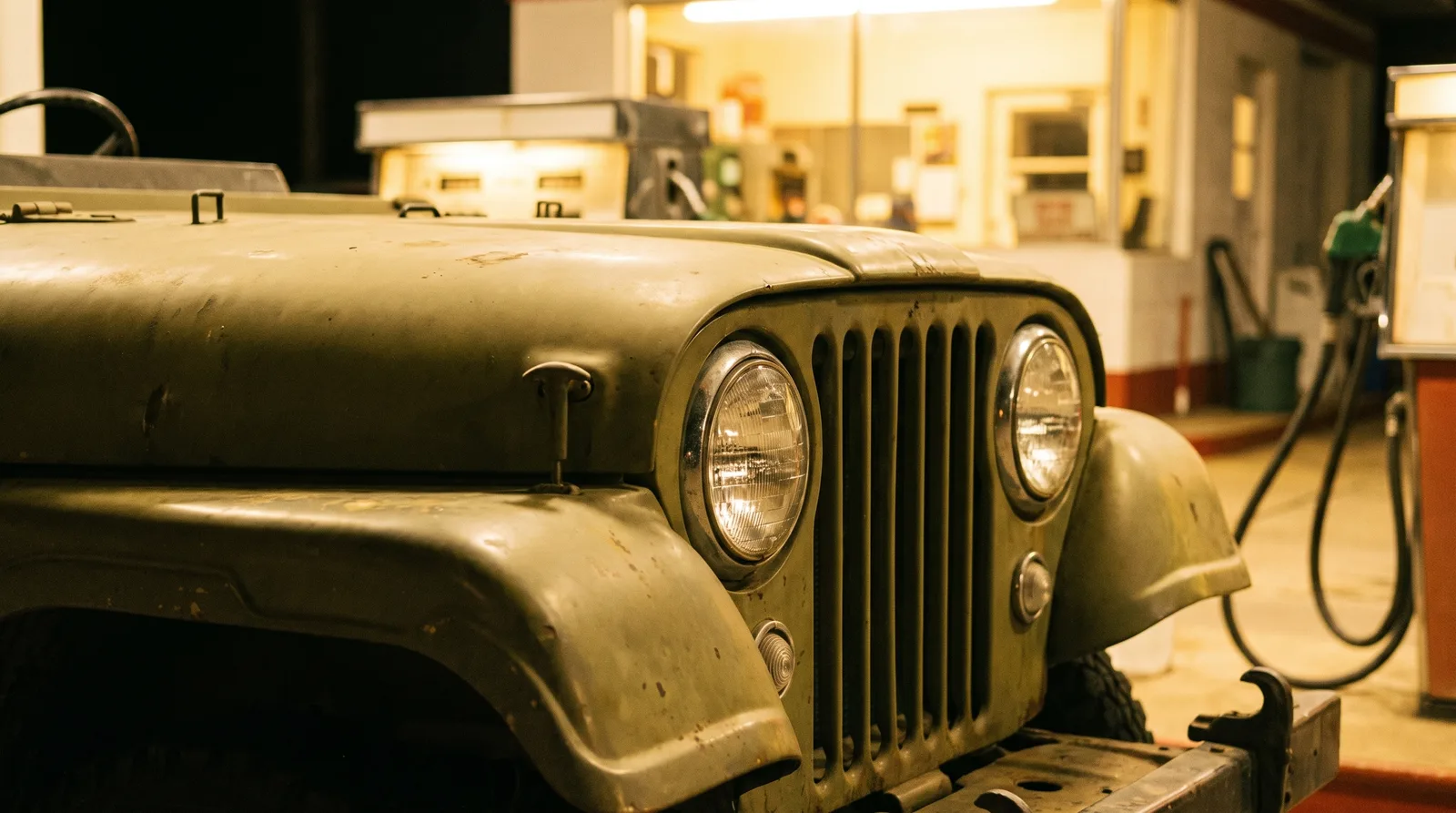
Start with the uniform it wore most often: olive drab, a white star stenciled on the hood, canvas top rolled back. War films and Vietnam-era television needed a jeep that looked plausible without the production paying for an actual period Willys MB, and the CJ-5 was close enough in silhouette that prop departments used it as a stand-in for decades. Anyone who watched war movies made in the 1960s and 1970s was, more often than they realized, looking at a CJ-5 dressed up as something ten or twenty years older.
The small screen made it a regular
Television is where the CJ-5 built its real resume. It shows up in ranger stations, in rural sheriff scenes, in the background of sitcoms set anywhere with dirt roads. Producers liked it for reasons that had nothing to do with romance: it was cheap to insure, easy to drive for a non-stunt actor, and it read on camera as "working vehicle" without needing dialogue to explain itself. A character did not need a line of exposition to justify owning one. The jeep did that work silently, parked in a driveway or bouncing down a fire road in the opening credits.
Wildlife and adventure programming leaned on it especially hard. A CJ-5 with a spotlight bar and a winch became visual shorthand for "we are somewhere remote and a little dangerous," whether the show was actually shot in a national park or on a studio back lot dressed to look like one. The vehicle's low doors and open sides also helped camera operators, who could shoot actors' faces without a windshield frame or a roof pillar getting in the way, something a sedan or even a full-size truck could not offer as easily.
Feature films leaned on its plainness
In feature work, the CJ-5 tended to show up wherever a script needed a vehicle that felt honest rather than aspirational. Crime dramas set in border towns, survivalist pictures, anything requiring a character who was resourceful but not wealthy, the CJ-5 fit the part. It photographed as a tool, not a status symbol, which is precisely the quality that kept it out of the marquee roles reserved for muscle cars and European sports cars. Nobody remembers the CJ-5's name from the credits because nobody wrote one for it. It was cast the way a good character actor is cast: because it disappeared into the role.
There is also a practical reason the CJ-5 kept getting hired: parts and knowledge were everywhere. A production could source one from a local owner, have a mechanic on set who already understood the drivetrain, and return it to the owner in roughly the condition they borrowed it in. Studios liked predictability, and a CJ-5 was about as predictable a piece of machinery as existed by the 1970s, simple enough that a breakdown mid-shoot rarely meant losing the whole day.
What the camera actually loved about it
Cinematographers talk about a vehicle's silhouette the way casting directors talk about a face. The CJ-5's short wheelbase and high stance meant it could be shot from a low angle and look heroic, or from a distance across open terrain and look small and vulnerable, depending on what the scene needed. Few vehicles offer that range without modification. A production could use the exact same jeep to suggest freedom in one act and isolation in another, just by changing the lens and the landscape around it.
"You could put a CJ-5 in a war picture, a western, or a family drama set on a farm, and nobody in the audience would question it. That kind of flexibility is rare, and it's why the thing kept getting work long after flashier jeeps came along."
- Nora Beckett
The stunt community's quiet affection for it
Stunt coordinators have their own reasons for liking the CJ-5, reasons that rarely make it into any behind-the-scenes featurette. The vehicle's low curb weight and simple mechanicals made it forgiving for controlled rollovers, water crossings, and jump sequences, the kind of practical effects work that was standard before digital compositing took over so much of an action sequence. A CJ-5 could be modified for a stunt, repaired between takes with tools a competent crew already carried, and reused across multiple shots in a single day. Compare that to a vehicle with more delicate electronics or a more complex suspension, and the appeal for a production on a schedule and a budget becomes obvious. None of that work earned applause from an audience who assumed the jeep in a chase scene was simply doing what jeeps do, but stunt crews who worked with the CJ-5 across decades of productions understood exactly how much the vehicle's simplicity saved them in time and risk.
Life after the credits roll
Plenty of screen-used CJ-5s went on to unremarkable second lives, sold off by studios or rental fleets once a production wrapped, and most owners today have no idea whether their jeep ever crossed a soundstage. Documentation for that kind of history is thin. Studios rarely kept meticulous records of which specific vehicle appeared where, and CJ-5s were interchangeable enough that a production might use three or four across a single shooting schedule without anyone tracking VINs. Collectors chasing genuine screen-used provenance on a CJ-5 are usually chasing paperwork that simply does not exist, which is part of why the car's Hollywood career remains more folklore than catalog.
What survives instead is the cultural memory, the sense that a CJ-5 in the background of an old film or television episode belongs there, that it looks right without looking staged. That is its own kind of legacy, quieter than a car that gets its own poster, but longer-lasting in its way. The jeep never needed a starring credit to leave an impression on a generation of viewers who grew up watching it idle in the corner of the frame.
For the fuller arc of how the CJ-5 got to that point, from its 1955 introduction through the changes that made it a fixture on American roads and American screens alike, our complete history lays out the whole timeline. And if the working side of the CJ-5's life interests you as much as its screen time did, keep exploring into the fleets and farms that used the same jeep for entirely unglamorous, and arguably more important, work.
Chasing one of your own
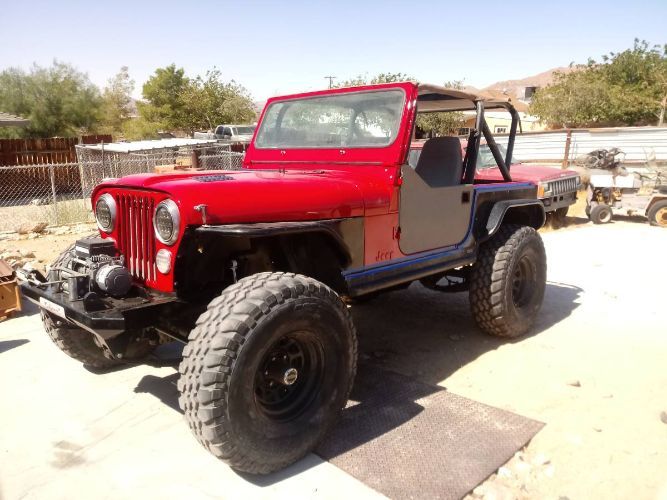
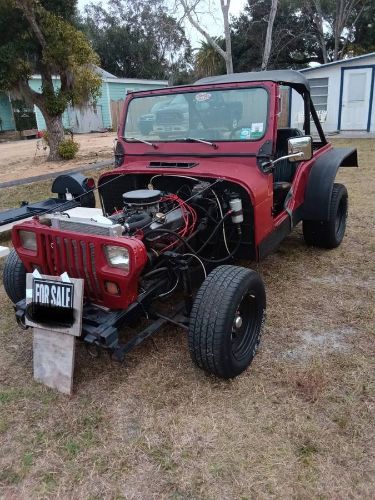
None of this Hollywood history changes what a CJ-5 actually is to own today: a simple, durable, increasingly appreciated piece of American vehicle design that happens to have logged more screen time than most of us will ever know. If the on-camera pedigree has you looking seriously, a classic CJ for sale is usually not hard to find, and unlike a screen-used muscle car, you will not pay a premium for a résumé nobody can verify. You are simply buying the jeep, plainness and all, the same jeep that quietly carried half a century of American film and television on its back without ever once asking for a close-up.
There is something fitting about that quiet legacy for a jeep cj cj5 hollywood presence built almost entirely without the industry's usual fanfare. No award show has ever honored a vehicle for background work, and no studio ever thought to preserve one specifically because of what it appeared in. Yet the CJ-5's screen career shaped how millions of viewers understood what a working jeep looked like, informing expectations long before those same viewers ever stood next to one in a driveway or a dealer lot. That kind of cultural imprint does not show up on a spec sheet, but it is real, and it is part of why the CJ-5 still feels instantly familiar to people who have never actually driven one.
Sources and notes
Related Reading

About the author
Nora Beckett
Automotive features writer and photographer who tells the human stories behind the cars, from show fields to cross-country road trips.
Related Listings - Jeep CJ





Comments
Be the first to comment on this article.