
There's a photo that gets passed around every so often at swap meets, a Sixties dealer lot with a CJ-5 and a brand new Ford Bronco parked close enough to touch bumpers, and it captures the jeep cj cj5 vs early bronco story better than any spec sheet could. Two Detroit-area answers to the same question, arriving within a few years of each other, aimed at buyers who wanted genuine off-road capability without buying a full-size truck to get it.
Car Features
7 min read
CJ-5 Versus the Early Bronco: Two Ways to Go Off-Road
Ford's 1966 Bronco arrived with coil-spring front suspension and three body styles, giving the long-dominant CJ-5 its most interesting rival yet.
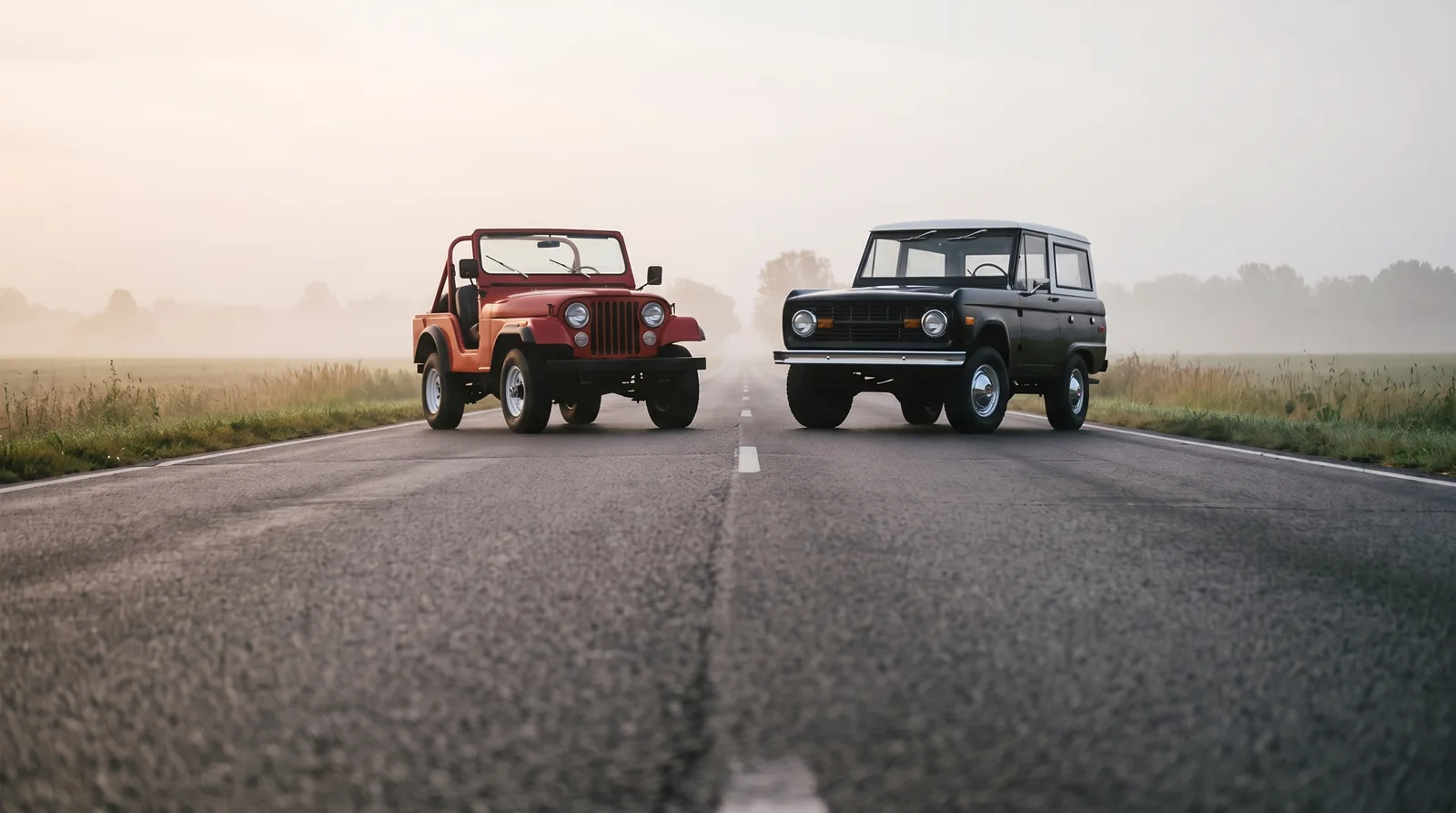
Ford enters a segment Jeep already owned
Ford introduced the Bronco for the 1966 model year, well over a decade after the CJ-5 had already established itself as the standard for compact American off-roaders. That timing mattered. Ford wasn't inventing a category, it was chasing one, and the Bronco's engineering shows the fingerprints of a company studying what worked and looking for ways to improve on it. The Bronco rode on a 92-inch wheelbase, longer than the CJ-5's pre-1972 81-inch chassis, and it came in three body configurations from the start, a wagon, a half-cab, and a pickup-style roadster, giving Ford buyers more variety in one showroom than Jeep offered across the whole CJ-5 line at the time.
The suspension difference that mattered most
The most talked-about technical difference between the two trucks was up front. The early Bronco used a radius-arm coil-spring front suspension, a genuinely unusual setup for a solid-axle off-roader in the mid-1960s, while the CJ-5 stuck with a more conventional leaf-spring front end through this whole era. The coil-spring design gave the Bronco a noticeably smoother ride and better wheel articulation off-road, advantages that off-road enthusiasts noticed immediately and that Ford leaned on heavily in period advertising. Jeep's leaf-spring setup was simpler, cheaper to maintain, and had decades of proven reliability behind it, but it couldn't match the Bronco's articulation in the roughest terrain. This was a genuine engineering trade-off, not a case of one company simply doing it better than the other.
Two different personalities on the trail
Drive a CJ-5 and an early Bronco back to back and the difference in character comes through fast. The CJ-5 feels stripped down and immediate, a truck built around the idea that fewer parts between you and the trail meant fewer things to go wrong. The Bronco feels a step more refined without losing its off-road credibility, offering a smoother ride and, depending on the body style chosen, noticeably more weather protection and cargo room than a typical CJ-5. Neither approach was wrong. Buyers who wanted the rawest possible off-road experience tended to land on the CJ-5, while buyers who wanted genuine capability with a bit more everyday livability often chose the Bronco instead.
How the rivalry actually played out in sales
The Bronco never managed to dethrone the CJ-5 as the segment's benchmark, but it didn't need to in order to matter. It carved out a real and lasting following, forced Jeep to keep sharpening its own product through the late 1960s and into the 1970s, and established Ford as a legitimate player in a category Jeep had essentially owned by default before 1966. That competitive pressure is part of what pushed Jeep toward continued refinement of the CJ-5 through the following decade, including the 1972 wheelbase stretch that brought a stronger frame and new axle options to the line.
"I've talked to guys who cross-shopped these two new in the showroom back in the day, and almost every one of them says the same thing. It came down to whether you wanted the simplest possible trail truck or something with a little more polish. Both were right for somebody."
- Patrick Walsh
What happened after the "early" years
Part of why the phrase "early Bronco" carries so much weight among enthusiasts today is what came after it. Ford kept the Bronco nameplate going, and by the late 1970s the truck had grown substantially larger, moving onto a full-size F-Series based platform that shared almost nothing in spirit with the compact original. That growth pushed the Bronco out of direct competition with the CJ-5 entirely, since the two trucks were no longer fighting for the same buyer once the Bronco ballooned in size. It also had the effect of making the original 1966 through 1977 Bronco, the genuine CJ-5 rival, into its own distinct and increasingly collectible category, separate in the minds of enthusiasts from everything Ford built under the Bronco name afterward.
The CJ-5, by contrast, never grew away from its original mission the way the Bronco eventually did. Even after the 1972 wheelbase stretch, it stayed recognizably true to the compact, no-frills formula it launched with back in 1954. That consistency is part of why the CJ-5 versus early Bronco comparison still feels like a fair, apples-to-apples matchup decades later, while comparing a CJ-5 to a late-1970s full-size Bronco would be comparing two completely different classes of vehicle. The rivalry that matters, the one people still argue about at shows, is specifically bounded to those first dozen years of Bronco production, running right alongside the CJ-5 it was built to challenge.
Where the CJ-5's fuller story picks up
The Bronco rivalry is just one thread in a much longer CJ-5 story, one that runs from the model's 1954 debut all the way through its 1983 retirement. For more on the jeep cj5, the full model history covers the design choices that shaped how the CJ-5 competed against rivals like the Bronco across nearly three decades. And zooming out even further, if you want our complete history of the entire CJ family from the earliest postwar models through the CJ-8 Scrambler, that broader arc shows just how consistently Jeep kept defending the territory it staked out long before Ford ever built a Bronco.
Two icons, no clear winner
Six decades on, both trucks have earned their own devoted followings, and neither one has faded into the other's shadow. If anything, the rivalry has aged into mutual respect among people who actually own and drive these trucks rather than just argue about them online. If you're weighing which side of that old showroom rivalry fits you better, the CJ-5 side of that equation is easy enough to explore, with classic CJs on the market right now showing the range of condition and pricing across the model's long production run.
Why the comparison still matters
The CJ-5 versus early Bronco question isn't really about which truck was objectively better, because both were well engineered for what they set out to do. It's about which philosophy speaks to you, simplicity and immediacy or a bit more refinement without sacrificing capability. That's the same choice buyers were making at dealer lots in the late Sixties, and it's remarkably still the same choice facing anyone cross-shopping these two trucks today.
Sources and notes
Related Reading

About the author
Patrick Walsh
Automotive journalist covering classic car shows, events, and the enthusiast community across North America.
Related Listings - Jeep CJ







Comments
Be the first to comment on this article.