
Corporate ownership changes rarely make for compelling automotive history, but the jeep cj cj5 willys kaiser years are an exception, because the CJ-5 that left the factory in 1970 was recognizably descended from the one built in 1955, even as the company that made it changed hands entirely. Willys-Overland introduced the CJ-5 in 1955, sold it through Kaiser Motors' acquisition of the Willys name in 1953, saw Kaiser fold the brand into Kaiser Jeep Corporation in 1963, and kept building the model largely unchanged in its fundamentals right up until American Motors bought the whole operation in 1970. Fifteen years, one basic platform, two corporate parents.
Car Features
6 min read
The Willys and Kaiser CJ-5 Years, 1955 to 1970
From the 1955 launch through Kaiser Jeep Corporation's ownership, the CJ-5 gained a V6 option and a wider export footprint before AMC took over in 1970.
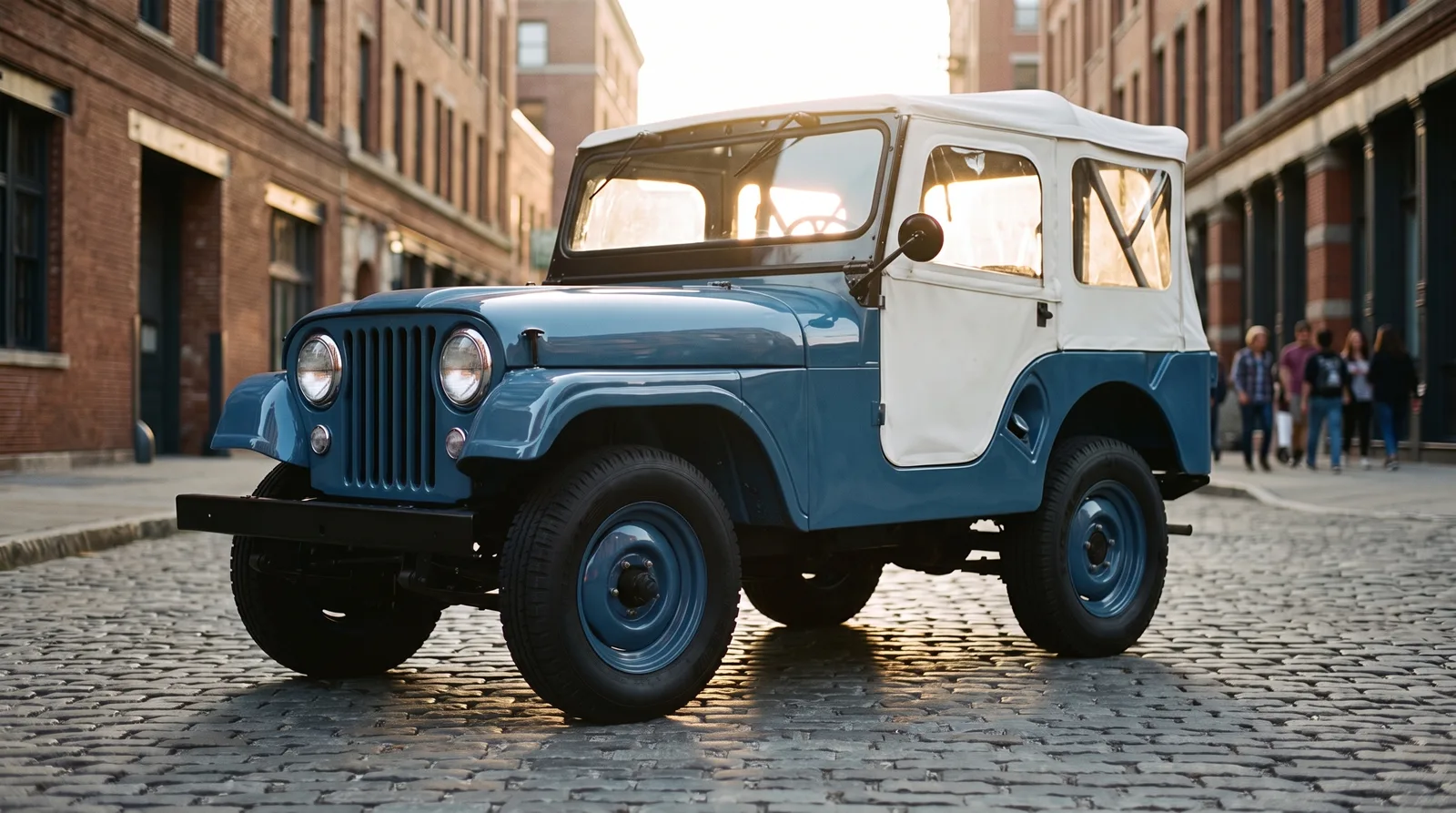
Willys sets the pattern, 1955 to 1963
The first eight years of CJ-5 production belonged to Willys-Overland in name, though the company had actually been under Kaiser's ownership since 1953, before the CJ-5 even existed. Kaiser kept the Willys name on the vehicles and largely left the engineering culture in place, a decision that preserved the continuity buyers expected. The Hurricane F-head four-cylinder engine that launched the CJ-5 stayed the standard powerplant through this period, joined in 1966 by the option of a Dauntless V6, though that addition came late enough in the Willys-badge era that most of the early Willys CJ-5s ran the four-cylinder exclusively.
Dealers during these years marketed the CJ-5 as a dual-purpose vehicle, equally at home on a farm or on a hunting trip, and that positioning worked. Sales grew steadily through the late 1950s as postwar prosperity gave more American families the disposable income for a second vehicle built purely for utility and recreation. The company also expanded the CJ-5's options list gradually, adding a passenger seat, a heater, and eventually a soft top with roll-up doors, small comforts that moved the Jeep further from its military ancestry with each model year.
Kaiser Jeep Corporation takes the wheel
The 1963 reorganization into Kaiser Jeep Corporation marked more of an administrative shift than an engineering one at first, but it set the stage for changes that would follow through the rest of the decade. Kaiser invested in expanding Jeep's export markets, building relationships with overseas assembly operations that would eventually make the CJ platform a familiar sight well beyond North America. Domestically, the CJ-5 kept selling to the same core buyers, ranchers, hunters, rural mail carriers, and a growing number of enthusiasts who simply liked the vehicle for what it was rather than what it could be dressed up to look like.
The most consequential change of the Kaiser era arrived in 1966, when the GM-sourced Dauntless V6 became available as an option across the CJ-5 lineup. Kaiser had purchased the rights to build this engine from General Motors' original Buick design, and it gave the CJ-5 a genuine horsepower jump, from 72 hp with the old four-cylinder to roughly 160 hp with the V6. That single option did more to reposition the CJ-5 as a capable, quick-off-the-line vehicle than anything else in its history to that point. For the full arc of how the CJ-5 got to this point, read the background covering the entire generation from launch to retirement.
| Era | Ownership | Key engine change |
|---|---|---|
| 1955-1963 | Willys-Overland (Kaiser-owned) | 134 ci Hurricane four only |
| 1963-1966 | Kaiser Jeep Corporation | Hurricane four continues |
| 1966-1970 | Kaiser Jeep Corporation | Dauntless V6 introduced as option |
| 1970 onward | American Motors Corporation | Dauntless remains through 1971, later AMC engines added |
"Kaiser gets underrated in Jeep history because the company didn't reinvent the CJ-5. What Kaiser did was fund the improvements that mattered, particularly that V6, without breaking what already worked."
- Tom Ramirez
Why the Kaiser years get overlooked
Jeep enthusiasts tend to talk about the Willys era with reverence and the AMC era with excitement over later performance variants, leaving the Kaiser Jeep Corporation years sitting quietly in the middle. That is a mistake from a collecting standpoint. The Kaiser-era CJ-5s, particularly those built after the 1965 V6 introduction, offer a meaningful power upgrade over the earlier four-cylinder trucks while still carrying the simpler, less emissions-regulated mechanical layout that predates AMC's later changes. They sit in a genuine sweet spot for buyers who want usable power without the added complexity that came with emissions equipment in the 1970s.
Production numbers from this period are harder to pin down precisely than later AMC-era records, since Kaiser's year-by-year breakdowns are not as widely published, but the CJ-5 as a whole would go on to total roughly 603,000 units across its full 1954-1983 run, and surviving registration data and club records suggest steady growth through the mid-1960s before Kaiser began exploring a sale of the Jeep division toward the end of the decade. That sale, completed in 1970, closed the Kaiser chapter and opened the AMC one, a transition covered in more detail in a companion piece that is worth a look too for anyone tracking the full ownership timeline.
The export push that widened the CJ-5's reach
Kaiser's decision to expand overseas assembly was not a minor footnote to domestic sales figures. Licensed and joint-venture production of CJ-based vehicles took root in several countries during this period, with local assembly operations building versions of the Jeep for markets Willys had never seriously pursued on its own. That global footprint meant parts and mechanical knowledge for the CJ-5 platform spread further than most American light vehicles of the era, and it is part of why replacement parts and knowledgeable mechanics for Kaiser-era Jeeps remain easier to find today than for some equally old domestic-only vehicles. The export operations also gave Kaiser a revenue stream that helped fund continued development of the CJ-5 at home, including the V6 program that eventually became the Dauntless option.
Domestically, Kaiser also broadened the CJ-5's dealer network and pushed harder into the recreational vehicle market than Willys had, sensing correctly that postwar suburban growth was creating a new class of buyer with money for a second vehicle used purely for weekend trips rather than daily farm work. That shift in marketing focus, subtle at the time, previewed the direction American Motors would push even further after 1970, when four-wheel-drive recreation became a mainstream category rather than a niche one.
What Kaiser-era CJ-5s offer buyers today
For a buyer weighing which era of CJ-5 to pursue, the Willys and Kaiser years, taken together, represent the platform in its most mechanically straightforward form. No catalytic converters, no smog pumps, minimal electronics, and by the back half of the period, an available V6 with real usable power. That combination has made these Jeeps popular with owners who want to drive and maintain the vehicle themselves rather than farm out every repair to a specialist. Anyone drawn to that era specifically can start narrowing a search and shop classic CJ listings to compare Willys-badged four-cylinder trucks against later Kaiser V6 models before deciding which fits their budget and mechanical comfort level best.
Sources and notes
Related Reading

About the author
Tom Ramirez
Corvette researcher and historian based in Bowling Green, Kentucky. Two decades documenting Corvette production history from original factory records.
Related Listings - Jeep CJ





Comments (1)
G
Gary Tompkins
2 days ago
Back in '68 a fellow on my line had a Kaiser CJ-5 with the Buick V6, and I remember thinking it was a lot of motor for that little frame... going from 72 horsepower to roughly 155 is more than double. We argued about it over lunch for a week. So my question is whether Kaiser changed anything behind the engine when the Dauntless went in, the transmission, the axles, the clutch, or did they just bolt it in and trust the old Jeep drivetrain to hold up...
Gary, the record I trust says Kaiser did not simply bolt it in. V6 trucks generally got a heavier-duty three-speed and a bigger clutch, while the axles carried over largely unchanged. I would still check the transmission tag on any V6 Jeep, because swaps from four-cylinder trucks are common.