
There's a guy at every Jeep show who parks his square-headlight rig next to the round-eyed ones and waits for somebody to say something. Usually somebody does. "That's not a real CJ," a purist mutters, and the owner just grins, because he's heard it a hundred times and he's got the paperwork to settle it anyway. The argument is always the same one: CJ7 vs YJ, and where exactly the line falls between the last of the CJs and the first of the Wranglers.
Car Features
7 min read
Jeep CJ-7 vs Wrangler YJ: The End of the CJ Era
The CJ-7 and the Wrangler YJ share more bones than club arguments ever admit, and the story of how one became the other says a lot about why the CJ name disappeared in 1987.
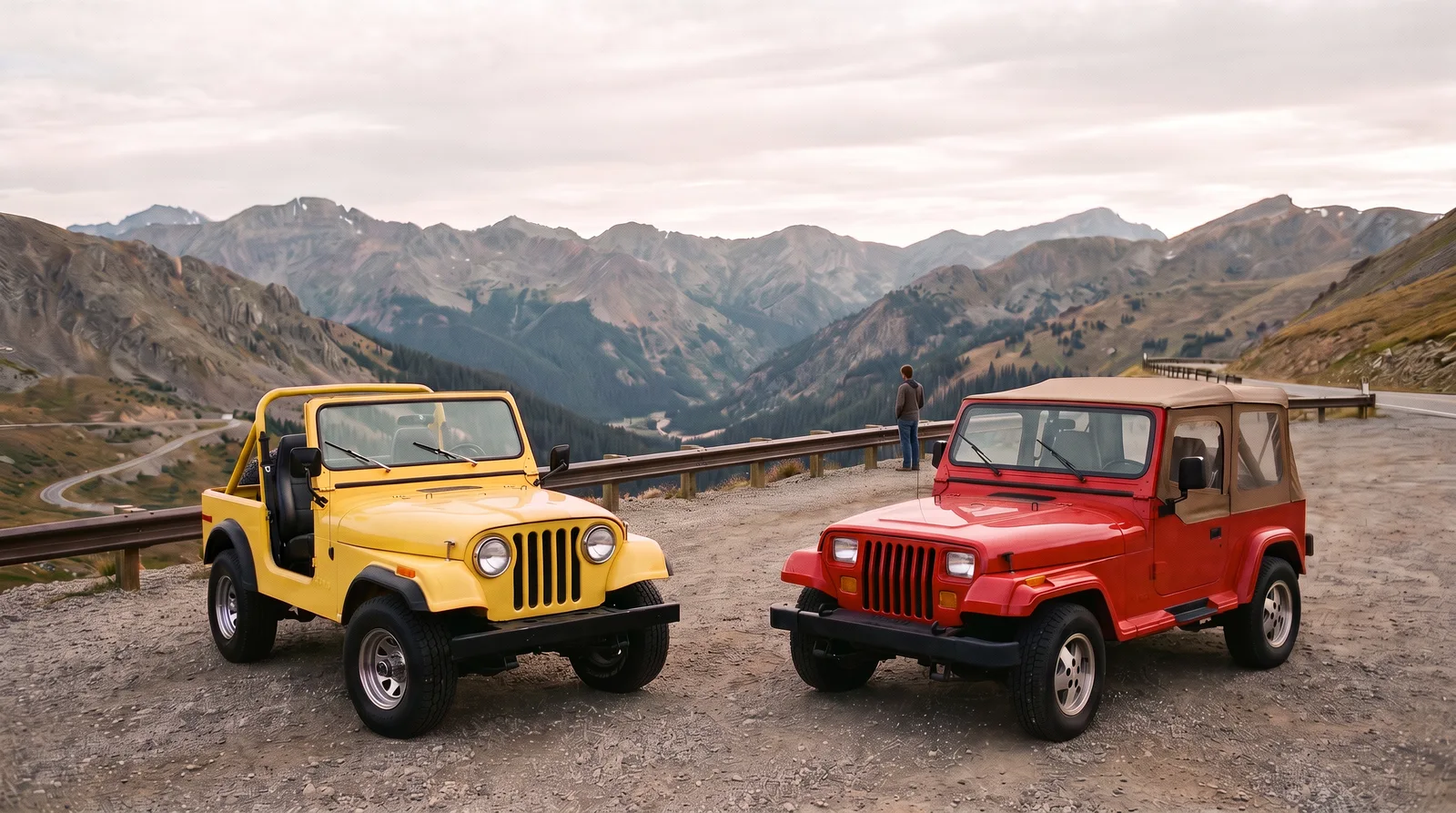
I've sat through that argument at club meets from Ohio to Arizona, and the honest answer is messier than either side wants. The Wrangler YJ wasn't a clean break from the CJ-7. It was the CJ-7's replacement built on a lot of the CJ-7's own bones, wearing a new suit because the lawyers and the engineers both had reasons to want one.
Why the CJ-7 had to go
By the mid 1980s the CJ-7 had a problem that no amount of loyal buyers could fix: a string of rollover lawsuits and a very public 60 Minutes segment in 1980 that aired Insurance Institute for Highway Safety rollover footage and called the CJ-5 unsafe in emergency maneuvers. Jeep, then owned by American Motors, fought the reputation for years. The CJ-7 kept selling, but the cloud never lifted. The CJ nameplate, worn by every civilian Jeep since the CJ-2A rolled out in 1945, ended production in January 1986, the same year the Wrangler YJ went on sale as an early 1987 model. Chrysler's purchase of American Motors followed in 1987, after the CJ was already gone.
The Wrangler YJ arrived to take its place, and the timing wasn't an accident. A wider track and a lower center of gravity were the direct answer to the rollover complaints. The frame stretched slightly, the springs softened a touch, and the whole package sat wider on the road than the CJ-7 ever had. It drove less like a tractor and more like a truck you could take to work without white-knuckling the on-ramp.
That 1980 60 Minutes segment deserves more context than it usually gets at swap meets. The broadcast showed IIHS test footage of a CJ-5 tipping onto two wheels during sharp J-turn and obstacle-avoidance maneuvers, run at speeds ordinary passenger cars could handle without drama. AMC pushed back hard, arguing the test conditions were unrealistic and that it took hundreds of runs to produce the handful of rollovers shown on air. Sales dipped anyway. Insurance costs crept up. By the time the CJ-7 inherited that same basic reputation a few years later, the damage to the whole CJ badge was already done, regardless of how the newer, longer-wheelbase 7 actually handled in practice.
What actually carried over
Underneath the new sheet metal, a surprising amount of the CJ-7 survived. Early YJs used the same AMC 4.2 liter inline six that powered late CJ-7s, along with familiar Dana axles. The wheelbase barely changed. Club old-timers who've wrenched on both will tell you the family resemblance runs deeper than the doors.
What didn't carry over was the face. AMC's stylists gave the YJ rectangular headlights instead of the round units every Jeep had worn since the war, and that one decision still starts more arguments than anything mechanical. Round headlights came back on the Wrangler TJ in 1997, which tells you AMC read the room a little too late.
An ownership change that sealed the decision
Chrysler's 1987 purchase of American Motors wasn't primarily about Jeep, but Jeep came along as the prize nobody at Chrysler wanted to mess up. By the time the sale closed, AMC had already retired the CJ name and launched the YJ on its own, a program built specifically to answer years of safety criticism. Club historians sometimes frame this as Chrysler killing the CJ. It's closer to say AMC made the call well before Chrysler's ink was dry, and Chrysler simply inherited the result.
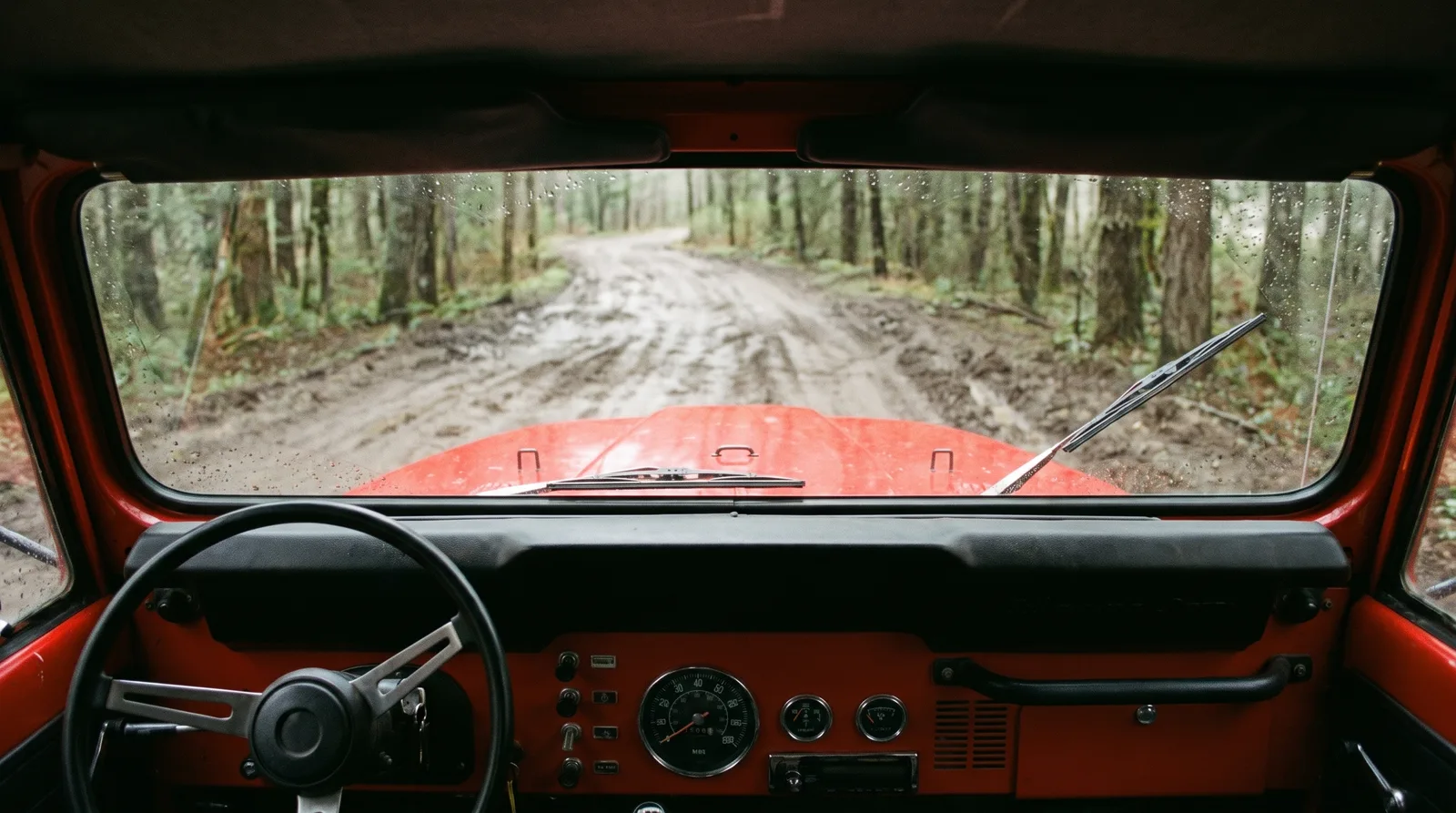
Inside the cabin, the changes told the same story as the chassis. The YJ's dashboard sat higher and squarer than the CJ-7's, with a glovebox and a more car-like set of gauges that reflected AMC's push toward a daily driver rather than a stripped utility rig. Seat belts, always a weak point in rollover litigation, got redesigned mounting points. None of it was flashy. All of it was aimed at the same lawsuits that had been dogging the CJ name for most of the decade.
The club verdict, decades later
Talk to any long-running Jeep club and you'll hear the same soft consensus: the CJ-7 and the early YJ are cousins, not strangers. Both use leaf springs, both carry solid axles front and rear, both were built to be driven hard and fixed in a driveway. The YJ just did it with a wider stance and a warranty department that slept a little easier.
Values reflect that kinship more than people expect. A clean CJ-7 and a clean early YJ often land in similar money at auction, with the CJ-7 carrying a slight premium for being the last of a lineage that started with the war Jeep and ran unbroken for over four decades. Anyone chasing where this started will find the CJ-7 sitting right at the end of that story, one model away from the square headlights.
"Nobody in the club calls the YJ a fake Jeep. It's just the CJ that finally got a wider stance and a better lawyer."
- Wayne Coburn
Buying into either camp
If you're weighing a CJ-7 against a YJ for a garage spot, the decision usually comes down to what you want the rig to feel like on a trail. The CJ-7 sits narrower and rides taller, which means more body roll but also a purer connection to the original Jeep formula. The YJ trades a little of that character for stability, and parts are often easier to source since AMC and early Chrysler production numbers were healthy.
Either way, the shopping pool for these trucks has gotten tighter every year as more of them get restored, parted out, or simply used up on trails they were never quite meant for. If the CJ-7 side of that argument is calling your name, you can find a classic CJ and decide for yourself whether the square headlights ever really mattered.
What nobody argues about, at any show, on any weekend, is that both trucks earned their place in the lineage. The CJ-7 closed out a name that had been on Jeep hoods since Roosevelt was in office. The YJ opened the next forty years of Wranglers. cj7 vs yj isn't really a fight about which one is better. It's a fight about which forty-two years of history you'd rather own.
Sources and notes
Related Reading
Have a
Jeep CJ
for Sale?
Reach thousands of serious classic car collectors across the US.
Sell It Here →
Selling a classic? Here's how: sell my classic car
Are You a Classic Car Dealer?
List your full inventory and connect with targeted classic car buyers.
Join as a Dealer →

About the author
Wayne Coburn
Longtime Corvette owner, judge and club figure who knows the cars, the records and the people behind them.
Related Listings - Jeep CJ

Comments (2)
G
GearheadGranny
1 week ago
My grandson brought his '89 YJ to Sunday dinner and the whole family lined up to tease him about the square headlights. Then he took me up the gravel pit road behind the farm, and that wide stance never so much as wobbled. Granny's verdict: it's a real Jeep. Wear those square eyes proudly, kiddo.
R
Ray Staubach
1 week ago
The wide stance is real. It is worth noting, though, that the 1987 to 1990 YJ used the 4.2 liter six with a feedback carburetor, which many owners consider the weakest part of the truck. The fuel-injected 4.0 liter arrived for 1991. If your grandson ever shops for another, that is the one I would look for.
G
GearheadGranny
6 days ago
Ray, I'll pass it along. He'd sooner trade his grandmother than that '89, carburetor and all. Kids.
B
Bill Cassidy
2 weeks ago
Bought a YJ in '89. The square headlights cost me nothing but dignity. Rock stable on the highway though.