
By the early 1980s, the jeep cj culture laredo trim had turned the CJ-7 into something its founders in Toledo would barely have recognized: a truck with carpet, woodgrain trim, and a name borrowed from a Texas cattle town, sold to buyers who had no intention of ever hauling cattle. Laredo was Jeep reaching for a customer it had never seriously courted before, the buyer who wanted comfort as much as capability, and the experiment worked well enough that the name outlived the CJ itself.
Car Features
7 min read
Laredo: The CJ That Reached for Luxury
The Laredo trim pushed the CJ-7 toward comfort and cowboy-town styling, a name that outlived the CJ and carried into decades of later Jeep SUVs.
Chasing a different buyer
The CJ line had spent the 1970s selling personality through appearance packages like Renegade and Golden Eagle, loud graphics aimed at a younger, more casual crowd. Laredo, introduced on the CJ-7 in 1980, aimed somewhere else entirely. AMC's Jeep division had watched full-size trucks and early SUVs start adding creature comforts that a bare-bones utility vehicle simply did not offer, and Laredo was the answer: a trim built around comfort and a touch of Western-inflected luxury rather than off-road bravado or youthful graphics.
The name itself did real work. Laredo carried a cattle-town, cowboy-adjacent image that fit neatly with the CJ's rugged reputation while still signaling something softer and more upscale than a plain work truck. It borrowed a naming convention Jeep would lean on again decades later, but in 1980 it was a fresh idea for the CJ-7, distinct from anything the CJ line had worn before.
What Laredo actually added
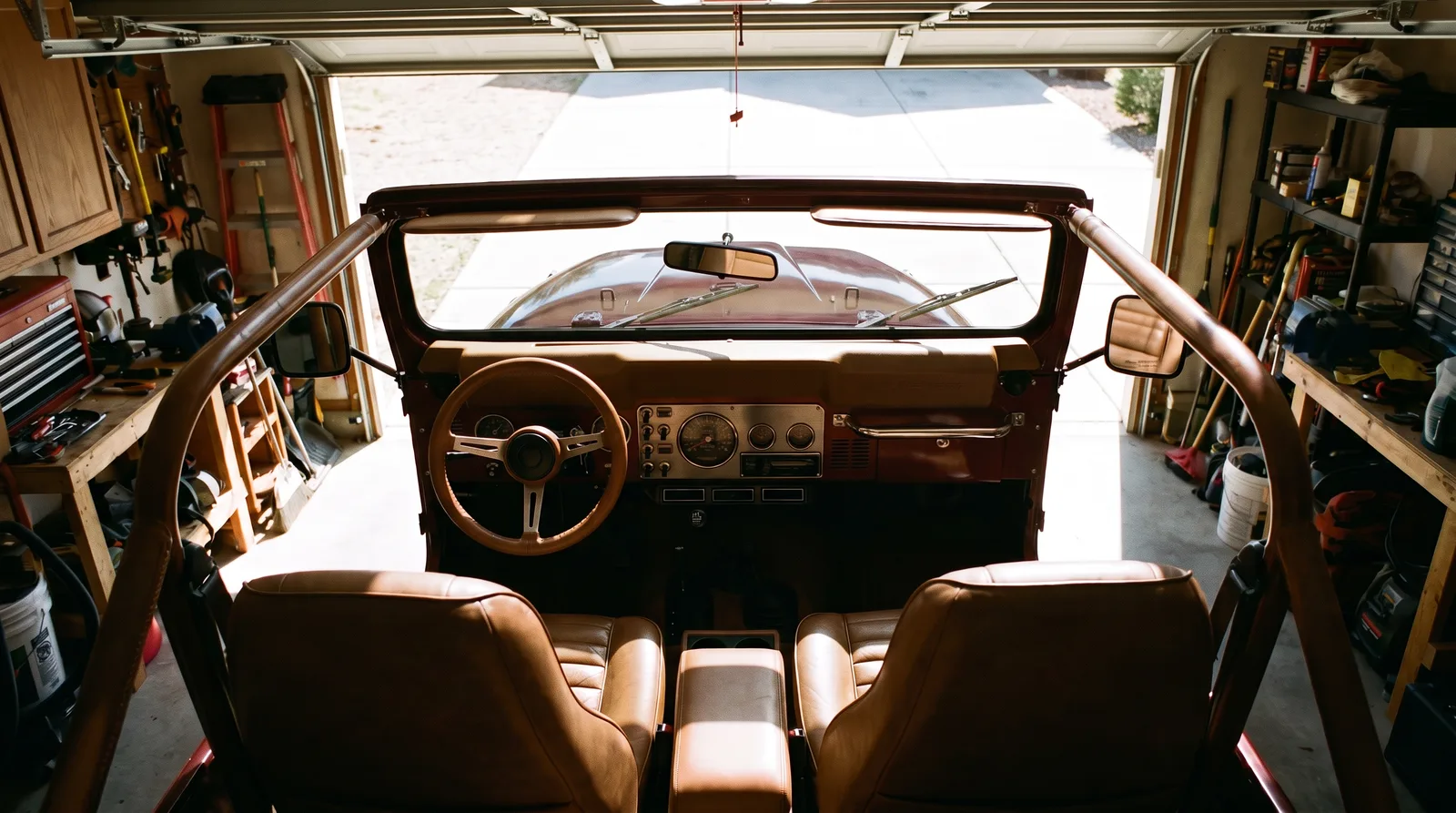
Underneath the trim badge, the Laredo package brought real upgrades rather than just a nameplate. Buyers got upgraded upholstery, extra sound insulation, chrome exterior trim, styled wheels, and a general cabin experience that felt closer to a passenger car than the spartan CJ-5 that preceded it. Woodgrain accents on the dashboard pushed the interior further toward luxury-truck territory, a look that would have seemed almost comic on an early CJ-2A but fit naturally on a CJ-7 built to double as a daily driver.
Mechanically, a Laredo CJ-7 ran whatever engine and drivetrain combination the CJ-7 offered that model year, most commonly a six-cylinder or the AMC V8, paired with the same solid-axle underpinnings every CJ used. Laredo never claimed to be a performance package, and it never pretended to improve the truck's trail manners. It sold comfort and image, plain and simple, at a moment when the SUV market was starting to reward exactly that combination.
A trim that signaled a market shift
Laredo arrived at a pivotal moment for the CJ, though pivotal is not a word this article needs to lean on twice, so it is enough to say the timing mattered. Buyers of small SUVs and off-road capable trucks were beginning to expect features that had once belonged strictly to sedans, and Jeep's competitors were noticing the same shift. A CJ-7 buyer in 1980 could reasonably cross-shop against a Ford Bronco or a Chevy Blazer, both of which offered their own comfort-oriented trims, and Laredo was Jeep's direct answer to that competitive pressure.
For a deeper look at how Laredo fit alongside the CJ's other appearance and comfort packages across the decade, more on the jeep cj renegade and the broader trim lineup covers how these options evolved together, each aimed at a slightly different slice of the buying public. The CJ that started this whole story looked nothing like the Laredo-equipped trucks selling a decade later, and where this started traces that distance from the earliest postwar utility Jeep to the comfort-focused CJ-7 of 1980.
"Laredo is the moment you can point to and say, this is where the Jeep buyer stopped wanting a work truck and started wanting a lifestyle. Nothing wrong with that. It just changed the whole conversation."
- Patrick Walsh
Reading the option sheet
Ordering a Laredo in 1980 or 1981 meant working through a factory brochure that looked noticeably different from the CJ-5 sheets of just a few years earlier. Gone were the loud stripe diagrams and eagle artwork that had defined the mid-1970s catalogs. In their place sat photographs of upholstery swatches, wood-tone dash inserts, and interior shots that emphasized comfort features over rugged capability. That shift in how Jeep photographed and described its own products tells you almost as much about the era as the hardware itself did.
Buyers cross-shopping a Laredo against a plain CJ-7 were often paying a meaningful premium for what amounted to a nicer cabin and some exterior trim, since the frame, axles, and available engines stayed the same regardless of trim level. That pricing structure was standard practice across the industry by 1980, but it meant a Laredo buyer was explicitly paying for comfort and image rather than any gain in off-road ability, a trade plenty of buyers were happy to make as the CJ's audience kept shifting toward daily use and weekend recreation rather than dedicated off-road work.
Dealers also used Laredo as a way to keep customers inside the Jeep family who might otherwise have drifted toward a competitor's more comfortable small SUV. A buyer who liked the CJ-7's size and image but balked at its spartan cabin now had a reason to stay loyal to the brand rather than looking at a Bronco or Blazer with a nicer interior already built in. That retention strategy, keeping a hesitant buyer in-house with a trim upgrade rather than losing them to a competitor entirely, is a pattern automakers still lean on decades later.
Collecting a Laredo today
A well-kept Laredo CJ-7 occupies an interesting place in the current market. It is not the trim collectors chase for maximum trail credibility, and it is not the loudest graphics package from the decade, but it represents a genuine turning point in how Jeep understood its own customer. Interior condition matters enormously on these trucks, since the comfort features that defined the trim are exactly the parts most prone to wear, fading, and cracking after four-plus decades. Original woodgrain trim, uncracked upholstery, and functioning sound insulation are worth a real premium over a stripped or heavily modified example.
Buyers researching the trim should expect some variation year to year in exactly which features were bundled under the Laredo name, since AMC and later Jeep-Renault-era management adjusted content as the CJ-7 moved through its production run. Sourcing correct replacement trim pieces can also be harder than it looks, since some Laredo-specific badging and wheel designs were never shared with other CJ-7 trims and were not produced in large numbers to begin with. Anyone ready to start comparing real examples can look at classic CJs on the market to see how Laredo trucks are currently priced against plainer CJ-7s, and how much originality is actually surviving on the ones for sale.
Sources and notes
Related Reading
Have a
Jeep CJ
for Sale?
Reach thousands of serious classic car collectors across the US.
Sell It Here →
Selling a classic? Here's how: compare the places to sell classic cars
Are You a Classic Car Dealer?
List your full inventory and connect with targeted classic car buyers.
Join as a Dealer →

About the author
Patrick Walsh
Automotive journalist covering classic car shows, events, and the enthusiast community across North America.
Related Listings - Jeep CJ





Comments
Be the first to comment on this article.