
In 1986, after forty-one years of continuous production, the last Jeep CJ rolled off the line and the badge disappeared from Jeep's lineup entirely. That was not a small decision. The CJ was the vehicle that had defined the Jeep name since the war ended, and retiring it meant betting the entire brand identity on something unproven. The jeep cj culture successor handoff, the quiet transfer of DNA from CJ to Wrangler, is one of the more underappreciated turning points in American automotive history, and it happened almost entirely because of a lawsuit nobody outside the industry remembers today.
Car Features
7 min read
Passing the Torch: How the CJ Shaped the Jeep That Followed
A rollover lawsuit ended the CJ in 1986, but the Wrangler YJ that replaced it kept the CJ's frame, doors, and soul intact.
The rollover problem that forced the issue
By the mid-1980s, the CJ-7 was facing a wave of product liability lawsuits over rollover stability, stemming largely from its short wheelbase and high center of gravity when driven aggressively. a CBS 60 Minutes segment had aired a widely seen rollover demonstration in 1980 that dogged the CJ's reputation for years afterward, regardless of how owners actually used the vehicle on typical trails. American Motors, and then Chrysler after its 1987 acquisition of AMC, needed a replacement that addressed those concerns without abandoning what made the CJ desirable in the first place. That balancing act, keeping the soul while fixing the liability, shaped nearly every early decision about what would become the Wrangler YJ.
What Chrysler kept on purpose
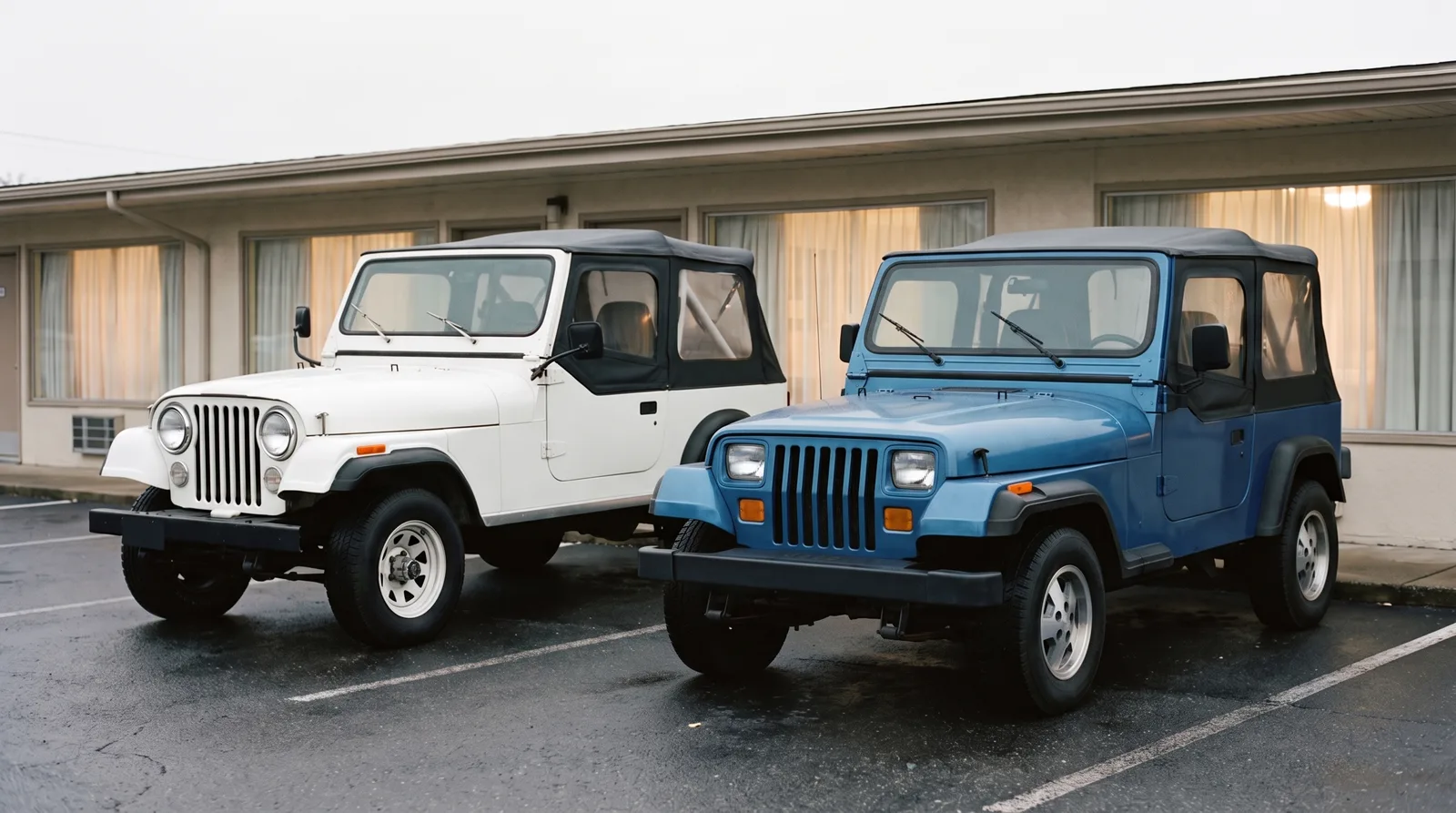
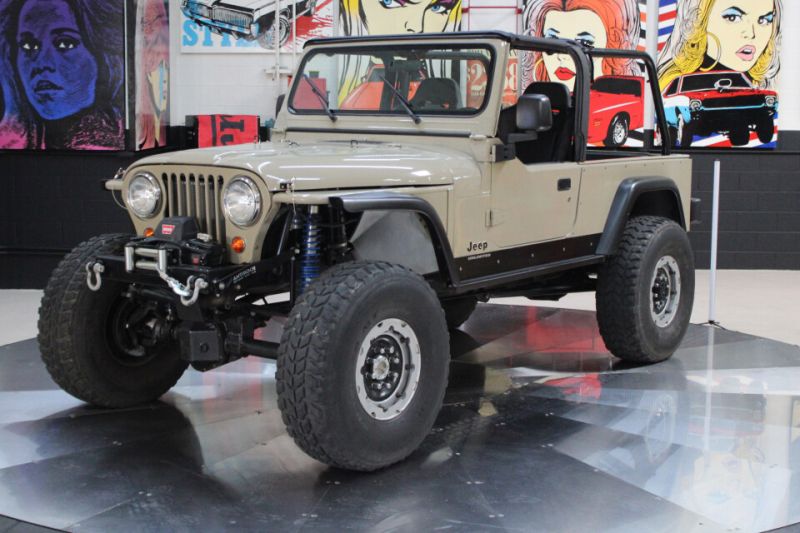
The Wrangler YJ that arrived for the 1987 model year was, mechanically, closer to the CJ-7 than most people realize at first glance. It shared a widened version of the CJ-7's frame, carried over powertrain options familiar to CJ buyers, and kept the removable doors and folding windshield that had defined the CJ experience since the war. Chrysler's engineers were not trying to erase the CJ. They were trying to fix its specific liability exposure, primarily by widening the track and lowering the center of gravity, while preserving everything else that made the truck recognizable. The result looked different enough to satisfy legal counsel and familiar enough to keep loyal CJ owners from feeling betrayed.
"Chrysler didn't kill the CJ so much as it widened the CJ and gave it a new name. Anyone who drove both back to back in 1987 could feel the family resemblance immediately."
- Patrick Walsh
The square headlights that split opinion
Not every change was welcomed. The YJ's rectangular headlights, replacing the round units that every CJ had worn since 1945, became an instant flashpoint among longtime owners and remain a point of good-natured argument at shows decades later. It was a small styling detail with outsized emotional weight, because round headlights had become shorthand for the CJ's entire visual identity. Chrysler eventually reversed course, returning to round headlights with the TJ generation in 1997, a decision widely read as an acknowledgment that the CJ's original face mattered more to buyers than anyone at the company had initially assumed.
The dealers who had to sell the change
It fell to Jeep dealers, not corporate headquarters, to explain the switch to buyers who had spent years shopping specifically for a CJ. Many dealerships leaned hard into continuity in their own local advertising, describing the new Wrangler as simply the next CJ rather than a break from it, because that framing was closer to the truth than a full rebrand would have suggested and because it was an easier sell to a loyal customer base. Some longtime buyers refused the change anyway and went looking for late-model used CJ-7s instead of a new Wrangler off the lot, a preference that pushed up used CJ values almost immediately after 1986 and never really reversed. That early collector premium on the last CJ-7 model years is still visible in the market today, decades after the reason for it, stubborn brand loyalty, has mostly faded from memory.
The Wrangler YJ was actually developed and launched by AMC, unveiled at the 1986 Chicago Auto Show and entering production that summer, before Chrysler completed its acquisition of AMC in August 1987. Whatever internal caution existed at AMC about retiring a nameplate that had carried the brand since the war, the external result held. Wrangler sales climbed steadily through the late eighties under Chrysler's new ownership, evidence that the handoff, awkward headlights and all, worked.
Why the CJ's fingerprints never really left
What makes the jeep cj culture successor handoff worth studying is how little actually changed in spirit even as the specifics evolved. Every Wrangler generation since 1987, through the TJ, JK, and JL, has kept the CJ's basic formula intact: solid axles, a removable top, a boxy silhouette instantly identifiable from three hundred feet away. Jeep's marketing has leaned on that continuity deliberately, treating the CJ not as a discontinued product but as an ancestor whose values still govern every decision about what a Wrangler is allowed to be. Few automotive lineages have stayed this legible across four decades and multiple corporate owners. If you want to trace how that identity took shape in the CJ's own trim history, where this started lays out the earlier chapters.
What the handoff means for buyers now
For collectors, this history changes how a CJ should be judged against its successor. A CJ-7 is not simply an older, less refined Wrangler. It is the source document, the vehicle every later stability fix and styling decision was measured against, and that gives it a different kind of value than nostalgia alone would explain. Buyers who understand the handoff tend to shop differently. They are not looking for the truck that came before the "real" Jeep. They are looking at the truck that set the terms every Wrangler since has had to honor, doors, windshield, axles, silhouette, and all. That perspective is worth having before you go looking, and if the story above has you curious, you can go find a classic CJ and see how much of that original formula is still sitting on dealer lots today, largely unchanged since 1986.
There is also a quieter mechanical thread running through this handoff that gets overlooked in favor of the headlight debate. The YJ's suspension geometry, while wider than the CJ's, was tuned by engineers who had spent years listening to CJ owner complaints about on-road handling at highway speed, a known weak point of the shorter wheelbase trucks. That feedback loop, informal as it was, meant the first Wrangler addressed real driver complaints rather than just legal exposure. Owners who cross-shopped a clean CJ-7 against a new YJ in showroom lots during 1987 often noted the improved stability immediately, even if they missed the round headlights and the narrower stance they had grown used to. Chrysler was threading a needle between two different audiences: buyers who wanted the CJ's character preserved exactly, and buyers who wanted the CJ's known flaws fixed. It largely managed both, which is a harder trick than it gets credit for.
The CJ did not really end in 1986. It just changed its name, widened its stance, and kept doing the same job it had done since the war, which is about as clean a handoff as any American vehicle has ever managed.
Sources and notes
Related Reading
Have a
Jeep CJ
for Sale?
Reach thousands of serious classic car collectors across the US.
Sell It Here →
Selling a classic? Here's how: sell my classic car
Are You a Classic Car Dealer?
List your full inventory and connect with targeted classic car buyers.
Join as a Dealer →

About the author
Patrick Walsh
Automotive journalist covering classic car shows, events, and the enthusiast community across North America.
Related Listings - Jeep CJ

Comments
Be the first to comment on this article.