
Ownership changes rarely improve consistency overnight, but the jeep cj engine amc 232 six is a rare case where a corporate takeover actually simplified something that had grown a little complicated. When American Motors bought Jeep from Kaiser in 1970, it inherited a CJ lineup running on a Buick-sourced V6 that AMC had no manufacturing rights to keep indefinitely. The 232 six was AMC's answer, and it became the engine that quietly stabilized the CJ for the rest of the decade.
Car Features
6 min read
The AMC 232: The Six That Bridged Two Eras
When AMC took over Jeep in 1970, it needed an engine it fully controlled to replace the borrowed Dauntless V6, and the 232 six was the bridge.
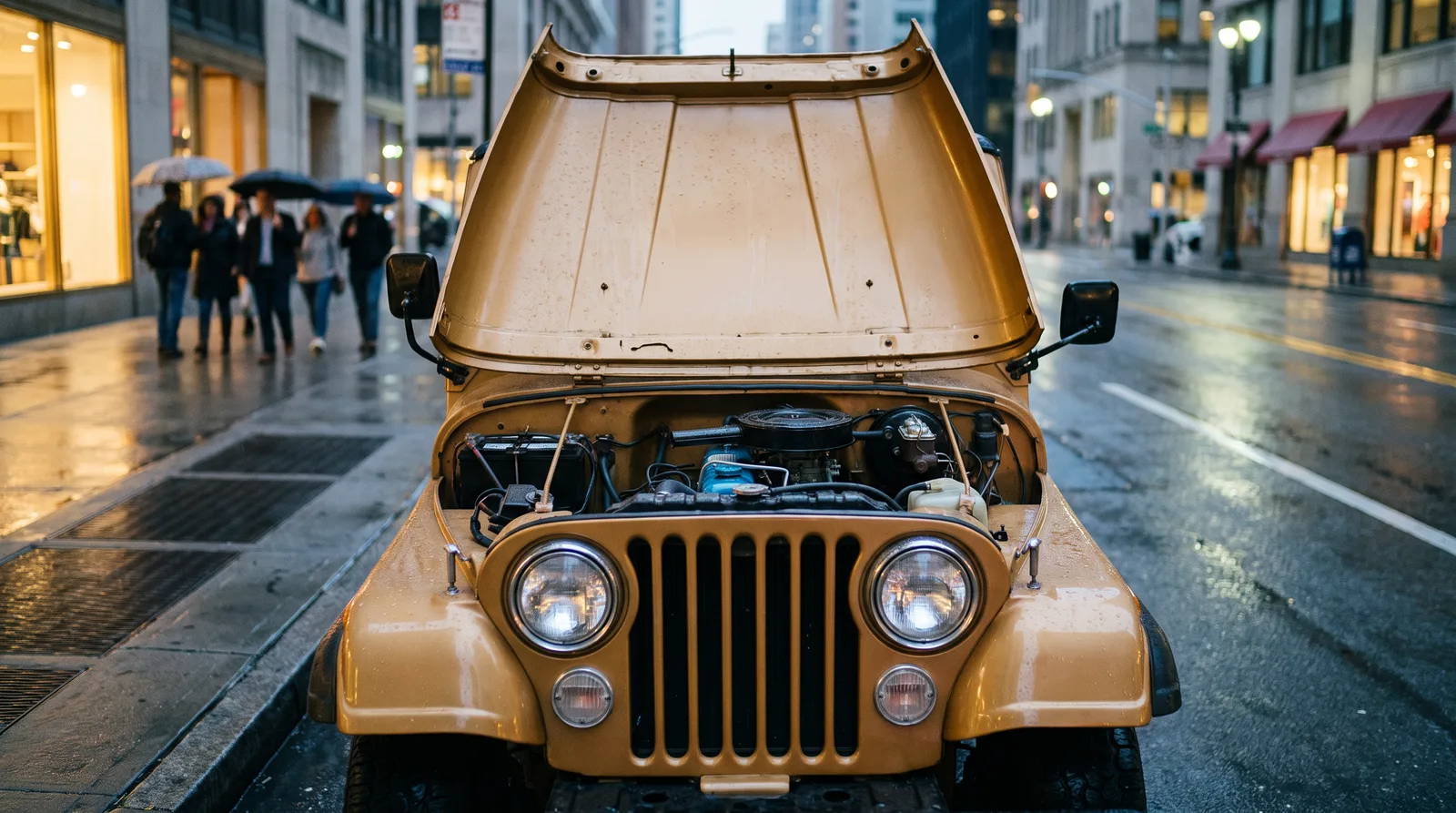
AMC inherits a borrowed engine
Kaiser Jeep had been building the CJ-5 and CJ-6 around the Dauntless V6, an engine Kaiser had bought the tooling for from Buick back in 1966. When AMC acquired Jeep in 1970, it kept the Dauntless in production for a couple more years, but the arrangement was never meant to last. Buick itself wanted the V6 tooling back once the 1973 oil crisis made compact-efficient six-cylinder engines valuable again, and AMC needed its own engine to fill the gap rather than depending on a supplier that might reclaim its own design.
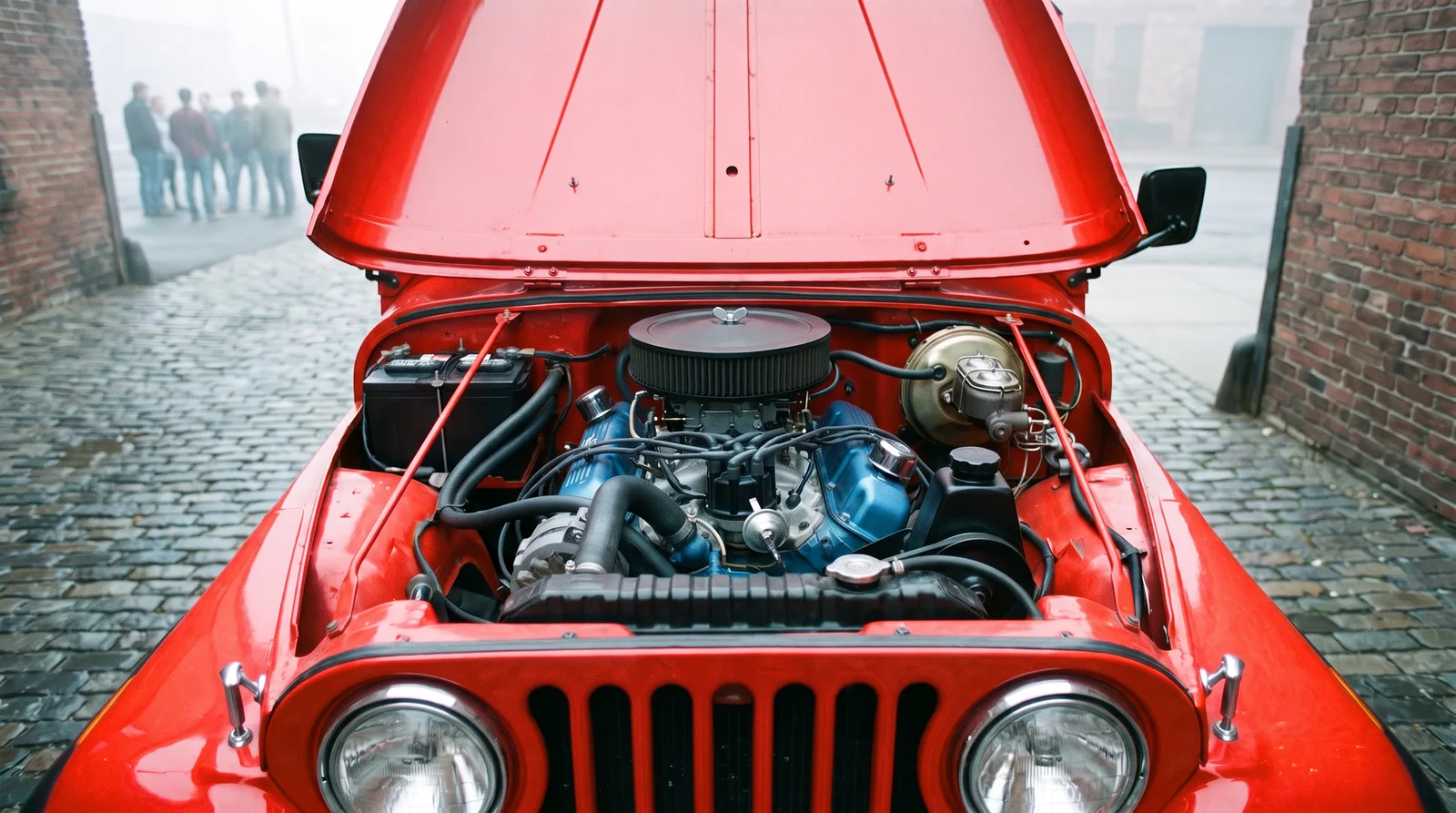
AMC already had an inline six in its own lineup, developed originally for its passenger cars, and the 232 cubic inch version became the natural fit for the CJ once the Dauntless relationship wound down. The 232 arrived in the CJ for 1972 as the standard engine, replacing the V6 outright, with the larger 258 six and the 304 V8 offered as options from the same year.
232 six quick facts
| Spec | AMC 232 six |
|---|---|
| Displacement | 232 cu in |
| Configuration | Inline six |
| CJ introduction | 1972 |
| Replaced | Dauntless V6 (225) |
| Superseded by | AMC 258 six (optional from 1972, standard from 1979) |
What the switch actually changed
The 1972 CJ-5's 232 six was rated at about 100 horsepower (SAE net), a figure that reflects the industry's shift to more conservative net ratings around this time rather than a real power drop from the Dauntless. Numerically the 232 did not dramatically outgun the Dauntless V6 it replaced, and some buyers at the time likely saw it as a lateral move rather than a clear upgrade. What it did offer was independence. AMC controlled the design, the tooling, and the supply chain for the 232 outright, meaning production of the CJ no longer depended on decisions made in Buick's engine planning offices. That mattered enormously once the 1973 oil embargo hit and automakers everywhere were scrambling to secure engine supply for their own vehicles first.
The 232 also gave AMC a consistent inline-six architecture it could scale. Read the background on how the CJ engine lineup evolved leading into this point, and the pattern becomes clear: every transition in CJ power, from the F-head four to the Dauntless V6 to the AMC sixes, was driven by supply security and buyer demand for more usable torque, not by chasing horsepower for its own sake.
A short-lived base engine with a long shadow
A precise, isolated production count for CJ units built with the 232 as their original engine is not readily available today. Precise production figures for the 232-specific window remain harder to pin down than for the longer-running 258, since AMC's internal reporting from this period grouped inline-six production data in ways that did not always separate the two displacements cleanly. What is clear is that many buyers paid for the larger 258, which sat on the option list alongside the 232 from the very first AMC model year.
The 232 was never the top choice. AMC offered a larger-displacement 258 cubic inch version of the same basic inline-six architecture as an option from 1972, and the 258 eventually became the CJ's defining engine through the late 1970s and into the 1980s. But the 232 mattered because it proved the inline-six family could work in the CJ chassis at all, clearing the path for its larger sibling to take over as the standard once buyers and AMC itself confirmed the layout was a success.
232 versus the Dauntless it replaced
| Spec | Dauntless V6 (225) | AMC 232 six |
|---|---|---|
| Manufacturer origin | Buick, licensed to Kaiser | AMC in-house |
| Configuration | V6, odd-fire | Inline six, even-fire |
| Main bearings | 4 | 7 |
| CJ introduction | 1966 | 1972 |
| Supply control | Dependent on Buick | Fully AMC owned |
"The 232 is easy to overlook because the 258 gets all the attention later. But the 232 is the engine that proved AMC could run its own six in this chassis without leaning on Buick for parts. That is not a small thing."
- Emily Chen
What the 232 felt like to actually drive
Owners who cross-shopped a 232-powered CJ against a Dauntless V6 example in the early 1970s were not just comparing spec sheets. The inline-six layout gave the 232 a smoother, more even power delivery than the odd-fire V6's characteristic uneven idle, which some buyers preferred for everyday driving even if outright torque figures were fairly close between the two engines. The seven-main-bearing bottom end also gave the 232 a reputation for smoothness at higher RPM that the shorter-lived Buick-derived V6 could not quite match, since the V6's four-main-bearing design was originally built down to a lower cost target for Buick's compact cars rather than up to a durability target.
That refinement came without much of a fuel economy penalty either, which mattered to buyers already feeling the effects of rising gas prices even before the 1973 embargo made the issue unavoidable for the entire industry.
The transition years on today's market
Model changeovers rarely happen on a clean calendar boundary, but the Dauntless-to-232 switch actually did. The V6 ended with the 1971 models and the AMC engines took over for 1972, yet five decades of engine swaps mean a buyer today examining an early-1970s CJ-5 cannot assume which engine sits under the hood based on the model year alone. Original build sheets and casting numbers remain the only reliable way to confirm which engine a specific transition-year CJ left the factory with.
The Dauntless V6 was fully phased out of CJ production by the end of the 1971 model year, with the 232 taking over as the standard six for 1972. That changeover came well before Buick bought the V6 tooling back in 1974. AMC simply preferred to power its Jeeps with engines it already built.
Finding a 232-powered CJ today
Because so many buyers paid for the optional 258, and the 258 replaced the 232 as the standard six for 1979, genuine 232-equipped examples are less common on the used market than the longer-running 258. That scarcity is worth knowing for anyone specifically chasing an early AMC-era CJ rather than a Kaiser-era V6 truck or a late-model 258 example. Buyers who want to see what is currently available across the AMC engine window can find a classic CJ and check the build sheet or engine tag before assuming every AMC-era six under the hood is the more common 258.
Sources and notes
Related Reading
Have a
Jeep CJ
for Sale?
Reach thousands of serious classic car collectors across the US.
Sell It Here →
Selling a classic? Here's how: where to sell your classic car online
Are You a Classic Car Dealer?
List your full inventory and connect with targeted classic car buyers.
Join as a Dealer →
#jeep cj-5
#classic Jeep history
#AMC 232
#AMC Jeep engines
#Dauntless V6 replacement
#Jeep inline six

About the author
Emily Chen
Bay Area engineer with a deep focus on vintage Japanese and European performance cars. Approaches classic car research and restoration with an analytical eye.
Related Listings - Jeep CJ





Comments
Be the first to comment on this article.