
Not every big Willys engine ended up under a CJ hood, and the Super Hurricane six is the clearest example of that. It shares a name with the four-cylinder Hurricane that raised the CJ-3B's hood, and enough CJ owners assume the two are related options on the same order sheet that it is worth setting the record straight. The jeep cj engine hurricane six story is really a story about an engine that never actually made it into a CJ at all, and why the confusion persists anyway.
Car Features
6 min read
The Super Hurricane Six: A Bigger Heart for the Jeep
Before the Dauntless V6 arrived, Willys and Kaiser offered a larger L-head six for CJ-6 and export buyers who needed more torque than a four could give.
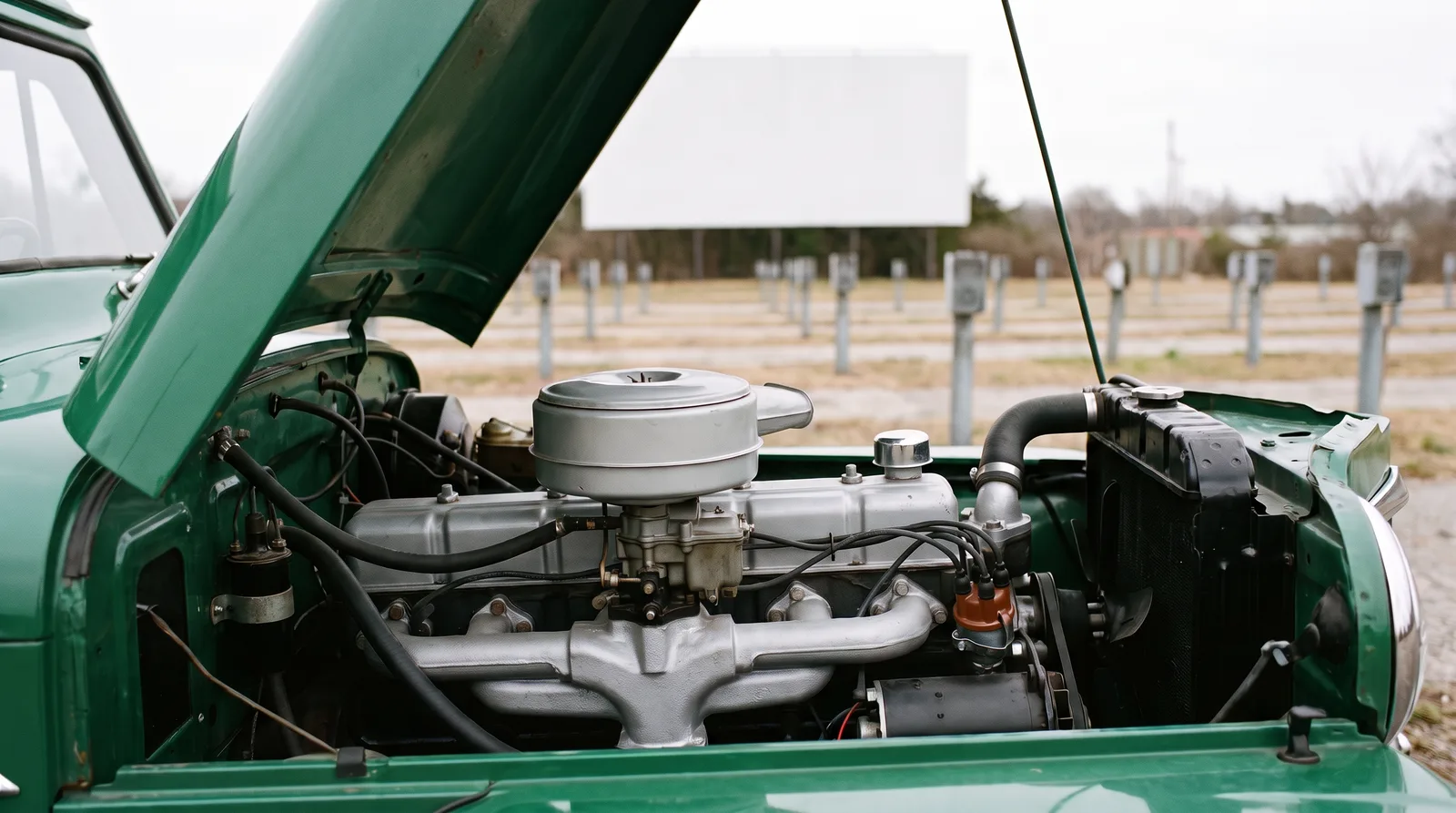
A bigger relative of a familiar name
The Hurricane name is best known from the F-head four that powered the CJ-3B starting in 1953, but Willys also built a larger L-head six-cylinder engine that shared the Hurricane family branding, commonly referred to as the Super Hurricane 226. That six, sourced from Continental, saw service in the Willys pickup truck, the Willys Station Wagon, and the FC-170 forward-control truck from 1954 through 1963. It was never a factory-installed option in the CJ-5 or CJ-6.
Where the F-head four topped out around 75 horsepower, the larger L-head six made roughly 105 to 115 horsepower and about 190 lb-ft of torque depending on the model year, meaningfully more displacement and a broader torque curve than the four-cylinder CJ engines. That made it a natural fit for the heavier Willys trucks and wagons it actually powered, even though it never crossed over into the CJ lineup itself.
What the CJ-6 actually got instead
The CJ-6 existed specifically because some buyers found the standard-wheelbase CJ-5 too short for the loads they wanted to carry. Stretching the wheelbase added cargo room and towing stability, but it also added weight, and a longer, heavier utility vehicle asks more of its engine than a shorter one does. Willys and Kaiser answered that demand not with the Super Hurricane six, but by keeping the F-head four as the base engine and later adding the Dauntless V6 in 1966, followed by the AMC 232 and 258 sixes once American Motors took over Jeep in 1970.
This is the same basic demand for more torque and towing capacity that eventually pulled the Dauntless V6 and the AMC sixes into the CJ lineup. The Super Hurricane 226 simply was not part of that answer. Our jeep cj engines retrospective covers this full arc in more detail for readers who want to see how each real CJ engine option fits into the bigger picture.
A truck and wagon engine, not a CJ one
The Super Hurricane 226 stayed exactly where Willys put it, in the pickup, the Station Wagon, and the FC-170, through 1963. When Kaiser needed more six-cylinder power in the CJ a few years later, it looked outside rather than reaching for the older L-head six, buying the Buick 225 V6 tooling instead. The Dauntless was newer, more compact, and did not carry the packaging penalties of a longer L-head six under a relatively tight CJ engine bay.
"People hear Hurricane and assume every engine wearing that name found its way into a CJ eventually. The six-cylinder version never did. It lived its whole life in Willys trucks and wagons."
- Dan Reeves
Where the confusion usually starts
Anyone researching this engine online runs into a naming problem fast. Willys reused the Hurricane name across genuinely different engines spanning different displacements, valve arrangements, and applications, and period sales literature was not always careful about distinguishing them for a general audience. The F-head four that raised the CJ-3B's hood and the L-head Super Hurricane six discussed here traded on the same recognizable branding even though a mechanic working on one would find almost nothing interchangeable with the other, and only one of them ever appeared under a CJ hood from the factory.
That branding overlap is exactly why documentation matters so much for anyone told a CJ is running a "Hurricane six." A casual seller description reading simply "Hurricane engine" tells a buyer almost nothing useful without a casting number or a build tag, and in the case of a claimed six-cylinder Hurricane in a CJ, it is worth asking directly what engine is actually installed, since it did not come that way from the factory.
Torque over speed, by design
Engineers of this era generally understood that a utility vehicle's real-world usefulness came down to low-RPM pulling power far more than top speed or peak horsepower, and the Super Hurricane six was built with that priority in mind for the trucks and wagons it powered. Its larger displacement compared to the F-head four meant it could produce meaningful torque, around 190 lb-ft depending on model year, at engine speeds well below where the smaller four was still working hard, which translated directly into an easier time towing or hauling a loaded Willys truck without constantly downshifting or lugging the engine.
How it compares to what actually powered the CJ
For collectors today, the Super Hurricane six sits in an odd spot precisely because it is so often misfiled as a CJ engine. It predates the AMC-era sixes that eventually became the CJ's long-term backbone, and it shares only branding, not lineage or application, with anything that actually powered a CJ-5 or CJ-6. Anyone researching a related story on the AMC sixes that genuinely did replace the Dauntless V6 will notice how much cleaner and more standardized Jeep's engine strategy became once AMC took control in 1970.
What to make of a "Hurricane six" CJ listing
Because the Super Hurricane 226 was never a factory CJ engine, a listing or a seller claiming one almost always points to one of two things: a period aftermarket or owner-installed swap, or simple confusion between the four-cylinder Hurricane and the unrelated six. Neither is a scandal, but a buyer should treat the claim as something to verify with casting numbers rather than take at face value, the same way any non-factory engine swap deserves scrutiny before it affects a purchase decision.
Worth knowing either way
The Super Hurricane six is a genuinely interesting piece of Willys history, just not a CJ one. Knowing what it actually powered, and what it never did, helps buyers ask sharper questions when a Hurricane name shows up somewhere it should not. Buyers who want to see what is currently available across the real CJ engine spectrum, four-cylinder, V6, or AMC six, can check CJs for sale now and compare drivetrain notes before deciding which era of Jeep power actually fits what they plan to do with the vehicle.
Sources and notes
Related Reading
Have a
Jeep CJ
for Sale?
Reach thousands of serious classic car collectors across the US.
Sell It Here →
Selling a classic? Here's how: where to sell your classic car online
Are You a Classic Car Dealer?
List your full inventory and connect with targeted classic car buyers.
Join as a Dealer →
#kaiser jeep
#classic Jeep history
#Jeep CJ-6
#Super Hurricane six
#Willys Jeep engines
#Jeep six cylinder

About the author
Dan Reeves
Performance engine builder from North Carolina's motorsports corridor, focused on swaps, forced induction and making real, repeatable power.
Related Listings - Jeep CJ





Comments
Be the first to comment on this article.