
Ask a longtime CJ owner what engine they picture when someone says "AMC-era Jeep" and most will not say the V8, and most will not say the smaller 232. They will say the jeep cj engine amc 258 six, because it is the engine that ran under the hood of more CJ-5s and CJ-7s than any other option through the back half of the model's production run.
Car Features
7 min read
The 258 Six: The Engine That Defined the AMC CJ
The AMC 258 inline six became the default CJ-5 and CJ-7 engine for most of the late 1970s and 1980s, prized for torque and reliability over horsepower.
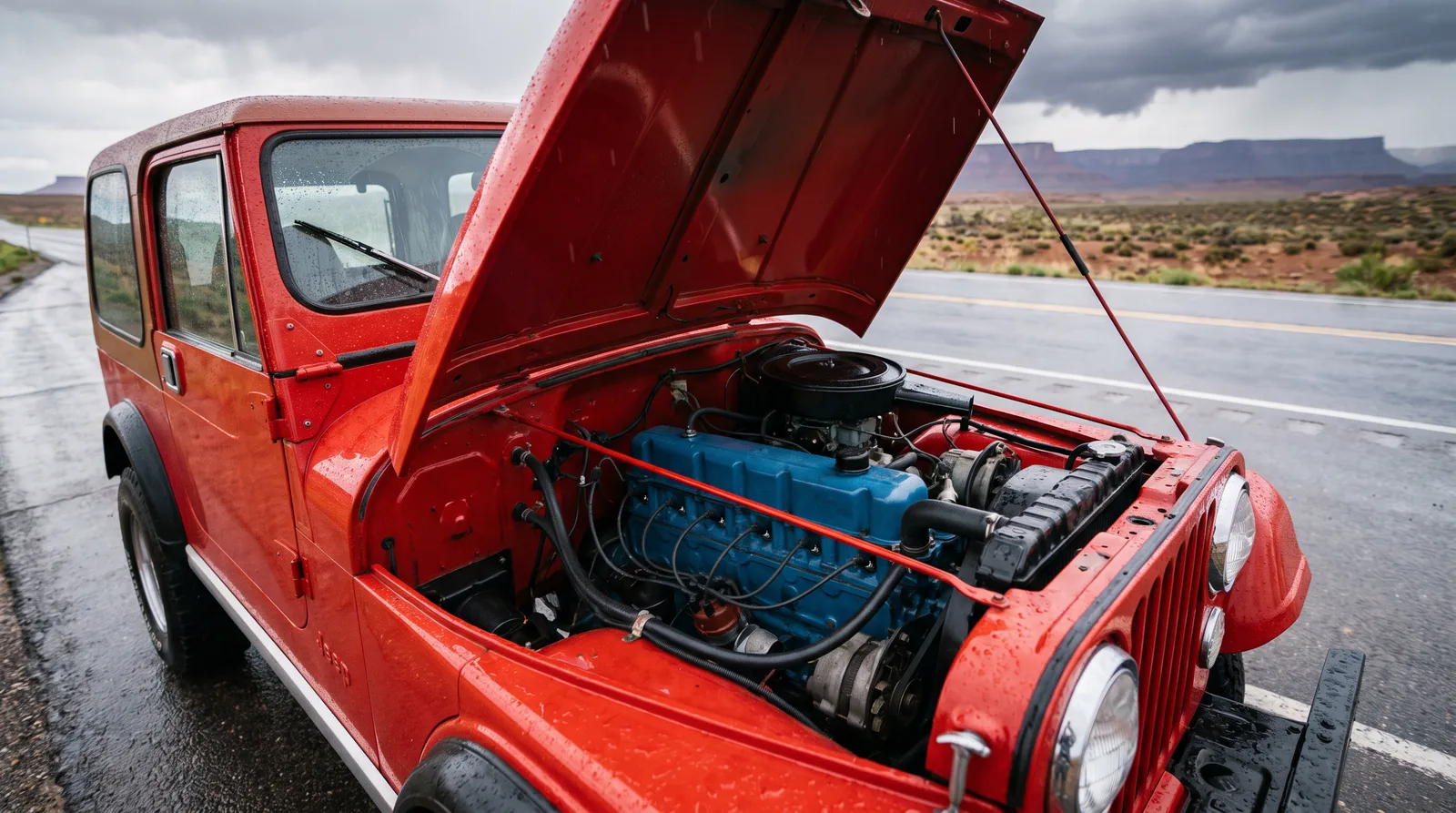
Bigger bore, same basic family
The move from 232 to 258 cubic inches was not just a bigger number on a spec sheet. AMC's engineers understood that a working vehicle like the CJ needed low-end pulling power far more than it needed a higher top speed, and stretching the stroke to add displacement is one of the most direct ways to build torque lower in the RPM range without a complete redesign. That decision reflected years of feedback from utility and off-road buyers who valued a truck that pulled hard from just off idle over one that revved out to an impressive but rarely used peak.
The 258 cubic inch inline six shared its core architecture with the smaller 232 AMC had introduced into the CJ in 1972, using the same seven-main-bearing bottom end but stroked out for more displacement and more low-end torque. AMC introduced the 258 into the CJ lineup for 1974, and within a couple of model years it had effectively taken over as the engine most buyers actually ordered, pushing the 232 toward the margins of the option sheet.
Early gross ratings put the 258 around 150 horsepower and 240 lb-ft of torque, though the industry-wide switch to more conservative SAE net ratings soon after brought the published figure down to roughly 115 horsepower and 192 lb-ft, and further emissions tuning through the rest of the decade, especially on California-spec engines, pushed some years as low as around 100 horsepower and 200 lb-ft. The appeal was straightforward. More displacement meant more torque at low RPM, which is exactly what a utility vehicle used for towing, plowing, or trail work needs more than peak horsepower. A CJ buyer hauling a trailer up a grade cared far more about pulling power at 2,000 RPM than about a horsepower number on a spec sheet.
Weathering the emissions era
The 1970s and early 1980s were brutal years for engine output across the entire American auto industry. Tightening emissions regulations forced automakers to detune engines with leaner carburetors, lower compression, and smog equipment that choked breathing, and the 258 was not immune. Horsepower figures on paper dipped through the late 1970s even as the engine's fundamental design stayed sound, a pattern that frustrated period buyers but did little to hurt the engine's long-term reputation for durability.
What kept the 258 relevant through those lean years was the same torque-first character that made it popular in the first place. Even detuned, a 258 six pulled hard at low RPM, which mattered more to a working CJ owner than a horsepower figure sapped by emissions hardware. Readers curious about the earlier engines this replaced can find the whole picture across the CJ's full engine history for context on how output and torque priorities shifted decade to decade.
The default engine for the AMC CJ-7
By the time the CJ-7 launched in 1976, the 258 had essentially become the expected engine for anyone not specifically ordering the optional AMC 304 V8. It offered a real balance most buyers wanted: enough torque for genuine trail and towing work, better fuel economy than the V8 during a decade when gas prices spiked more than once, and a reputation for running for hundreds of thousands of miles with basic maintenance. That reliability record is a large part of why so many surviving CJ-5s and CJ-7s on the road today are running a 258 rather than the flashier V8 option.
258 six at a glance
| Spec | AMC 258 six |
|---|---|
| Displacement | 258 cu in (4.2 liter) |
| Configuration | Inline six, seven main bearings |
| CJ introduction | 1974 |
| Successor to | AMC 232 six |
| Later use | Wrangler YJ, Cherokee XJ into the 1990s |
"Ask any AMC-era CJ owner why they still trust the 258 and the answer is almost always the same. It just keeps running. Nobody talks about a 258 the way they talk about a finicky performance engine, because it was never built to be one."
- Dan Reeves
Living with a 258 day to day
Owners who put real miles on a 258-powered CJ tend to describe the same experience regardless of what decade they bought the vehicle in. The engine starts easily, idles smoothly for an inline six of its era, and delivers its torque low enough in the rev range that a driver rarely needs to chase RPM to get moving from a stop, whether on pavement or climbing a rocky trail. That predictability, more than any single performance number, is what built the engine's reputation among owners who depended on their CJ for actual work rather than occasional weekend trail runs.
Fuel economy for a stock 258-powered CJ-7 was modest by modern standards, generally in the mid-teens to around 20 miles per gallon on the highway depending on gearing, transmission, and the specific model year's emissions tune, and lower still off-road or towing. None of that means the 258 was without its quirks. Like most carbureted engines of its era it could be sensitive to altitude and cold-start conditions without proper tuning, and owners restoring one today generally find that a correctly rebuilt carburetor matters more to how the engine actually runs than any bolt-on modification.
The carburetor changes tell the real story
Tracking the 258's evolution through the 1970s means tracking a string of carburetor and emissions hardware changes rather than any single dramatic redesign. Federal and California emissions standards tightened almost every model year through the decade, and AMC responded with progressively leaner carburetor tunes, exhaust gas recirculation systems, and catalytic converter requirements that each nibbled at usable power in exchange for regulatory compliance. None of these changes touched the core engine architecture. The seven-main-bearing block, the basic displacement, and the fundamental torque character all stayed the same from 1974 through the end of CJ production.
The specific carburetor model and emissions hardware changed more than once across the run, generally moving toward leaner Carter and Motorcraft carburetors, added exhaust gas recirculation, and eventually catalytic converters as federal and California standards tightened, though exact hardware by individual model year is best confirmed against a specific vehicle's factory service documentation rather than assumed from the model year alone. That consistency is part of why the 258 built a reputation few emissions-era American engines earned. Owners could feel confident that a later, more emissions-choked 258 was mechanically the same reliable engine as an earlier, stronger-running example, just tuned differently to meet the regulations of its specific model year.
What it means for buyers today
A 258-powered CJ-5 or CJ-7 remains one of the easiest AMC-era Jeeps to own precisely because of how long the engine stayed in production across multiple Jeep models. Parts availability, mechanic familiarity, and documented reliability all favor the 258 over rarer earlier options like the Dauntless V6 or the export-only Perkins diesel. For a buyer prioritizing an engine that is straightforward to keep running rather than a rare curiosity, the 258 is usually the safer bet.
Shoppers weighing a 258 six against the optional V8 or an earlier CJ generation can shop classic CJ listings and compare engine codes directly, since the 258's long production run means examples from nearly every year of the AMC CJ era are still findable on the market today.
Sources and notes
Related Reading
Have a
Jeep CJ
for Sale?
Reach thousands of serious classic car collectors across the US.
Sell It Here →
Selling a classic? Here's how: where to sell your classic car online
Are You a Classic Car Dealer?
List your full inventory and connect with targeted classic car buyers.
Join as a Dealer →

About the author
Dan Reeves
Performance engine builder from North Carolina's motorsports corridor, focused on swaps, forced induction and making real, repeatable power.
Related Listings - Jeep CJ





Comments
Be the first to comment on this article.