
For twenty-seven years the CJ made do without a V8 option from the factory. Buyers who wanted eight cylinders under the hood of a short-wheelbase Jeep had to build one themselves. That changed in 1972, and the jeep cj engine amc 304 v8 is the story of the one factory V8 the classic CJ ever officially wore, a short and sometimes contentious run that ended not because the engine failed but because the era it was born into eventually caught up with it.
Car Features
7 min read
The 304 V8: The Wildest Engine the CJ Ever Wore
AMC gave the CJ its only factory V8 in 1972, the smallest V8 in its lineup, and fuel economy regulations killed the option a decade later.
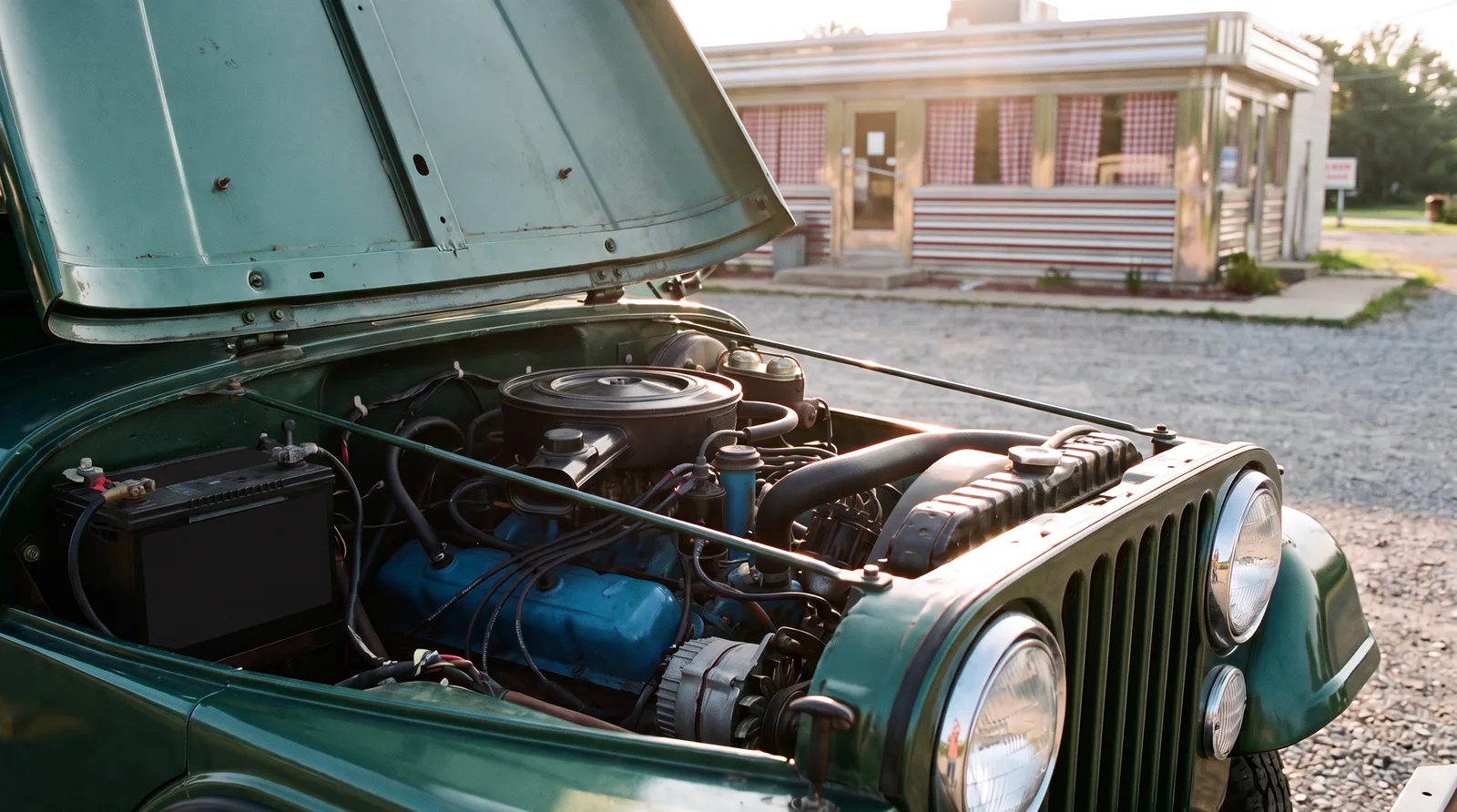
The first factory V8 in a CJ
American Motors had a family of V8 engines already in production for its passenger cars and the Javelin, and the 304 cubic inch version, the smallest displacement AMC was still building by then, was the one AMC judged to fit reasonably within the CJ's compact engine bay and lighter chassis. It arrived as an option for the CJ-5 starting in 1972 and continued into the CJ-7 after that model launched in 1976, giving buyers a genuine factory alternative to the AMC sixes for the first time.
Rated output fell steadily across the decade, from around 210 gross horsepower in 1970-71 to roughly 150 net horsepower once AMC switched to SAE net ratings for 1972, and down further into the 125 to 130 horsepower range by the late 1970s as emissions equipment tightened. Output figures shifted year to year as emissions equipment tightened through the decade, but even in its more restricted later tunes the 304 offered noticeably more low-end punch than either the 232 or 258 six, and it gave the CJ a genuinely different character on the trail, quicker off the line and more capable of spinning tires than any six-cylinder CJ before it.
Why AMC chose the smallest V8 in its lineup
AMC also built larger 360 and 401 cubic inch V8s, and it is worth asking why neither of those made it into the CJ. The answer comes down to packaging and weight distribution. A short-wheelbase off-road vehicle like the CJ-5 already had a high center of gravity and a light nose, and stuffing a heavier, larger-displacement V8 up front would have made handling worse both on and off road. The 304 was the smallest V8 AMC had in production at the time, which made it the only one that fit the CJ's proportions without seriously compromising the vehicle's balance.
That restraint mattered to buyers who wanted V8 power specifically for off-road torque rather than straight-line speed. Readers who want the jeep cj engines story in full can see how this V8 decision fits alongside every other engine choice made across the model's history, each one balancing power against the CJ's fundamentally compact, off-road-focused chassis.
304 V8 versus the 258 six it competed with
| Spec | AMC 258 six | AMC 304 V8 |
|---|---|---|
| Displacement | 258 cu in | 304 cu in |
| Configuration | Inline six | V8 |
| CJ introduction | 1972 | 1972 |
| Typical buyer priority | Fuel economy, reliability | Off-the-line torque |
| Discontinued in CJ | Continued past 1981 | 1981 |
Why the V8 option disappeared in 1981
The 304's run in the CJ ended in 1981, and the reason was not mechanical. Corporate Average Fuel Economy regulations, tightened through the late 1970s, put real pressure on automakers to raise the average fuel economy across their entire model lineup, and a thirsty V8 option in a low-volume model like the CJ dragged that average down disproportionately. AMC, already a smaller company than the Big Three with less room to absorb regulatory penalties, made the practical call to drop the 304 from the CJ rather than risk compliance costs. The full story of the engine's replacement and what came after it connects directly to the six-cylinder options that carried the CJ through its final years of production.
"The 304 wasn't killed by a design flaw. It got killed by a fuel economy spreadsheet. That is the honest version, even if it is less romantic than people want to hear."
- Emily Chen
What buyers actually got for the extra cylinders
Ordering the 304 option added real cost to a CJ purchase, and period buyers weighing that cost against the standard six-cylinder engines were making a deliberate trade. The V8 delivered noticeably quicker acceleration and stronger low-end response for technical trail obstacles where an instant burst of torque mattered, but it came with a real fuel economy penalty at a time when gas prices were becoming a genuine household concern rather than a background expense. That trade-off meant the 304 never became the default choice for most CJ buyers the way the 258 six eventually did, even though it consistently found an audience among owners who prioritized capability and performance over running costs.
The V8 option also changed the character of the vehicle in ways beyond straight-line performance. A 304-equipped CJ carries more weight over the front axle than a six-cylinder example, which shifts handling behavior slightly and is part of why AMC never seriously considered offering either of its larger V8s in the same chassis.
How the swap community changed the 304's reputation
Even after AMC dropped the 304 from the CJ order sheet in 1981, the engine did not disappear from CJ culture. Because the 304 shared its basic mounting architecture and bellhousing pattern with other AMC V8s, and because so many junkyard AMC sedans and Jeeps of the era carried some version of the engine family, the 304 became one of the most common swap-in V8 choices for owners of six-cylinder CJs looking to add power after the fact. That popularity means a fair number of CJs on the road today running a 304 never actually left the factory that way, even though the swap is period-appropriate enough that many buyers do not mind.
No reliable count of surviving factory-original 304 CJs versus documented aftermarket swaps exists today, since neither AMC's original build data nor modern registries track that split with any precision. For collectors specifically chasing factory-original documentation rather than a period-correct swap, this distinction matters considerably more than it might for a buyer simply looking for a capable trail vehicle with V8 power under the hood.
What a 304 CJ means for buyers now
Because the 304 was only available for roughly a decade and only in two CJ generations, a documented V8 CJ-5 or CJ-7 is meaningfully rarer than the far more common six-cylinder cars that surrounded it on both ends of the production run. That scarcity, combined with genuine period demand for the extra power, has made 304-equipped CJs a consistent target for buyers who want the most capable stock engine the classic CJ ever offered rather than the more common and more easily maintained six.
Anyone weighing a V8 CJ against a six-cylinder example should factor in both the rarity and the slightly higher parts and fuel costs that come with any V8 versus a six of the same era. For buyers ready to compare what is actually on the market, classic CJs on the market span both engine families, and checking the build tag remains the only reliable way to confirm which one sits under a given hood.
Sources and notes
Related Reading
Have a
Jeep CJ
for Sale?
Reach thousands of serious classic car collectors across the US.
Sell It Here →
Selling a classic? Here's how: where to sell your classic car online
Are You a Classic Car Dealer?
List your full inventory and connect with targeted classic car buyers.
Join as a Dealer →

About the author
Emily Chen
Bay Area engineer with a deep focus on vintage Japanese and European performance cars. Approaches classic car research and restoration with an analytical eye.
Related Listings - Jeep CJ





Comments (1)
L
Lou Vincenzo
1 day ago
My cousin Vinnie had a CJ-5 with the 304 around '75, parked it outside my shop with the top off, and when he fired it up customers got out of the chair half shaved to look, what a sound that was, then gas went crazy and he sold it to a kid from Warwick.