
Every CJ owner who has tried to start a cold Jeep in January has a carburetor story, and most of them are not flattering to the carburetor. The jeep cj engine carburetor drama is not a single dramatic incident so much as a decades-long pattern of engineering compromises, brand changes, and cold-morning frustration that shaped how an entire generation of owners talks about their trucks. It is worth understanding not as a complaint, but as a genuine thread in CJ history, because the carburetor a given CJ wore says a lot about when it was built and what Jeep was fighting at the time.
Car Features
8 min read
Carter, Carburetors and Cold Mornings: The CJ Fuel Story
From Carter single-barrels to emissions-era complexity, the jeep cj engine carburetor drama shaped how generations of owners learned to live with cold mornings.
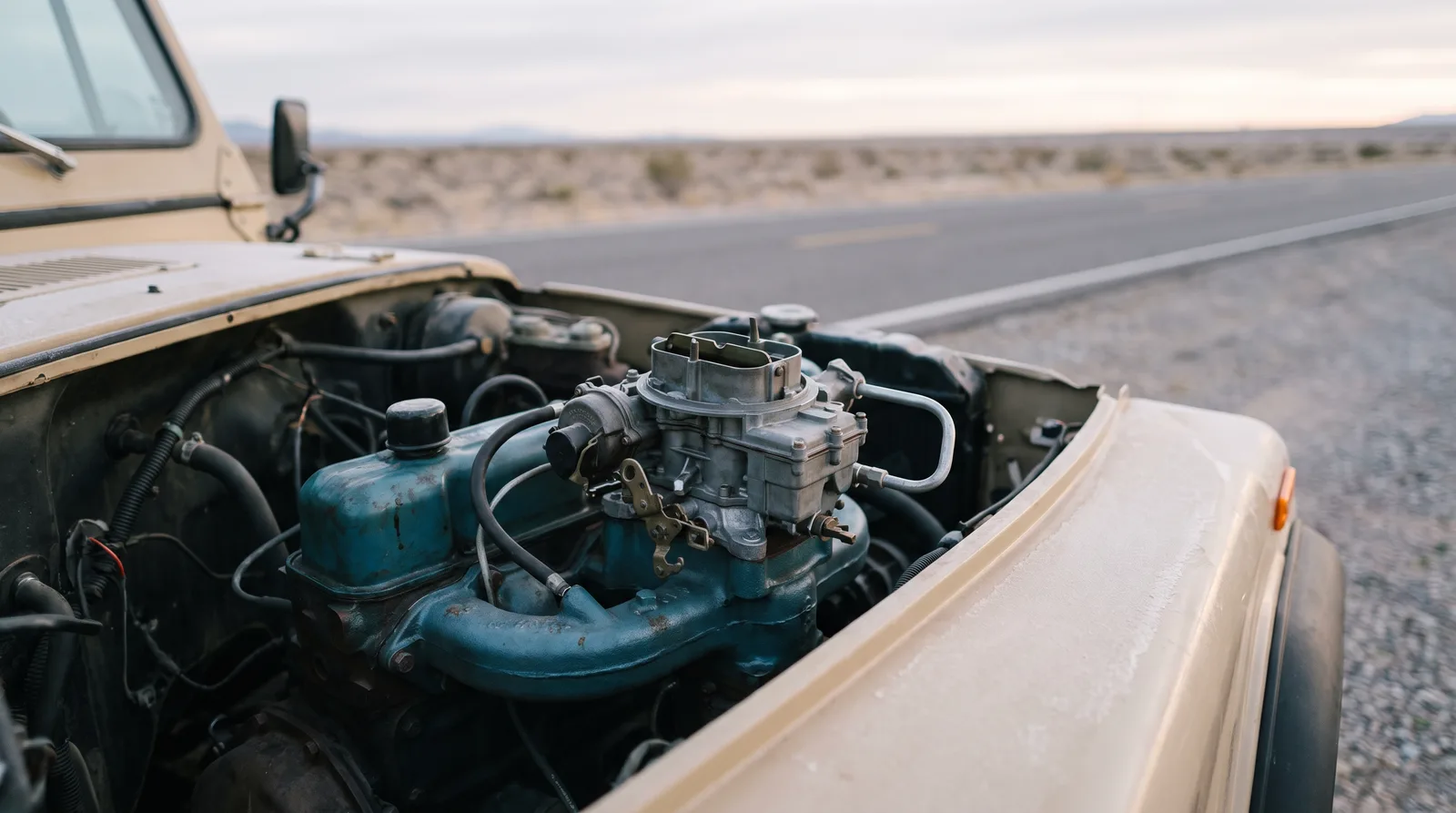
Carter took the early years
Through the CJ-2A, CJ-3A, and well into the CJ-5 era, Carter carburetors were the standard fitment on the Willys and Kaiser four-cylinder Go Devil and Hurricane engines. Carter's single-barrel and later two-barrel units were simple by any modern measure, which was a virtue in an era when the typical CJ owner was a farmer or small contractor expected to service the truck himself with basic tools. Simple also meant sensitive. These carburetors relied on manual choke operation, float levels that drifted with vibration on rough terrain, and jetting that assumed a fairly narrow range of altitude and temperature conditions. A CJ that ran perfectly at sea level could stumble and flood at elevation, and owners in mountain states learned to carry spare jets the way other drivers carried spare tires.
Cold starts were the recurring drama. A flooded carburetor on a subzero morning, choke pulled too far or not far enough, was common enough that period owner's manuals devoted real space to starting procedure. Get the sequence wrong and you were pulling spark plugs to dry them out before trying again, an experience that shows up in nearly every oral history collected from farm and ranch CJ owners of the era.
Emissions rules changed the equation
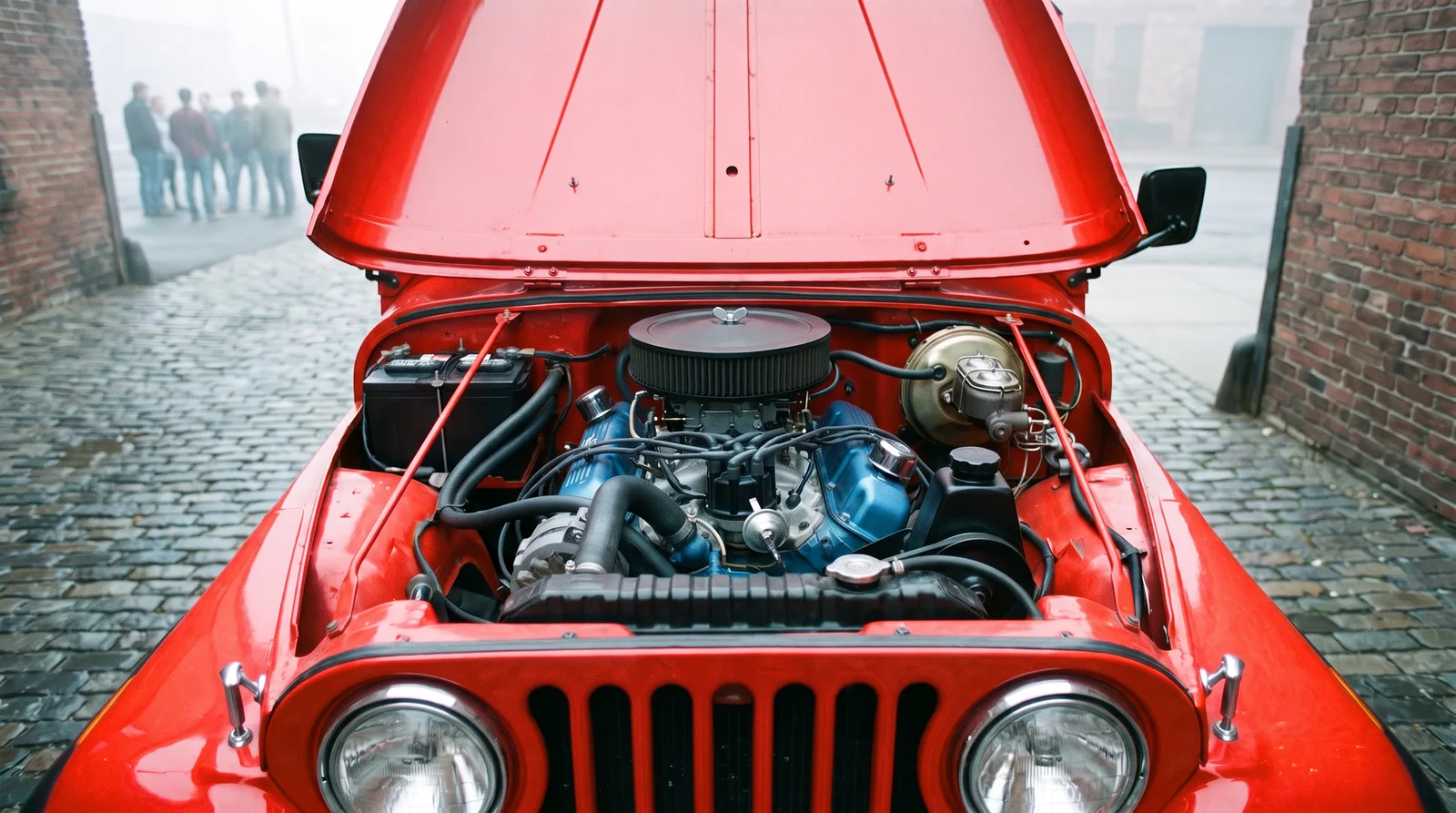
By the early 1970s, federal emissions standards forced a shift in carburetor design across the entire American auto industry, and CJs were not exempt. Later AMC-era four and six-cylinder engines picked up more complex carburetors with additional circuits for idle control, deceleration valves, and choke systems tied into engine temperature sensors rather than a simple manual pull cable. These units, mostly Carter designs, from the single-barrel YF through the later computer-controlled BBD two-barrel, were harder to tune correctly and less forgiving of the shade-tree adjustments that had kept earlier CJs running for two decades. A mechanic who could rebuild a 1948 Carter blindfolded sometimes struggled with the emissions-era version because there were simply more variables to get wrong.
This is where the drama shifted from "the carburetor floods in the cold" to "the carburetor cannot pass a smog check no matter what you do," a complaint that shows up constantly in CJ forums and club newsletters from states with strict emissions inspection regimes. The frustration was real enough that some owners in non-compliance states simply swapped back to earlier, simpler carburetors, technically illegal but common enough to be an open secret at CJ gatherings.
| Era | Typical carburetor | Main drama |
|---|---|---|
| CJ-2A / CJ-3A (1945-1953) | Carter single-barrel | Cold-start flooding, altitude jetting |
| Early CJ-5 (1955-1971) | Carter carburetors, various | Manual choke drift, field adjustment |
| AMC-era CJ-5/CJ-7 (1972-1980s) | Carter YF and BBD, emissions-tuned | Complex circuits, smog compliance |
Why this matters for buyers today
A carburetor is not usually what decides a purchase, but understanding the jeep cj engine carburetor drama helps set realistic expectations. A CJ running its original carburetor from the 1950s or 1960s is a mechanically simple system that a patient owner can learn to tune, but it will never start with the one-key ease of a modern fuel-injected vehicle, and cold mornings will always require a bit of ritual. A later AMC-era CJ with an emissions-tuned carburetor is more complex to service correctly but was engineered to a tighter standard, at least on paper, even if period reliability complaints suggest the execution did not always match the intent.
Neither situation is a defect specific to one truck. It is the nature of carbureted engines from an era before electronic fuel injection became standard, and every CJ from the platform's entire production run, 1945 through 1986, shares some version of this reality. Buyers who expect fuel-injected convenience from a carbureted CJ set themselves up for disappointment regardless of which specific year they choose.
"The carburetor is honest in a way modern engines are not. It tells you exactly what is wrong through how it runs, if you know how to listen, and that diagnostic honesty is part of why so many owners keep their CJs carbureted even when a fuel injection conversion is technically available."
- Emily Chen
The parts and rebuild landscape now
The good news for current owners is that Carter carburetor parts for these engines, along with popular aftermarket alternatives like the Motorcraft 2100/2150, remain relatively available through the classic Jeep aftermarket, unlike some other CJ components that have become genuinely scarce. Rebuild kits exist for nearly every carburetor CJ ever wore from the factory, and a competent carburetor specialist can bring a tired unit back to period-correct function without heroic sourcing effort. This is a meaningful point in the CJ's favor compared to some contemporaries whose carburetor parts dried up decades ago.
That said, correct tuning still requires patience and, ideally, someone who has worked on the specific carburetor family in question. A Carter single-barrel from 1948 and a computer-controlled Carter BBD two-barrel from 1983 are different enough in design philosophy that expertise in one does not automatically transfer to the other, which is part of why the drama around these components has never fully gone away even as parts availability improved.
For the complete picture of what powered a CJ across its entire production run, including how these carburetor choices connect to the engines themselves, our complete history traces every powerplant Jeep offered from the Go Devil four through the AMC-era six and V8 options.
The altitude problem nobody talks about enough
One drama that rarely gets its due in general CJ histories is the altitude problem, and anyone who has driven one of these trucks through mountain country understands it immediately. A carburetor jetted correctly for sea level runs rich at elevation, where thinner air needs less fuel per intake stroke to hit the correct mixture. A CJ that started easily and idled smoothly at a coastal dealership could stumble, hesitate, and foul plugs constantly once it reached a customer in Colorado or Wyoming. Dealers in mountain states learned to re-jet trucks before delivery, and independent mechanics in those regions built entire reputations around understanding altitude compensation long before anyone used that specific term casually.
This was not a minor footnote. Owners who bought a CJ in one region and later moved to a different elevation often discovered their truck ran noticeably differently after the move, sometimes badly enough that a full carburetor rebuild and re-jetting became necessary just to restore normal drivability. It is a detail easy to overlook today, when fuel injection systems handle altitude compensation automatically and invisibly, but it was a real and recurring source of frustration for CJ owners across most of the platform's carbureted decades, and it explains why period owner's manuals sometimes included specific jetting charts by elevation range.
If you are shopping with this history in mind, it is worth checking current inventory to compare how sellers describe carburetor condition and originality across available trucks. You can browse classic CJ listings to see how much variation exists between original-carburetor examples and those that have been rebuilt, converted, or otherwise modified from factory specification.
Sources and notes
Related Reading

Have a
Jeep CJ
for Sale?
Reach thousands of serious classic car collectors across the US.
Sell It Here →
Selling a classic? Here's how: sell my classic car
Are You a Classic Car Dealer?
List your full inventory and connect with targeted classic car buyers.
Join as a Dealer →

About the author
Emily Chen
Bay Area engineer with a deep focus on vintage Japanese and European performance cars. Approaches classic car research and restoration with an analytical eye.
Related Listings - Jeep CJ





Comments (1)
H
Hugo R.
11 hours ago
old CJ-5 of mine flooded every cold morning till i set the float right. easy fix