
Power dropped. Complexity went up. That is the entire jeep cj engine emissions choke story in two sentences, and everything else is detail. Starting in the early 1970s, federal clean-air rules reached into the CJ's engine bay and rewrote what a simple farm Jeep was allowed to be, and the trucks that came out the other side were measurably different animals than the ones that preceded them.
Car Features
7 min read
The Emissions Choke: How Clean-Air Rules Tamed the CJ
Clean-air rules rewrote the CJ's engine bay in the 1970s, turning simple manual chokes into complex automatic systems and softening horsepower along the way.
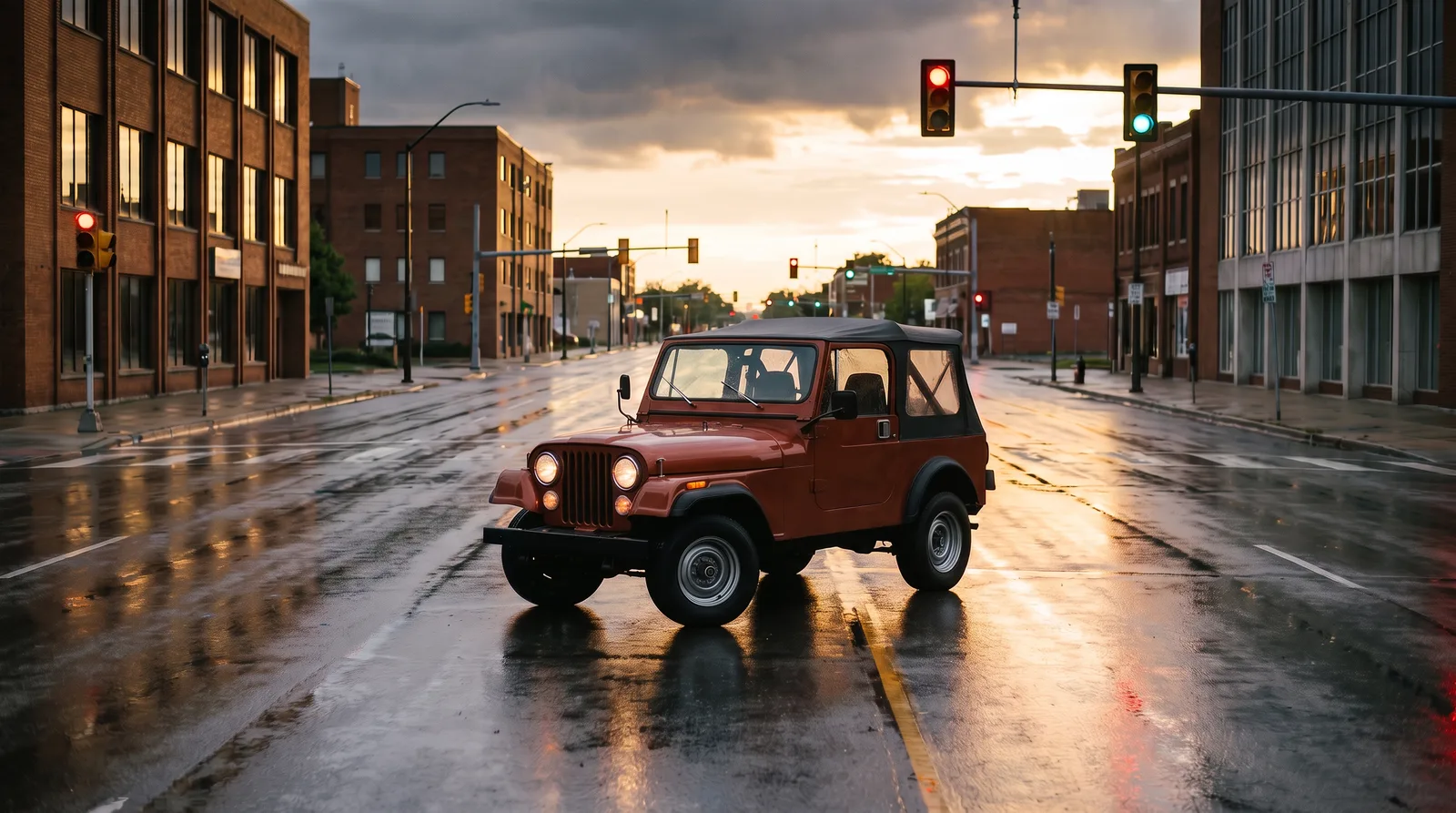
The rules arrived fast
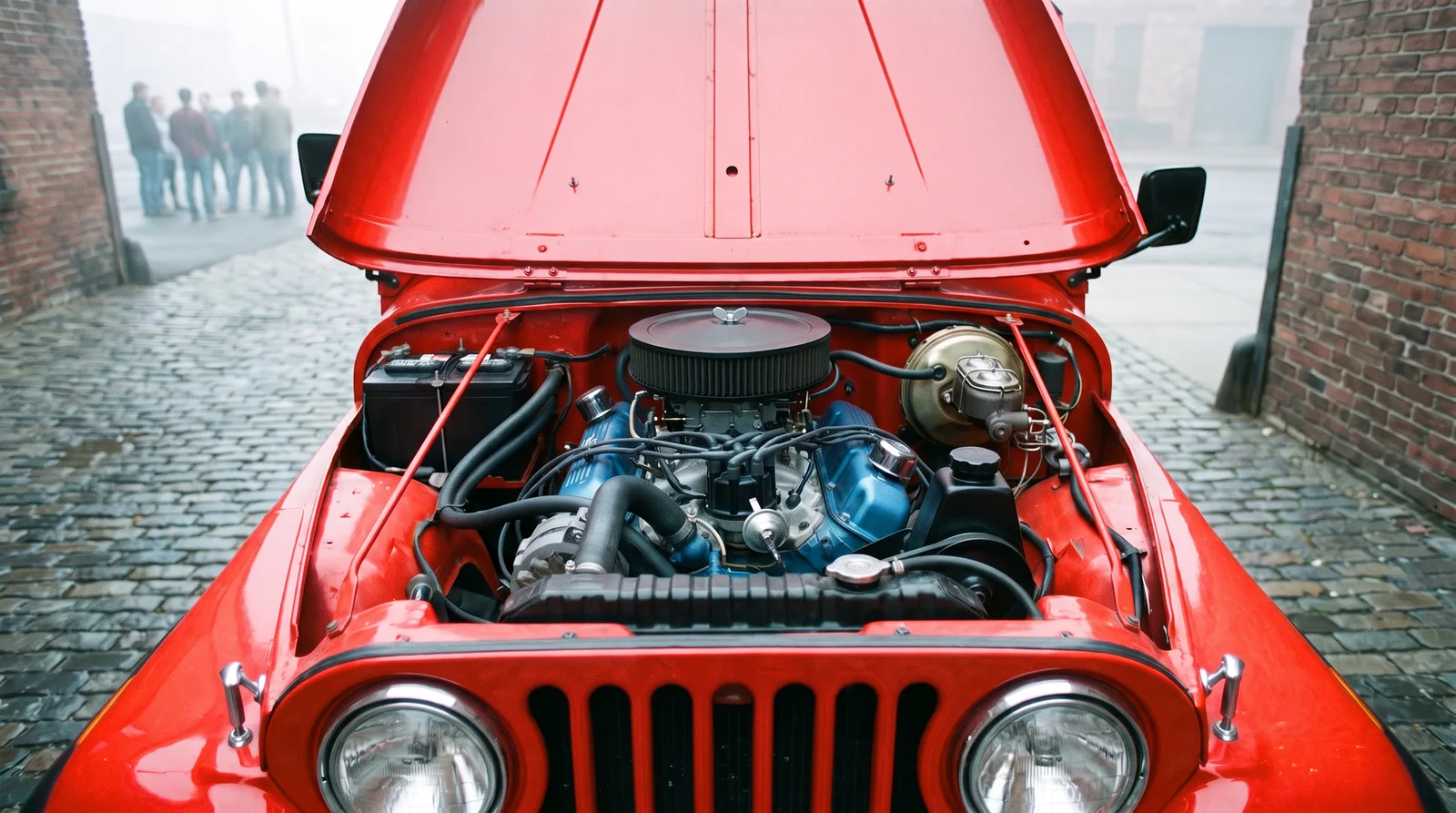
The Clean Air Act amendments of 1970 set the federal government on a path toward mandatory emissions controls on new vehicles, and by 1973 those requirements were showing up in real hardware on American light trucks, CJs included. This was not a gradual, decade-long phase-in from the buyer's perspective. A CJ-5 ordered in 1971 and one ordered in 1974 could differ substantially under the hood even with the same nominal engine, because AMC engineers were adding exhaust gas recirculation valves, air injection systems, and increasingly complex carburetor circuits in rapid succession to keep pace with tightening federal standards.
Horsepower took the hit first and hardest, at least on paper. The AMC 258 straight six, for example, had been rated around 150 gross horsepower before the industry switched to the more conservative SAE net measurement standard in 1972, after which the same basic engine was listed closer to 110 to 120 net horsepower even before emissions tuning leaned it out further with retarded timing and restrictive exhaust components. Owners who drove both eras of the same basic engine consistently describe the later versions as noticeably softer off the line, even when the displacement numbers on paper looked similar.
Choke systems got complicated
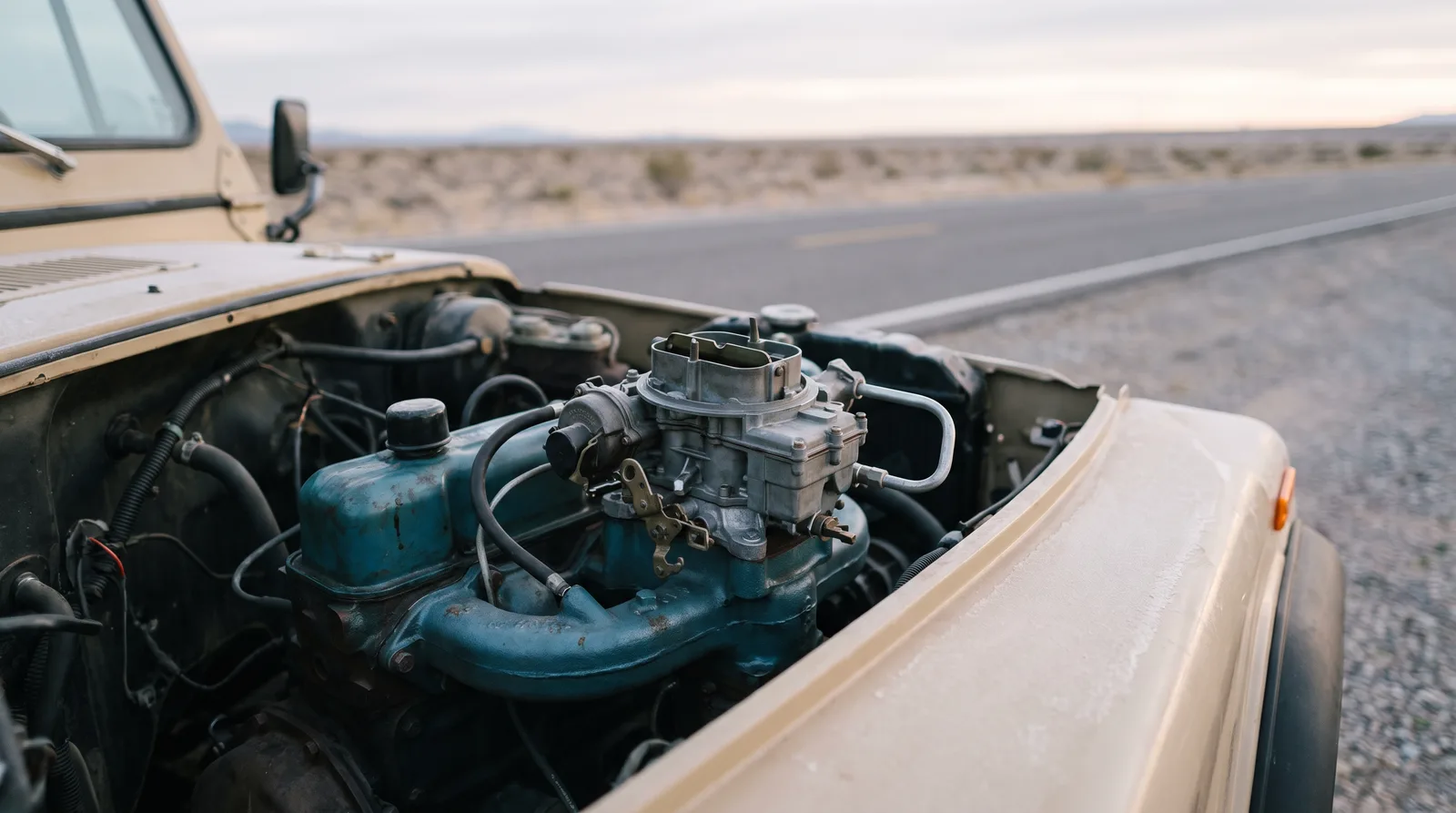
The choke itself is where the emissions story gets its name in owner circles. Pre-emissions CJs used simple manual chokes, a cable the driver pulled by hand, full stop, no electronics involved. Emissions-era CJs moved toward automatic choke systems tied to engine temperature, designed to run rich only as long as necessary during warmup and then lean out automatically to cut cold-start pollution. The theory was sound. The execution, on a truck built to a price point and driven hard on rough terrain, was often a headache.
Automatic chokes drifted out of adjustment. Temperature sensors failed. The whole system added failure points that a 1950s CJ simply did not have, and owners who had grown up on the old manual-choke trucks were not shy about saying so at gas stations and trailheads across the country. This is a real engineering tradeoff, not a myth: cleaner air came at the cost of mechanical simplicity, and the CJ's core appeal, a truck almost anyone could keep running with basic tools, took a genuine hit.
| Period | Choke system | Emissions hardware added |
|---|---|---|
| Pre-1972 | Manual cable choke | Minimal to none |
| 1972-1975 | Transitional, some automatic | EGR, basic controls introduced |
| 1976-1986 | Automatic, temperature-linked | EGR, air injection, catalytic converter (later years) |
Owners fought back, quietly
Not every owner accepted the emissions-era compromises without pushing back, and this is where the choke story overlaps with a broader pattern of CJ owners modifying their trucks to restore lost performance and simplicity. Some disconnected or bypassed EGR valves. Some swapped in earlier carburetors with simpler choke mechanisms where state laws permitted it. None of this was strictly legal in states with emissions inspection programs, but it was common enough that it barely qualified as controversial within CJ circles, more a shrug and a wrench than an act of rebellion.
This tinkering culture connects directly to a broader theme across the CJ's later production years, one covered in more depth in jeep cj engines history, which traces how power and complexity evolved across the platform's full four-decade run from the 1945 Willys MB successor through the final 1986 CJ-7.
"Emissions rules didn't kill the CJ engine, but they took the edge off it for about a decade, and every owner who drove one from that stretch knows exactly what I mean without me explaining further."
- Dan Reeves
What it means for a buyer now
If you are shopping a CJ built between roughly 1973 and 1983, expect an engine that runs cleaner on paper but softer in feel than its earlier counterpart, and expect a choke and emissions system with more parts that can fail or drift out of tune. That is not necessarily a dealbreaker. Plenty of owners have restored these systems to proper function, and some states no longer require emissions compliance on vehicles this old regardless of original equipment, which opens the door to removing some of the more troublesome hardware entirely if a buyer chooses.
The transmission and transfer case pairing behind these emissions-era engines also shifted during this window, a topic covered in a related story that walks through how drivetrain choices tracked engine changes across the same years.
Whichever era you land on, the emissions story is a real chapter in CJ history, not a footnote, and understanding it explains a lot about why enthusiasts talk about pre- and post-emissions CJs as almost different trucks despite sharing badges, sheet metal, and in some cases the same basic engine block. If you want to see how these distinctions play out on the market today, there are CJs for sale now spanning both eras, which makes for an easy side-by-side comparison of how sellers describe the difference.
The California factor
California's own emissions standards, enforced separately from the federal rules through the state's Air Resources Board, often arrived stricter and earlier than the national requirements, and CJs sold new in California frequently carried different, more restrictive hardware than trucks sold elsewhere in the same model year. This created a genuine regional split in the CJ population that persists in the used market today. A California-delivery CJ from the mid-1970s may wear emissions equipment that a Wyoming-delivery truck from the identical model year never had, and that difference matters to buyers trying to understand exactly what they are looking at.
Collectors and mechanics who specialize in this era learn to check build tags and regional delivery codes specifically because of this split. It is not enough to know the model year; knowing where a CJ was originally sold tells you which emissions hardware to expect under the hood, and mismatches between the two are a common red flag that a truck has had components swapped or removed somewhere in its ownership history.
Living with it today
Many states now exempt vehicles of a certain age from emissions inspection entirely, which gives current owners of emissions-era CJs a choice that original buyers never had: keep the factory hardware intact for originality, or remove restrictive components entirely now that compliance is no longer legally required. Both paths have defenders. Originality-minded owners argue that a complete, correct emissions system is part of the truck's factual history and worth preserving even if it costs some performance. Performance-minded owners argue that removing decades-old, often-failed emissions hardware makes for a more reliable, better-running truck with no legal downside in their state.
There is no single right answer here, and the choice usually comes down to what a specific owner values most. What matters for a buyer evaluating a used CJ from this window is simply knowing which path a given truck has taken, since it materially affects both the driving experience and the truck's standing with strict originality-focused collectors.
Sources and notes
Related Reading
Have a
Jeep CJ
for Sale?
Reach thousands of serious classic car collectors across the US.
Sell It Here →
Selling a classic? Here's how: the best sites to sell a classic car
Are You a Classic Car Dealer?
List your full inventory and connect with targeted classic car buyers.
Join as a Dealer →

About the author
Dan Reeves
Performance engine builder from North Carolina's motorsports corridor, focused on swaps, forced induction and making real, repeatable power.
Related Listings - Jeep CJ





Comments
Be the first to comment on this article.