
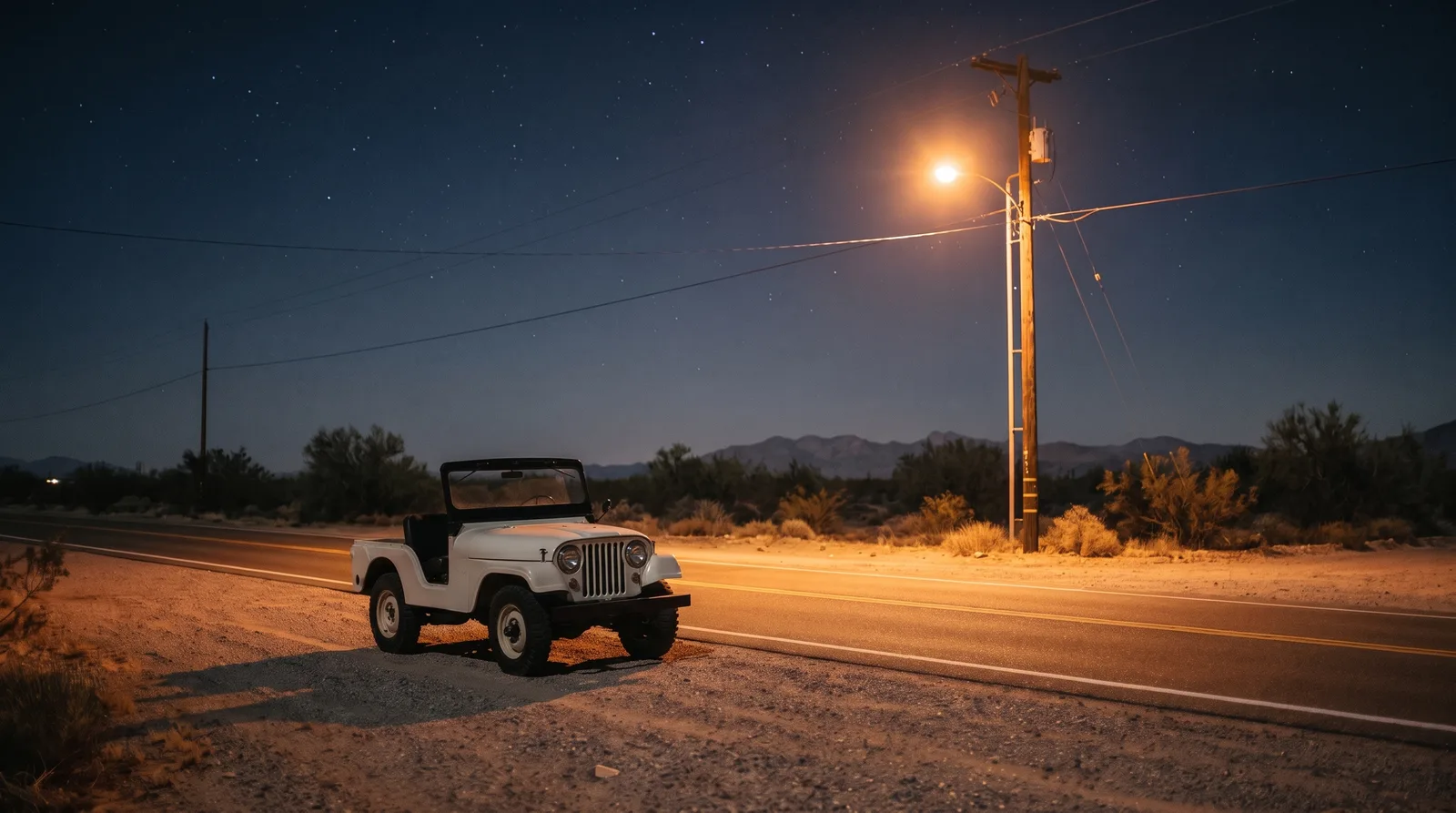
Most American enthusiasts picturing a classic CJ hear a gasoline four or six turning over. Almost nobody pictures a diesel clattering to life instead, yet for a stretch of export production that is exactly what buyers outside the United States got. The jeep cj engine perkins diesel story is a footnote to most domestic Jeep histories, but it was a mainstream option for CJ buyers on other continents, and it explains why some CJs surviving abroad sound nothing like the ones at a U.S. car show.
Car Features
7 min read
The Forgotten Diesel: Perkins Power in the CJ
For export markets where diesel ruled, Willys turned to British manufacturer Perkins to build a diesel option most American CJ buyers never saw.
Why a diesel CJ existed at all
Willys, and later Kaiser Jeep, sold the CJ platform far beyond American borders through licensing deals and export assembly, and diesel fuel dominates in a large share of those markets, particularly agricultural regions of Europe, Africa, and Asia where diesel is cheaper, more available, and taxed differently than gasoline. A gasoline-only CJ was a hard sell to a farmer in a market where every other piece of equipment on the property already ran on diesel. Willys needed a diesel option to compete for that business, and it turned to a specialist rather than building one in-house.
The supplier was Perkins, a British diesel engine manufacturer with decades of experience building compact diesels for tractors, trucks, and marine use. Perkins already had a proven four-cylinder diesel in its lineup, the 4.192, and adapting it for CJ installation was far faster and cheaper than developing a Willys diesel from scratch.
How the Perkins diesel actually worked
In automotive trim the Perkins 4.192 made about 62 horsepower at 3000 rpm and 143 lb-ft of torque at 1350 rpm, modest numbers on paper that undersell how the engine actually worked in daily use. The Perkins 4.192 was an indirect-injection diesel, meaning fuel ignited in a small pre-combustion chamber before spreading into the main cylinder, a common approach for diesels of that era that traded some outright efficiency for smoother, quieter running and easier starting in cold weather. Compression ratios on diesels of this type run far higher than a gasoline engine of similar displacement, which is what lets diesel fuel ignite from heat and pressure alone rather than a spark plug.
Where a gasoline Hurricane four or Dauntless V6 chased horsepower for highway driving, the Perkins diesel chased torque and fuel economy instead. That made it a poor match for buyers wanting quick acceleration but an excellent match for buyers who spent their days plowing a field, running a generator, or hauling a loaded trailer at low, steady speeds for hours at a time. Readers who want the full story of how this fits alongside the gasoline options can compare it against the rest of the CJ engine lineup.
Where it actually sold
Kaiser Jeep offered the Perkins diesel on the CJ-5 and CJ-6 starting in the 1961 model year, and it ran through 1968, with total production landing around 1,745 units, roughly 1,156 CJ-5s and 589 CJ-6s. The Export Division of Kaiser clearly aimed the option at overseas diesel-dominant markets, but a surprising number ended up sold domestically in the United States as well, which defied expectations for a niche light-truck diesel of that era. Even so, 1,745 units over eight years is a tiny fraction of total CJ output, which is exactly why so few American collectors have ever seen one in person, while a Jeep enthusiast in parts of Europe, Africa, or Asia might consider a Perkins diesel CJ a less unfamiliar sight from decades of local production and licensed assembly.
This mirrors a pattern seen elsewhere in the CJ's history, where licensed overseas builders like Mahindra kept variants alive and adapted them to local needs long after the domestic U.S. lineup had moved in a different direction entirely.
"People assume every classic Jeep engine story happened in Toledo. The Perkins diesel is proof a huge part of that history happened on farms and job sites nowhere near an American dealership."
- Emily Chen
Servicing a diesel far from the factory
Diesel engines of this vintage differ from their gasoline counterparts in ways that go beyond the fuel they burn. Injector pumps, glow plug systems in colder-start variants, and the higher compression internals all demand specialist knowledge that a general Jeep mechanic accustomed to gasoline Hurricane fours or Dauntless V6s might not have on hand. Owners running a Perkins-equipped CJ in period markets typically relied on agricultural equipment dealers and Perkins-authorized service points rather than the Willys or Kaiser dealer network, since those outlets already had the diesel-specific tooling and training the factory Jeep network did not prioritize.
Documentation on any dedicated factory-trained diesel service network from Willys or Kaiser is thin, and much of what is known today comes from surviving parts records and owner accounts rather than factory training materials. That servicing gap is part of why the Perkins diesel never crossed over into mainstream American Jeep culture even as a curiosity. It required an entirely separate support ecosystem that simply did not exist domestically, while gasoline CJs could lean on a Jeep dealer network that spanned the country.
A different kind of driving experience
Behind the wheel, a Perkins-powered CJ feels distinctly unlike its gasoline siblings. Diesel engines of this era produce peak torque at much lower RPM than a comparable gasoline four or six, which means a Perkins CJ pulls hard from just above idle but runs out of enthusiasm well before the RPM range where a gasoline Hurricane or Dauntless would still be building power. That characteristic suited exactly the kind of low-speed, high-load work, plowing, hauling, generator duty, that export buyers needed most, even though it made the diesel CJ feel comparatively sluggish for anyone used to driving a gasoline model on the highway.
What it means for today's collectors
A genuine Perkins diesel CJ is a rare find in the United States today, and that rarity cuts both ways for a collector. On one hand it is a legitimate, factory-documented variant with real history behind it, not a home-built swap. On the other hand, parts sourcing and documentation lean heavily on international records rather than the familiar domestic Jeep parts network most American restorers rely on, so a buyer taking one on should expect to do more legwork than a typical gasoline-engine restoration.
For collectors specifically chasing an unusual, low-volume CJ variant rather than a mainstream gasoline example, the Perkins diesel is one of the more genuinely obscure factory options in the model's entire production run. Anyone building a broader collection or simply hunting a common gasoline example instead can browse classic CJ listings and compare what is actually available against how rare a real Perkins-powered example would be by comparison.
Comparing it to the gasoline lineup
| Spec | Perkins 4.192 diesel | Dauntless V6 gasoline |
|---|---|---|
| Fuel type | Diesel | Gasoline |
| Injection type | Indirect injection | Carbureted |
| Priority | Torque, fuel economy | Horsepower, highway driving |
| Primary markets | Export, agricultural | United States |
| Cold-weather starting | Harder without glow plugs | Straightforward |
Glow plugs were standard equipment on the Perkins-powered CJ, though period accounts describe the engine as a middling cold starter even with them, and a later, slightly higher-compression version of the engine reportedly improved on that somewhat. That table is a simplification of course, but it captures the fundamental trade a buyer in an export market was making. Choosing the Perkins diesel meant accepting slower, less exciting acceleration in exchange for real fuel savings and stronger low-speed pulling power over the life of the vehicle, a trade that made obvious sense for a working farm vehicle and far less sense for anyone who mostly drove on paved roads at higher speeds.
A quiet chapter worth remembering
The Perkins diesel never defined the CJ the way the Hurricane four or the AMC sixes did, and it was never going to. But it answers a question a lot of Jeep buyers do not think to ask: how did Willys sell utility vehicles into diesel-dominant markets for decades. The answer is a British engine company most Americans have never heard of, quietly powering Jeeps an ocean away from Toledo.
Sources and notes
Related Reading
Have a
Jeep CJ
for Sale?
Reach thousands of serious classic car collectors across the US.
Sell It Here →
Selling a classic? Here's how: sell my classic car
Are You a Classic Car Dealer?
List your full inventory and connect with targeted classic car buyers.
Join as a Dealer →

About the author
Emily Chen
Bay Area engineer with a deep focus on vintage Japanese and European performance cars. Approaches classic car research and restoration with an analytical eye.
Related Listings - Jeep CJ





Comments
Be the first to comment on this article.