
Walk any CJ swap meet and count how many trucks are running the engine they left the factory with. It is fewer than you would think. The jeep cj engine swap culture is not a fringe hobby, it is close to a default expectation among long-term owners, and understanding why requires looking at what the CJ actually was when it was new: a cheap, simple, underpowered utility vehicle that practically invited improvement the moment warranty coverage ran out.
Car Features
7 min read
The Great Engine-Swap Tradition of the CJ
From necessity replacements on old farm Jeeps to deliberate V8 performance builds, jeep cj engine swap culture has shaped the platform for decades.
Necessity started it
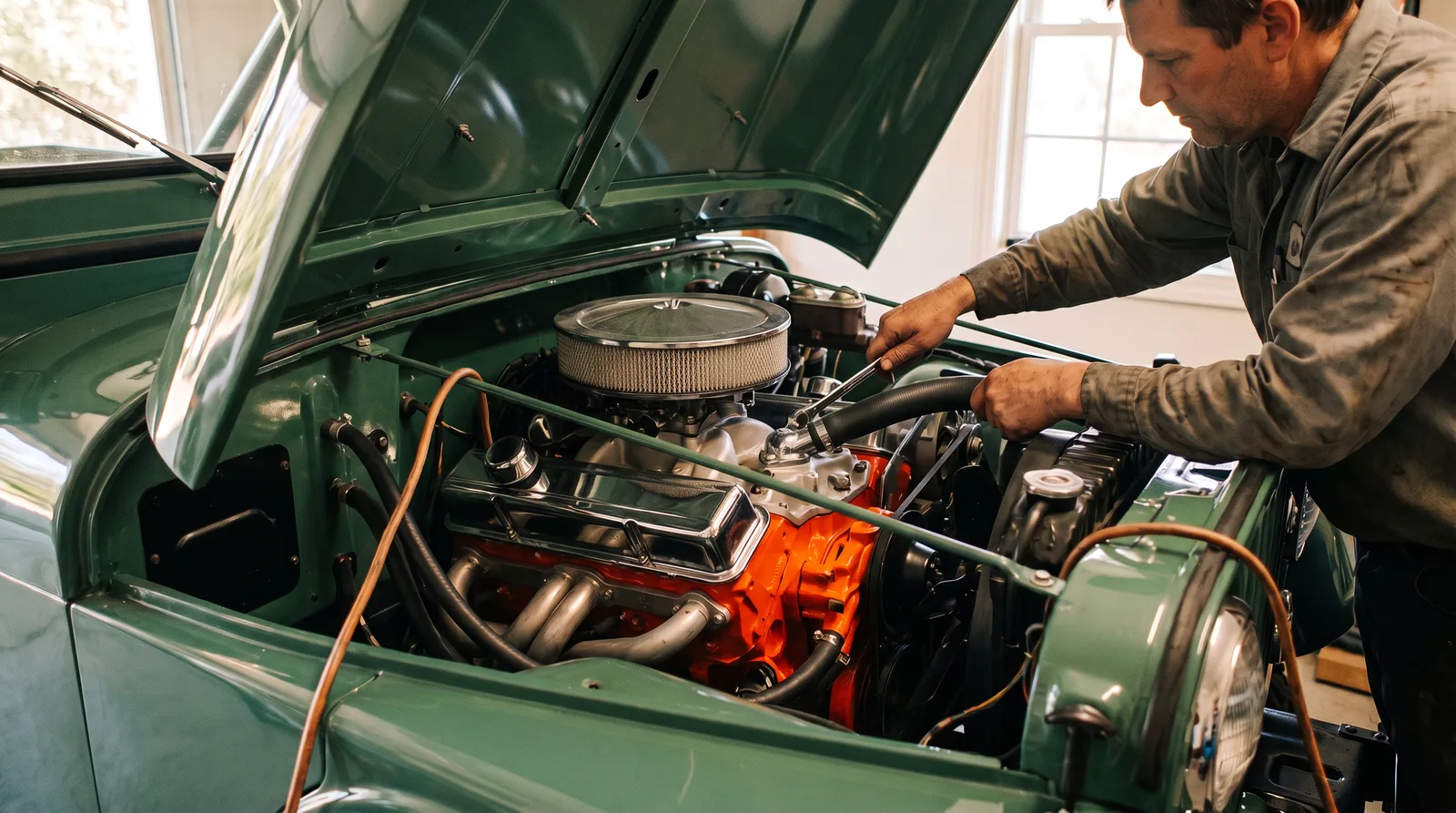
The earliest CJ swaps were not about performance bragging rights. They were about keeping a working truck working. A farmer or rancher running a CJ-2A or CJ-3A into the 1960s and 1970s, long after Willys and Kaiser had moved on to other models, often faced a simple problem: the original Go Devil or Hurricane four-cylinder engine wore out, and finding a factory-correct replacement got harder every year. Dropping in whatever six-cylinder or V8 was available and affordable locally kept the truck earning its keep, and nobody at the time thought twice about originality. These were work vehicles, not collectibles, and treating them as replaceable, serviceable machines was simply practical.
This utilitarian root is important context for the culture that grew from it. Swap culture in CJs did not start as a rebellion against factory specifications. It started as ordinary maintenance philosophy on a truck built to be fixed with whatever was on hand.
Performance took over by the 1970s
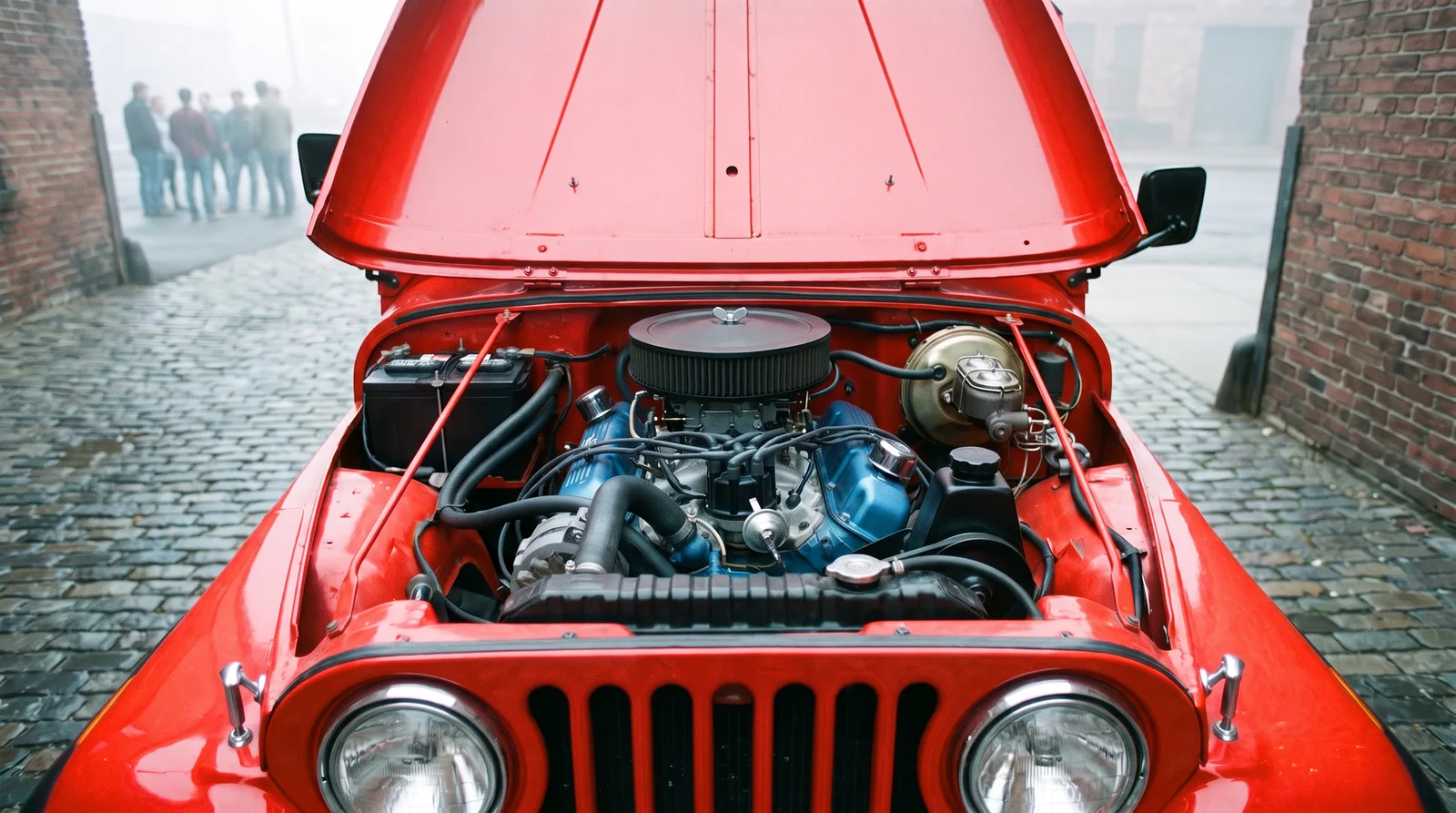
As the CJ platform aged and Jeep's own factory options stayed relatively conservative, particularly on the engine side, a second wave of swaps emerged driven purely by performance appetite. Desert racers, rock crawlers, and weekend trail drivers wanted more torque than the stock four-cylinder or even the AMC six could deliver, and small-block V8s from Chevrolet, Ford, and the Buick/Oldsmobile/Pontiac family became common transplants. This is where the swap culture picked up its performance identity, separate from the earlier necessity-driven replacements, and it is the era most people picture when they hear "CJ engine swap" today.
The AMC 258 straight six also became a popular swap target in its own right, since owners of earlier four-cylinder CJs wanted more torque without the fuel consumption or weight penalty of a full V8 conversion. This middle path, more power without going all the way to eight cylinders, remains a common choice for owners who want meaningfully improved drivability without committing to the bigger engineering project a V8 swap represents.
| Swap type | Typical motivation | Common donor engines |
|---|---|---|
| Necessity replacement | Original engine worn out, parts scarce | Whatever was locally available |
| Six-cylinder upgrade | More torque, moderate complexity | AMC 232, AMC 258 |
| V8 performance swap | Maximum power, trail and desert use | Chevrolet 350, Ford 302, Buick/Olds/Pontiac 350 |
What swap culture means for the collector market
This is where the story gets complicated for buyers. Decades of routine swapping mean that a genuinely numbers-matching, factory-original CJ engine is now the exception rather than the rule for many production years, particularly the earliest ones where necessity-driven replacements were most common. That scarcity has, somewhat counterintuitively, made original-engine trucks more valuable to strict collectors even as it made swapped trucks more common and more culturally accepted across the broader ownership base.
Two philosophies coexist in the market without much friction most of the time. Collectors chasing documented originality pay a real premium for a CJ that can prove its engine has never been touched. Everyone else, arguably the majority of active CJ owners, treats the engine bay as a legitimate space for personal choice, the same way earlier generations treated it as a space for practical necessity.
For the full picture of what engines actually left the factory before any of this swapping began, where this started covers every original powerplant Jeep offered across the CJ's 1945 to 1986 run.
"Ask ten CJ owners what should be under the hood and you'll get ten different answers, and every single one of them will be right for that particular truck and that particular owner. That is the whole culture in one sentence."
- Dan Reeves
Reading a swapped truck honestly
Not every swap is created equal, and the difference between a respected build and a liability comes down almost entirely to execution and documentation. A swap done by a competent shop or a careful individual, with matched transmission and transfer case, correct wiring, and some record of the work, holds real value and can be a genuinely better truck to own than a tired original engine limping toward failure. A rushed swap with mismatched components, no documentation, and questionable wiring is a different animal entirely, one that can cost a new owner significant money to sort out properly.
Buyers evaluating a swapped CJ should ask pointed questions: who did the work, when, what parts were used, and is there any paperwork. Sellers who cannot answer these questions with confidence are usually selling a truck with more unknowns than the price reflects, regardless of how good the engine sounds at idle in the driveway.
Whether you are hunting for a numbers-matching original or a thoughtfully swapped build, the market has both in real numbers right now. You can shop classic CJ listings to compare how sellers describe engine originality and swap history across available trucks, which is often the fastest way to understand how wide this culture's footprint actually is.
The regional flavor of swap culture
Swap preferences were never uniform across the country, and that regional variation is part of what makes the culture interesting to study rather than just a single monolithic trend. In the Southwest, where desert racing and rock crawling built demand for maximum torque and ground clearance, Chevrolet small-block V8 swaps became something close to a regional default, driven partly by parts availability from the huge number of Chevy trucks and cars already on the road there. In the Midwest and rural Northeast, where CJs skewed more toward farm and utility duty even into later decades, the AMC six-cylinder swap into earlier four-cylinder trucks was more common, reflecting a preference for practical torque over maximum power.
These regional patterns still show up in the used market today. A CJ with a long ownership history in the Southwest is statistically more likely to carry a V8 swap somewhere in its past than one that spent its life on a Midwestern farm, and buyers who understand this geography can sometimes predict what they will find under the hood before they even see a listing's full description.
What the swap tells you about the owner
Beyond the mechanical facts, a swap's execution says something about the person who did it, and experienced buyers learn to read that signal. A meticulous swap, correct wiring, properly matched components, careful attention to details like engine mounts and cooling capacity, usually indicates an owner who cared about the truck as a whole, not just the engine bay, and that carefulness often extends to other aspects of the vehicle's maintenance history. A sloppy, mismatched swap often correlates with sloppy maintenance elsewhere, a pattern experienced CJ shoppers watch for during inspection.
This is not a hard rule, and plenty of excellent overall trucks carry a rough early swap from a previous owner that a current owner has since cleaned up. But as a general signal during a walkaround inspection, the quality of engine bay work tends to correlate with the quality of everything else a buyer cannot easily see.
Sources and notes
Related Reading
Have a
Jeep CJ
for Sale?
Reach thousands of serious classic car collectors across the US.
Sell It Here →
Selling a classic? Here's how: sell my classic car
Are You a Classic Car Dealer?
List your full inventory and connect with targeted classic car buyers.
Join as a Dealer →

About the author
Dan Reeves
Performance engine builder from North Carolina's motorsports corridor, focused on swaps, forced induction and making real, repeatable power.
Related Listings - Jeep CJ





Comments
Be the first to comment on this article.