
Every CJ forum thread on this topic eventually turns into an argument, and that argument is the point. The question of the jeep cj engine most desirable choice has no single correct answer, because "desirable" depends entirely on what an owner plans to do with the truck, and four decades of CJ production offer genuinely different engines built for genuinely different priorities.
Car Features
7 min read
Which CJ Engine to Want: The Enthusiast's Reckoning
The jeep cj engine most desirable debate splits into three camps: the durable AMC six, the historic Go Devil four, and the rare factory V8.
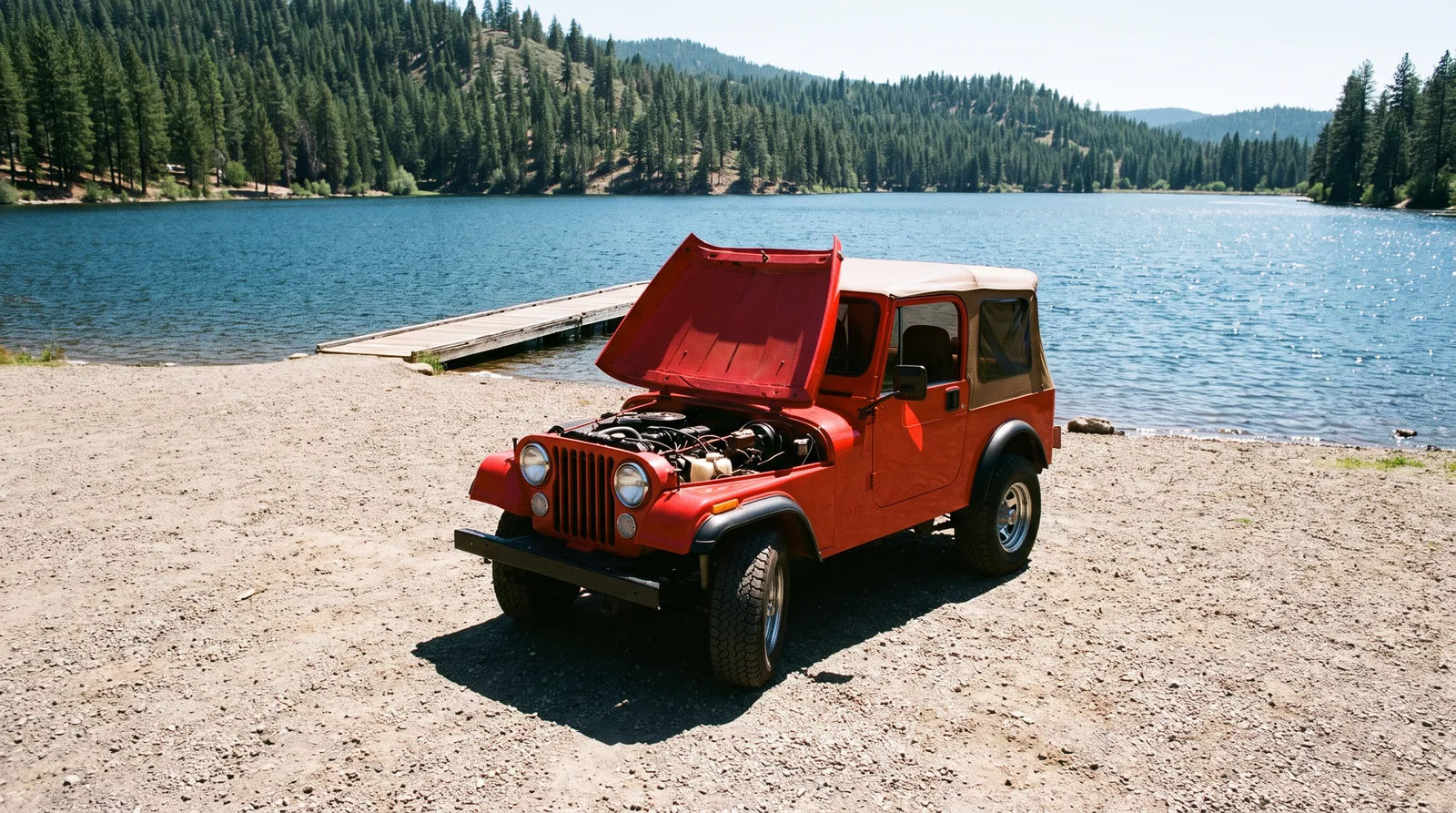
The case for the AMC 258 six
Ask a working-truck owner and the AMC 258 straight six usually wins by a comfortable margin. Introduced in the CJ lineup in the early 1970s and produced in various forms through the end of CJ production in 1986, the 258 offers a torque curve that suits low-speed trail work and towing far better than the earlier four-cylinder engines ever could, while remaining simpler and more fuel-efficient than the V8 alternative. It is also, by a wide consensus among mechanics who have kept CJs running for decades, one of the most durable engines AMC ever built, with a well-earned reputation for surviving neglect that would kill lesser designs.
Parts availability strengthens the 258's case considerably. Because AMC used this engine family across a wide range of vehicles beyond the CJ, including full-size Jeeps and other AMC passenger cars, rebuild parts and knowledgeable mechanics remain easier to find than for some of the more CJ-specific engine options from earlier decades.
The case for the Go Devil four
Purists make a different argument entirely, one rooted in history rather than practicality. The Go Devil four-cylinder that powered the original CJ-2A starting in 1945 is not the most powerful or the most comfortable option, but it is the engine that defines what a CJ originally was, a direct descendant of the wartime Willys MB powerplant. For collectors chasing historical authenticity above all else, particularly on early CJ-2A and CJ-3A examples, no other engine choice makes sense, regardless of what modern convenience arguments might suggest.
This is a genuinely different value system than the working-truck argument for the 258, and it rarely persuades the same buyer. Someone shopping for a numbers-matching CJ-2A for concours-adjacent presentation is not the same buyer weighing daily-driver practicality, and both are legitimate ways to approach CJ ownership.
| Engine | Strongest case | Main drawback |
|---|---|---|
| Go Devil four-cylinder | Historical authenticity, earliest CJs | Limited power, dated design |
| AMC 232/258 six | Torque, durability, parts availability | Emissions-era power dip in some years |
| AMC 304 V8 | Best factory power option | Rare, thirstier, harder to find factory-correct |
The case for the AMC 304 V8
Then there is the small but vocal camp that wants the factory 304 V8, available in the CJ-5 from 1972 through 1981 and in the CJ-7 from its 1976 debut through the same 1981 cutoff. This engine occupies an interesting middle ground in the desirability debate. It is the only factory-sanctioned path to V8 power in a classic CJ, which gives it a legitimacy that aftermarket V8 swaps cannot claim for originality purposes, but it was never common on order sheets against total CJ-5 and CJ-7 production that ran into the hundreds of thousands of units, and finding a genuine, unmolested 304-equipped CJ today takes real searching. Exact factory breakdowns of how many CJs left the line with the 304 specifically are not published anywhere reliable, which is itself part of why serious buyers lean on documentation rather than assumptions. For a deeper look at how this V8 fits into swap culture and collector demand more broadly, more on the jeep cj engines traces the platform's complete engine history in detail.
What actually drives value
Setting personal preference aside, market data tells a fairly consistent story. Original-engine trucks, regardless of which specific engine, generally command a premium over swapped examples when documentation supports the claim. Within that originality-first framework, rarity does more work than raw capability. A documented factory 304 V8 CJ, being genuinely uncommon, tends to draw stronger interest than an equivalent-condition six-cylinder truck simply because there are fewer of them to choose from, even though the six-cylinder is arguably the more practical everyday engine.
Meanwhile, condition and mechanical health matter more than engine choice in absolute terms. A well-maintained four-cylinder CJ-2A in excellent condition will outsell a neglected V8 CJ every time, because buyers in this category are ultimately purchasing a piece of history first and an engine second.
"I get asked which engine is best more than any other CJ question, and my honest answer disappoints people every time: best for what. A trail rig wants the six. A time capsule wants the four. Nobody's wrong, they're just answering different questions."
- Emily Chen
Matching engine to purpose
The practical takeaway for anyone shopping is to define the goal before worrying about engine preference. A daily driver or active trail truck benefits enormously from the 258's torque and parts availability. A show truck or historical restoration project benefits from originality, whatever the original engine happened to be for that specific year and trim. A truck bought primarily as an investment benefits from documented rarity, which points toward the 304 V8 or an unusually well-preserved early four-cylinder example.
None of these goals are mutually exclusive in every case, but they do pull in different directions often enough that clarity upfront saves considerable frustration during the search. For a deeper dive into how the platform's full engine lineup connects to the CJ's broader story, our complete history covers the model's entire 1945 to 1986 run.
Once you know which engine philosophy fits your goals, browsing helps clarify the tradeoffs in real terms. You can look through classic CJs on the market to compare how pricing and demand actually shift across four-cylinder, six-cylinder, and V8 examples currently available.
The Hurricane four as a middle option
Between the original Go Devil and the later AMC sixes sits an engine that rarely gets its due in these desirability debates: the Hurricane F-head four, introduced in the CJ-3B and carried into early CJ-5 production. The Hurricane's F-head design, with intake valves in the head and exhaust valves still in the block, gave it a meaningful power advantage over the Go Devil's flathead layout while staying within the same basic four-cylinder simplicity that early CJ owners valued. For buyers who want the historical character of a four-cylinder CJ but find the original Go Devil genuinely underpowered even by vintage standards, a Hurricane-equipped CJ-3B or early CJ-5 is worth serious consideration.
The tradeoff is that Hurricane-equipped trucks occupy a smaller niche in the collector conversation than either the earliest Go Devil trucks or the later six-cylinder models, which means fewer examples come up for sale at any given time and fewer specialists focus specifically on this engine. That relative obscurity can work in a patient buyer's favor, since demand-driven price premiums have not attached to Hurricane-equipped CJs the way they have to some other specific engine and model combinations.
Weighing rarity against usability one more time
It is worth stating plainly that desirability rankings shift depending on who is answering and why. A restoration specialist prioritizes originality regardless of driving character. A weekend trail driver prioritizes reliability and torque above almost everything else. An investor prioritizes documented rarity and provenance over both. None of these perspectives is more correct than the others, and a serious buyer benefits from being honest with themselves about which category they actually fall into before letting online debates about engine superiority steer a purchase decision that should really be driven by personal use case.
Sources and notes
Related Reading

Have a
Jeep CJ
for Sale?
Reach thousands of serious classic car collectors across the US.
Sell It Here →
Selling a classic? Here's how: sell my classic car
Are You a Classic Car Dealer?
List your full inventory and connect with targeted classic car buyers.
Join as a Dealer →

About the author
Emily Chen
Bay Area engineer with a deep focus on vintage Japanese and European performance cars. Approaches classic car research and restoration with an analytical eye.
Related Listings - Jeep CJ





Comments
Be the first to comment on this article.