
In 1997, Tommy Kendall started a Trans-Am season in a Roush-prepared Ford Mustang and kept winning. He won the first round, then the second, and kept going until he had won eleven in a row, a record for the series. The streak finally ended at round twelve of thirteen. That streak is the best-known moment in the life of the SN95 Mustang race car, and it says something about the car the 1994 redesign produced: Ford had built a new Mustang for the street, and within a few seasons its name and shape were winning on road courses, drag strips and in production-based racing all over the country.
Car Features
7 min read
The SN95 at the Track: Trans-Am, Le Mans and the Drag Strip
Tommy Kendall's 11 straight Trans-Am wins, Saleen's Le Mans SR, two Cobra Rs and John Force's Funny Cars: the SN95 Mustang at the track.
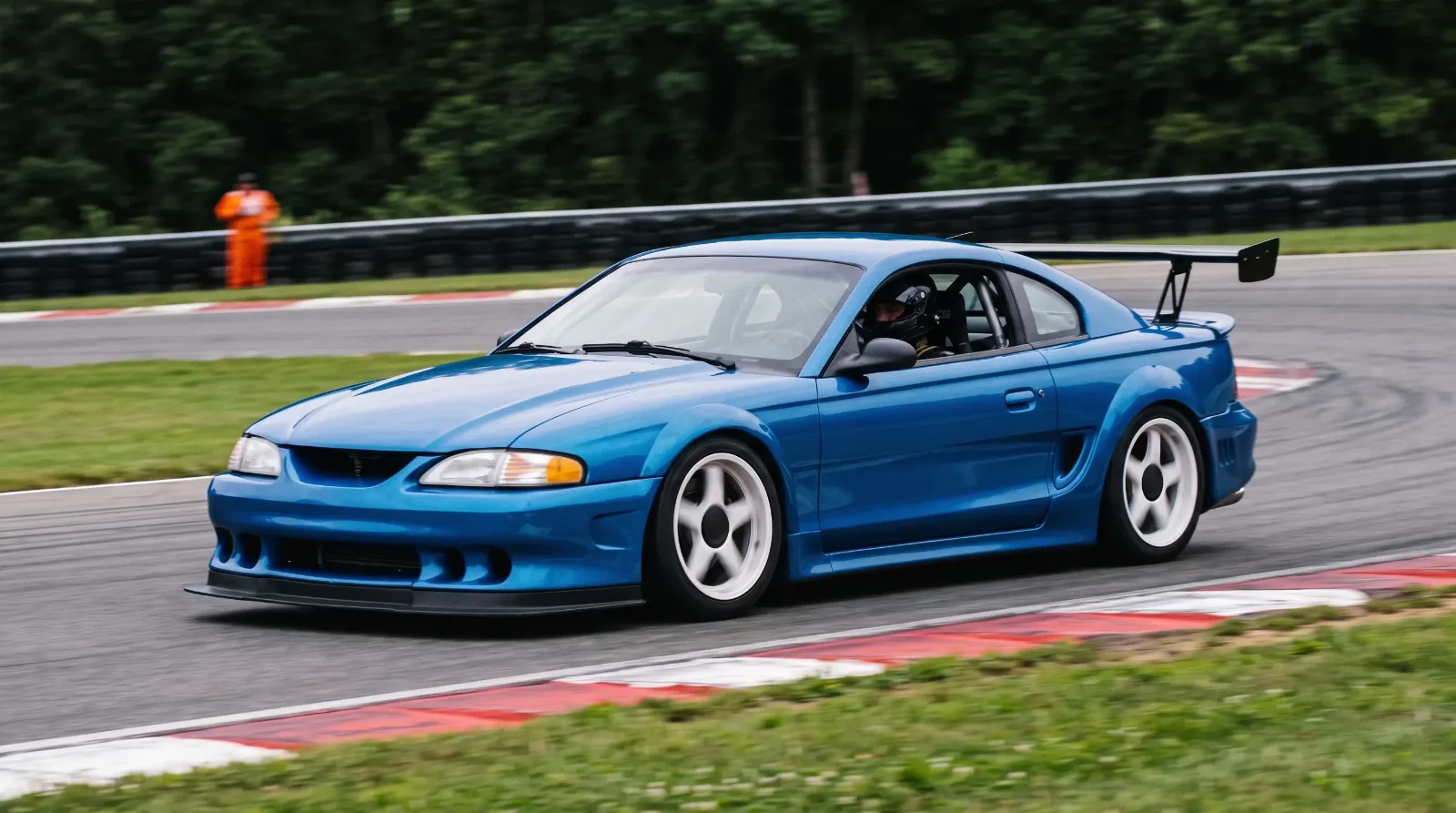
The road-car side of the SN95, from Team Mustang to the New Edge, is told in the details. This is the track side.
Trans-Am: Tommy Kendall's eleven straight
The Trans-Am story starts before the SN95. In 1989 a Roush Mustang driven by Dorsey Schroeder won Ford's first Trans-Am title since 1970, the year of the Boss 302. Jack Roush, who had bought his first Mustang in 1964 while working at Ford, had fielded Ford teams in GTX, GTP, IMSA and Trans-Am, and his company also worked closely with Team Mustang on development of the street cars from 1990 on. The racing and the production car were tied together from the start.
Kendall gave that relationship its peak. He had won the Trans-Am title in 1990, and then won it again in 1995, 1996 and 1997, the last of those his third in a row. The 1997 season was the one people still talk about: eleven straight wins from round one, and a Ford sweep of the series.
A note on what those cars were. A Trans-Am Mustang of the period wore the shape and the name of the street car, but underneath it was a racing machine. The rules called for a purpose-built tube-frame chassis, and the body panels were carbon fiber, Kevlar and fiberglass. Roush built Kendall's 1997 car around a 310 cubic inch pushrod V8, estimated at about 650 hp at 8,200 rpm, with a Hewland five-speed and a Ford 9-inch rear end. The value of that shape on television, winning week after week, was the point for Ford.
Saleen, Tim Allen and the SN95 Mustang race car at Le Mans
The most colorful SN95 racing program came from California. In 1995 Steve Saleen, comedian Tim Allen and Bob Bondurant formed the Saleen/Allen RRR Speedlab to race Saleen Mustangs in the SCCA World Challenge. Saleen was not new to this; he had raced a Mustang in SCCA Trans-Am from 1982, and his company had won SCCA championships in the Fox era.
The SN95-based cars did the same. Saleen's Widebody SR won the 1996 SCCA Manufacturers' Championship, and in 1998 Saleen took both the SCCA Manufacturers' and Drivers' titles. In between came the most ambitious outing of all. In 1997 the Speedlab entered a Saleen Mustang SR in the GT2 class at the 24 Hours of Le Mans, driven by Price Cobb, Carlos Palau and Steve Saleen himself. It completed 133 laps and did not finish. Palau got his reward two years later, when he won the GT2 class of the 1999 Spanish GT Championship in a Saleen Mustang.
A DNF at Le Mans is not a result anyone frames, but think about what it meant: a Mustang built on the 1994 platform, entered by a California tuner and a comedian, on the grid at the most famous endurance race in the world. That is the kind of story that kept the SN95 in front of enthusiasts who might otherwise have written it off as a commuter car.
Cobra R: the race car Ford sold with a license check
Ford's own contribution to SN95 racing was a pair of limited-production Cobra Rs built with racing in mind. The 1995 SVT Mustang Cobra R was the first. Buyers needed a valid NHRA or SCCA competition license (one account also accepts ownership of a race team) before they could buy one. Ford built 250, all Crystal White with a saddle interior, priced at $37,599, the most expensive Mustang to that point.
The 1995 car used an SVT-modified 5.8 liter (351) Windsor V8 rated at 300 hp at 4,800 rpm and 365 lb-ft at 3,750 rpm, under a raised fiberglass hood to clear it. A Tremec TR-3550 five-speed and a 3.27 limited-slip axle sat behind it. Ford took out the rear seat, radio, air conditioning, power windows, locks and mirrors, most of the sound insulation and the fog lamps, and added a racing fuel cell of about 20 gallons. A widely quoted test (attributed to Motor Trend, issue not identified) gave 0 to 60 mph in 5.2 seconds and the quarter mile in 13.8 seconds at 102 mph.
The second came at the very end of the generation. For 2000 there was no regular SVT Cobra at all, only 300 Cobra Rs. These were a different animal: a 5.4 liter DOHC 32-valve V8 rated at 385 hp and 385 lb-ft, a Tremec T-56 six-speed (the first six-speed Mustang), 3.55 gears, Brembo front brakes with four-piston calipers, Bilstein dampers, Eibach springs and Borla side exhausts. Every one was painted Performance Red.
| Spec | 1995 Cobra R | 2000 Cobra R |
|---|---|---|
| Engine | 5.8 L (351) Windsor V8 | 5.4 L DOHC 32-valve V8 |
| Rated output | 300 hp, 365 lb-ft | 385 hp, 385 lb-ft |
| Transmission | Tremec TR-3550 five-speed | Tremec T-56 six-speed |
| Axle ratio | 3.27:1 limited-slip | 3.55:1 |
| Built | 250 | 300 |
| Color | Crystal White | Performance Red |
Put those 550 cars against the SN95 production numbers and you can see how small the program was. In 2000 alone Ford built 215,239 Mustangs, and 300 of them were Cobra Rs. The cars mattered far more to racers and to the Mustang's image than to the sales chart.
The drag strip: Funny Cars and grassroots racers
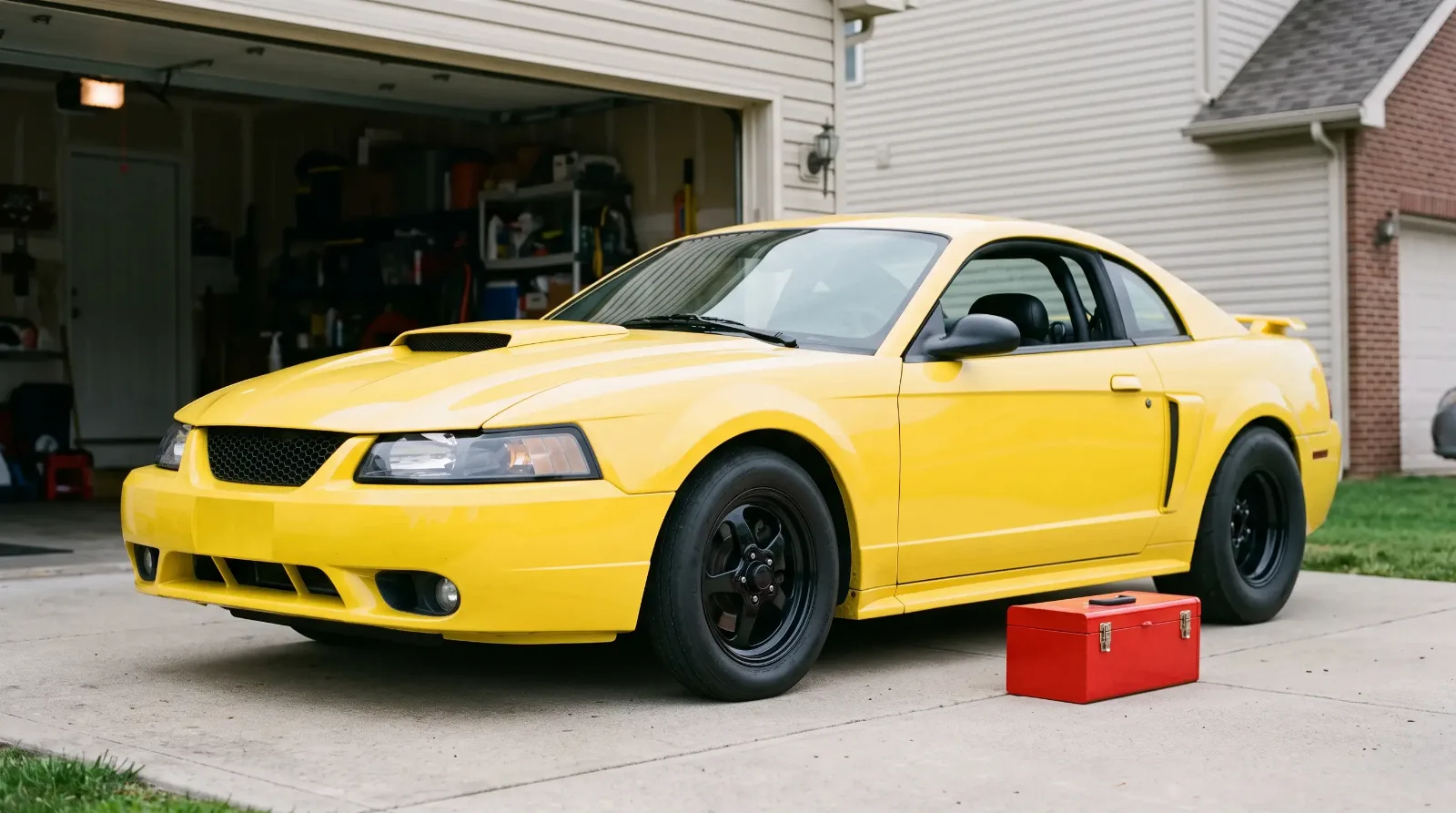
At the top of drag racing, the Mustang name belonged to John Force. He became a Ford driver in 1997, the year he started racing Castrol GTX Mustang Funny Cars, and ten of his NHRA Funny Car titles came in the Ford years, from 1997 to 2013. Like the Trans-Am cars, those Funny Cars shared the Mustang's look rather than its chassis, but every win put the shape of the current Mustang in front of a grandstand.
"The SN95 arrived with people asking whether the Mustang still meant anything. A few years later it had eleven straight Trans-Am wins, a Le Mans entry and a Funny Car champion behind the wheel. Racing answered the question faster than any brochure could."
Patrick Walsh
Further down the ladder, the street cars themselves went racing. The New Edge body of 1999 on became one of the most popular bodies in grassroots drag racing. The 1999 update helped here, with a rear track 1.4 inches wider than before. If you want to know what changed with that restyle, it is worth reading next.
What the track record adds up to
Taken together, the SN95's racing life has three layers. At the top, purpose-built Trans-Am cars and Funny Cars carried the Mustang name to titles. In the middle, Saleen's SR and Ford's two Cobra Rs were genuine production-based race cars, small in number and serious in intent. At the bottom, the ordinary GT became a grassroots drag car, especially in New Edge form. None of it changed how most SN95s were used, but it changed how the car was seen, and the Mustang that followed in 2005 inherited a reputation the SN95 had earned at the track.
Sources and notes
Related Reading
Have a
Ford Mustang
for Sale?
Reach thousands of serious classic car collectors across the US.
Sell It Here →
Selling a classic? Here's how: sell my classic car
Are You a Classic Car Dealer?
List your full inventory and connect with targeted classic car buyers.
Join as a Dealer →

About the author
Patrick Walsh
Automotive journalist covering classic car shows, events, and the enthusiast community across North America.
Related Listings - Ford Mustang



Comments
Be the first to comment on this article.