
A soldier in North Africa once wrote home that the little Jeep parked outside his tent had done more work than his mule ever had, and cost the Army about the same to feed. That's the kind of line that shows up in wartime letters again and again, half joke and half genuine gratitude, because the men who drove the Willys MB rarely called it by its factory name. They called it "the Jeep," and by the time the war ended the word belonged to the whole world, not just the Army quartermaster corps.
Car Features
7 min read
The Willys MB: The War Jeep That Started Everything
Built in 49 days and hundreds of thousands of units, the Willys MB carried soldiers across five continents and left a name, and a body style, that every classic CJ still wears.
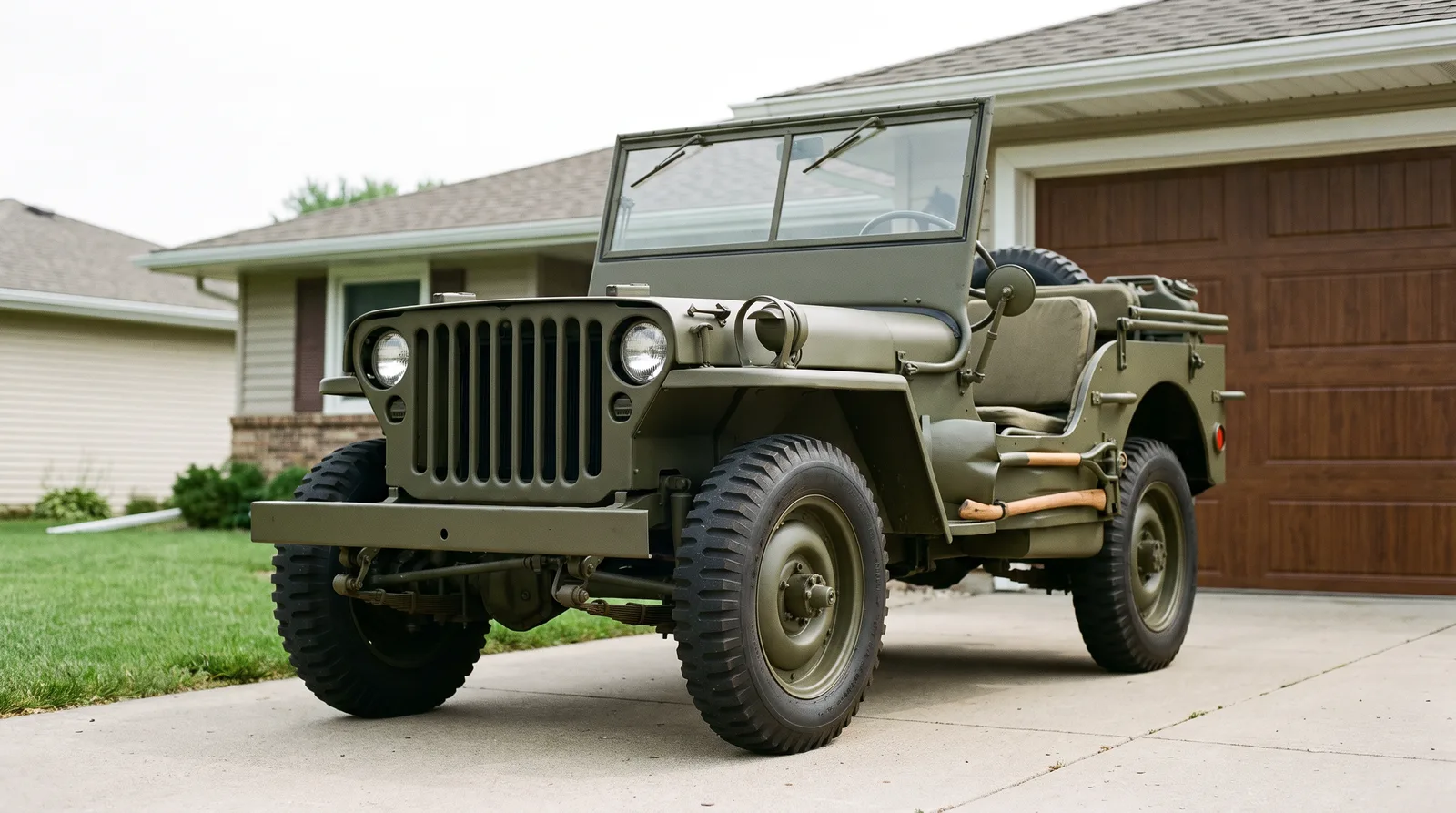
The jeep cj willys mb wartime story starts not with a single hero but with a scramble. In 1940, with war already burning in Europe, the U.S. Army put out a call for a light reconnaissance vehicle and gave manufacturers an absurd 49 days to deliver a working prototype. Three companies answered: American Bantam, Willys-Overland, and Ford. Bantam built the first one. Willys built the one that won.
A prototype born out of desperation
Bantam's little company in Butler, Pennsylvania, actually delivered first, but it lacked the manufacturing muscle to build vehicles at wartime scale. The Army quietly shared Bantam's blueprints with Willys and Ford, a decision that still stings old Bantam loyalists at swap meets. Willys engineer Delmar "Barney" Roos took the design and dropped in his own "Go-Devil" four cylinder engine, a torquey little unit that outmuscled the competing entries in Army trials at Camp Holabird.
Willys won the contract in 1941 for what became the Model MB, and Ford was brought in as a second production source under license, building its own version called the GPW. The two trucks were nearly identical, built to the same specifications so that parts would interchange in the field, a detail that mattered more than almost anything else once these vehicles were scattered across five continents.
Passing the trials that decided everything
The Army's testing at Camp Holabird was brutal by design. Prototypes had to climb steep grades, ford water, and carry a rated payload well beyond what their light frames suggested they could handle. Bantam's entry impressed testers with its handling but couldn't match the Willys engine's pulling power. Ford's GP prototype, built with input from both other designs, ran reliably but lacked the same low-end torque. Willys's entry, carrying Roos's reworked four cylinder, simply out-hauled the other two in every load test that mattered to the quartermasters signing the contract. Winning on raw pulling power rather than polish became a pattern that would define the whole Jeep lineage for the next four decades.
The number that still gets debated
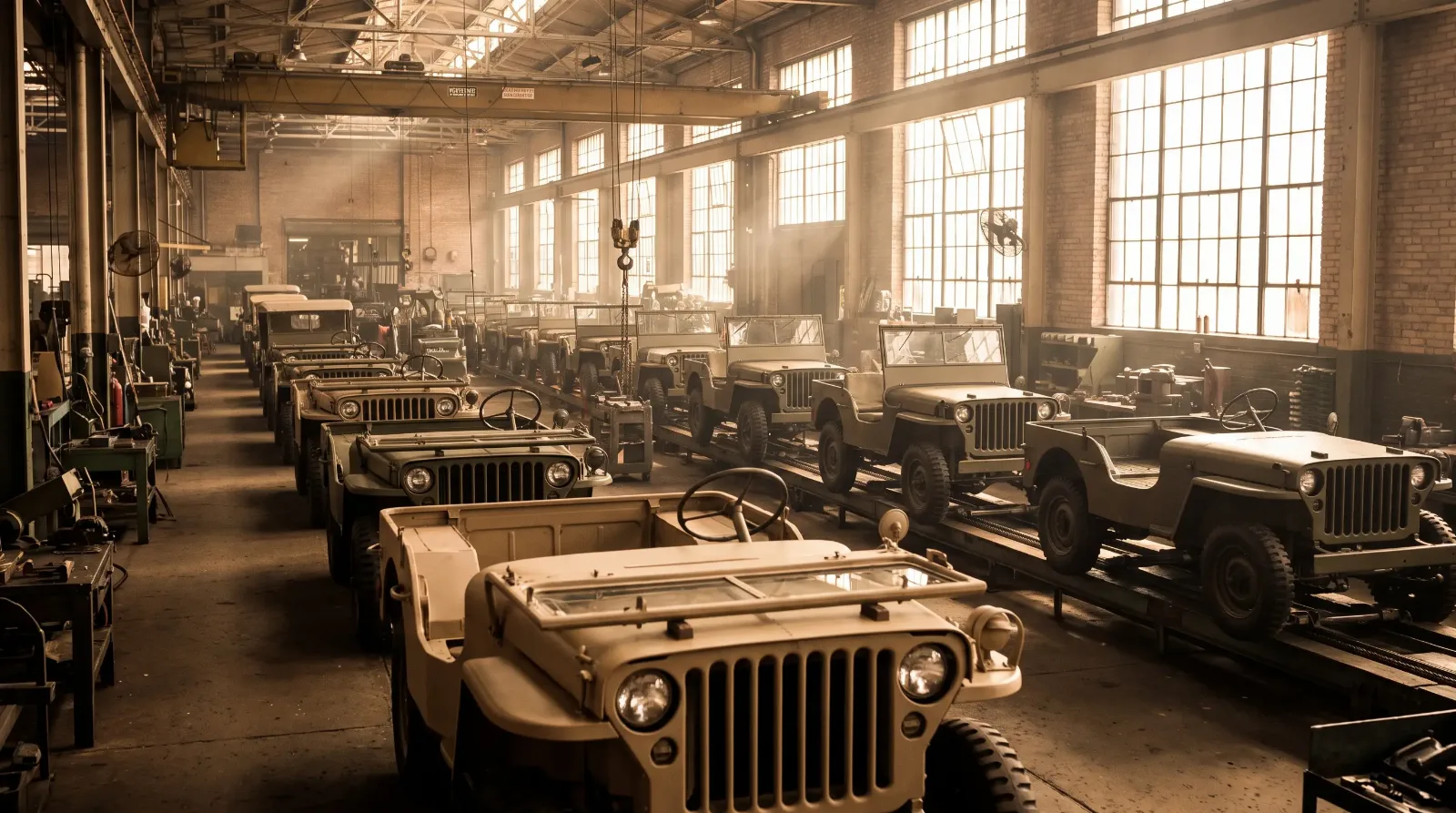
Between 1941 and 1945, Willys-Overland built roughly 359,000 MBs, with Ford adding another 278,000 GPWs on top of that. Total wartime jeep production across both companies is often cited near 650,000 units, though the exact figure depends on which contracts and variants get counted. What's not in dispute is the scale. No light military vehicle before it had ever been built in those numbers, and few since have matched it.
Every one of them shared the same basic recipe: a flat-fendered body stamped from steel, a folding windshield, a 60 horsepower four cylinder engine, and four wheel drive that could claw through mud that stopped bigger trucks cold. It weighed a bit over a ton empty and could still tow a small artillery piece.
Interchangeability was not a minor footnote either. Army logistics officers had learned hard lessons from earlier conflicts about vehicles that could not be repaired with parts scavenged from a sister unit halfway around the world. Forcing Ford's GPW and Willys's MB to share dimensions and mounting points down to the inch meant a mechanic in the Pacific could cannibalize a broken Ford jeep to fix a Willys one, and vice versa, without waiting weeks for a specific factory part. That single decision, more bureaucratic than glamorous, kept far more jeeps running in the field than either company's individual output numbers suggest.
What the men actually did with it
Soldiers turned the MB into an ambulance, a machine gun platform, a radio truck, and occasionally a snowplow, all without changing the basic chassis. Photographs from the era show it fording rivers, hauling wounded men on stretchers lashed across the hood, and idling outside command tents from the beaches of Normandy to the jungles of the Pacific. It went wherever the infantry went, which was the entire point of the design in the first place.
That versatility is really the heart of the willys jeep history, and it's why the vehicle survived the war at all instead of getting scrapped like so much other surplus hardware. The MB had proven itself too useful to abandon, and Willys knew it.
"You can read the specifications all day and still miss the point. The MB mattered because it never asked for good roads, and half the world it fought across didn't have any."
- Nora Beckett
War correspondents wrote about the MB almost as often as they wrote about the men driving it. Ernie Pyle, covering the infantry across North Africa and Europe, mentioned Jeeps repeatedly in his dispatches, treating the little truck less like equipment and more like a member of the unit. That kind of coverage, filtered back to newspapers across the United States, meant civilians on the home front already knew the Jeep's reputation years before they could buy one. Willys did not have to build brand awareness after the war. The infantry, and the reporters embedded with them, had already done it for free.
From the front lines to the farm
When the fighting ended, thousands of surplus MBs came home with returning soldiers, and thousands more stayed behind, sold off or simply left where they sat. Willys-Overland, watching farmers and ranchers press war-surplus Jeeps into civilian service, saw an opening that would define the company for the next decade. That transition from foxhole to farmyard is a related story in its own right, one that turned a wartime necessity into a civilian icon almost by accident.
Not every surplus MB found a peaceful second act. Some ended up rusting in fields, cannibalized for parts by farmers who only needed a working engine or a set of axles rather than a whole intact truck. Others were sold at government surplus auctions for a fraction of their wartime cost, snapped up by veterans who had spent years learning to fix them under far worse conditions than a barn or a driveway. Restoration hobbyists today still occasionally pull a genuine MB chassis out of a field, decades after it was abandoned there, a reminder of just how many of these trucks Willys and Ford built and how little care many of them received once the fighting stopped.
The MB itself never wore a civilian badge. It did its job in olive drab and went quiet once the CJ-2A took over showroom floors in 1945. But every classic CJ on the road today, from the earliest 2A to the last CJ-8 Scrambler, traces its DNA straight back to that 49 day scramble and the little truck that came out of it. If that lineage has caught you, the current crop of CJs for sale now is as close as you'll get to owning a piece of it.
Sources and notes
Related Reading
Have a
Jeep CJ
for Sale?
Reach thousands of serious classic car collectors across the US.
Sell It Here →
Selling a classic? Here's how: where to sell your classic car online
Are You a Classic Car Dealer?
List your full inventory and connect with targeted classic car buyers.
Join as a Dealer →

About the author
Nora Beckett
Automotive features writer and photographer who tells the human stories behind the cars, from show fields to cross-country road trips.
Related Listings - Jeep CJ

Comments
Be the first to comment on this article.