
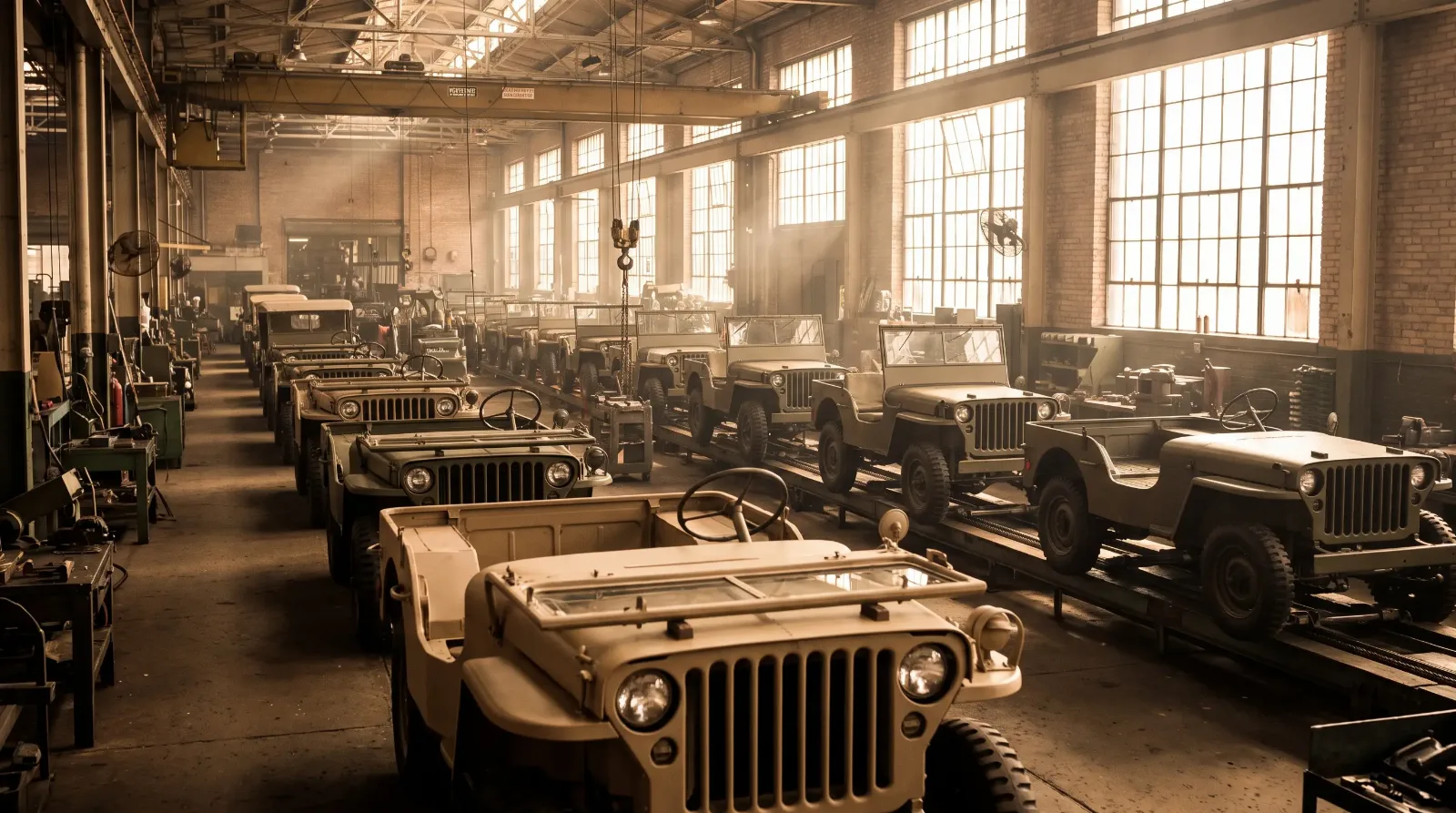
Willys-Overland faced an unusual problem in the summer of 1945. It had spent four years building nothing but the Willys MB for the United States military, and it was very good at that one job. Peace meant the government contracts would end, and a company that size could not simply stop manufacturing and wait for the next war. The story of jeep cj willys to civilian conversion is really the story of an arms manufacturer teaching itself, in real time, how to sell a farm implement.
Car Features
7 min read
Beating Swords Into Fenders: Turning the Army Jeep Civilian
When the war ended, Willys-Overland reworked its military MB into the CJ-2A, a farm-ready civilian Jeep that had to earn its keep, and its trademark, all over again.
A company betting on a name it didn't own
There was a legal complication before there was a marketing plan. Willys-Overland had not invented the Jeep in isolation. It won a wartime design competition and built the vehicle under contract, but the "Jeep" name itself had murky origins, possibly from military slang, possibly from a Popeye cartoon character named Eugene the Jeep. Willys spent years and considerable legal expense securing the trademark for civilian use, finally registering "Jeep" in 1950. Before that registration was locked down, the company was already selling the civilian model and betting the whole venture on a name it did not fully control yet.
The uncertainty ran deeper than most people realize. Willys had not been the only company building jeep-type vehicles during the war. American Bantam had designed the original prototype the Army used to launch the whole program, and Ford had produced its own version, the GPW, in numbers comparable to Willys's own MB output. Any of these companies, or none of them, might reasonably have claimed rights to sell a civilian version under the popular wartime name. Willys moved first and moved fastest, filing its trademark application and beginning civilian sales before its competitors had settled on a postwar strategy at all. Speed, more than any legal certainty, is what actually secured the Jeep name for Willys-Overland.
The CJ-2A steps out of uniform
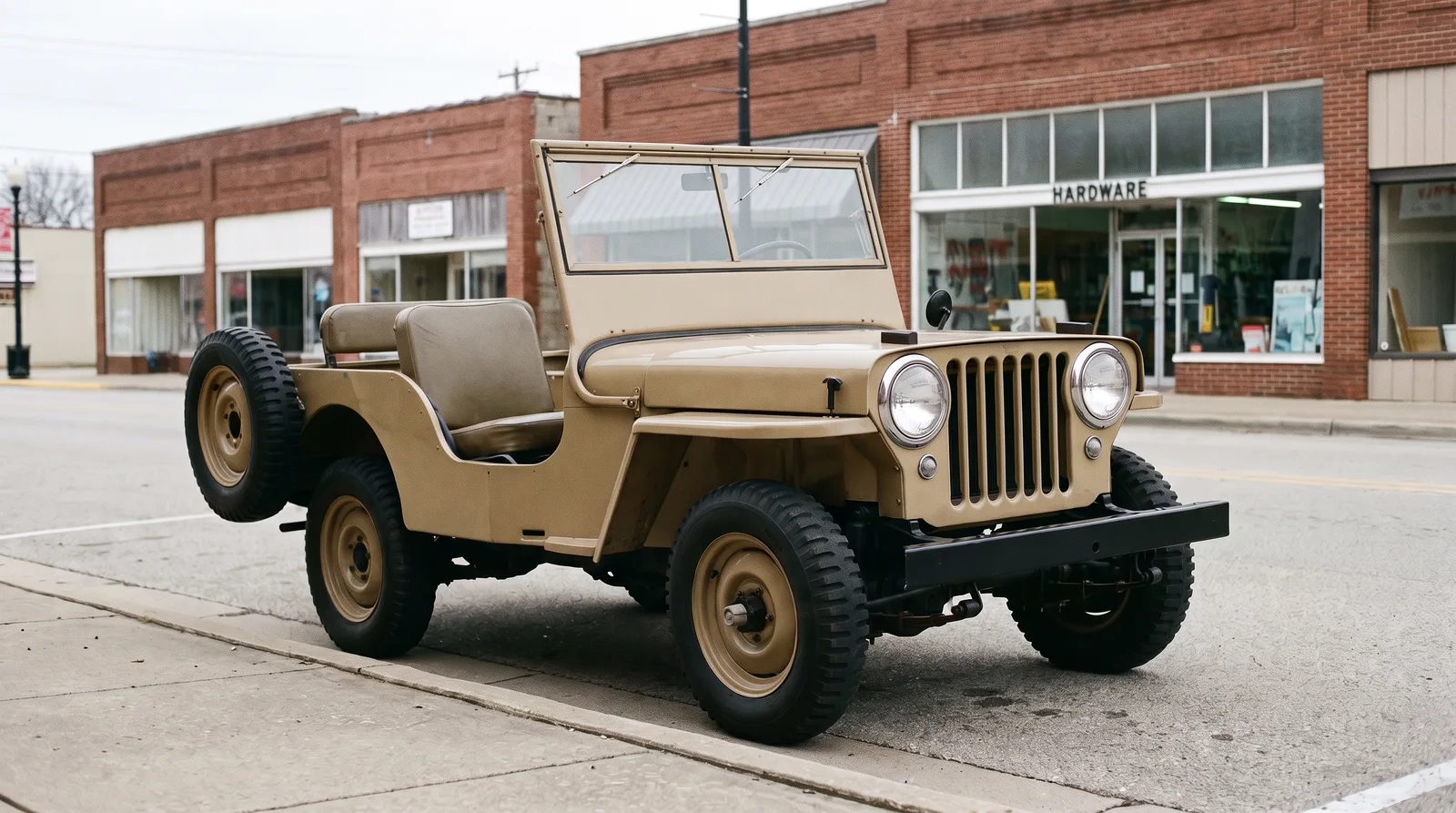
The first civilian Jeep, the CJ-2A, went on sale in July 1945, weeks before Japan's surrender ended the war outright. Willys engineers took the wartime MB and reworked it for peacetime labor rather than combat. A tailgate replaced the rear panel so the bed could be loaded and unloaded easily. A side mounted spare tire freed up cargo space. A larger, side-hinged hood made the Go-Devil engine easier to service on a farm without a mechanic on staff. Willys even offered a front mounted power takeoff, letting the Jeep run a buzz saw, a water pump, or a post-hole auger straight off the engine, something no wartime MB was ever asked to do.
The pitch to farmers was direct: one machine that could replace a mule team, a light tractor, and a delivery truck, all for a fraction of what those three would cost separately. Willys ran advertisements showing the CJ-2A plowing fields, hauling milk cans, and running farm equipment, a deliberate rebranding away from its wartime image toward something closer to a Ford tractor with four wheel drive.
Willys dealers played a bigger role in this transition than the factory ever gets credit for. Rural dealerships, many of them still selling prewar Willys passenger cars out of the same small showrooms, became the front line for convincing skeptical farmers that a wartime vehicle belonged on their land. Salesmen who had spent years pitching sedans suddenly found themselves demonstrating four wheel drive in muddy fields, running power takeoff attachments in front of crowds at county fairs, and fielding questions about towing capacity from men who had never before considered a motor vehicle a farm implement rather than a road car. That grassroots sales effort, dealership by dealership, mattered as much to the CJ-2A's early success as any national advertising campaign Willys ran.
What actually changed under the skin
Mechanically, the CJ-2A kept the Go-Devil four cylinder engine from the MB but ran it with a slightly different gear ratio suited to low speed farm work rather than convoy driving. The frame stiffened in places, and Willys widened the track a touch for stability while towing implements. None of these were dramatic engineering leaps. The genius of the CJ-2A was restraint: change only what civilian buyers actually needed changed, and leave the rest of the proven wartime design alone.
| Feature | Willys MB (military) | CJ-2A (civilian) |
|---|---|---|
| Tailgate | None, flat rear panel | Fitted for cargo loading |
| Spare tire | Rear mounted | Side mounted |
| Power takeoff | Not fitted | Available option |
| Hood | Flat, minimal access | Larger, side hinged |
| Production start | 1941 | July 1945 |
Pricing was part of the strategy too. Willys positioned the CJ-2A well below the cost of a light tractor and a used pickup truck combined, a deliberate move to make the math obvious for a cash-strapped postwar farmer weighing equipment purchases. The company understood it was not just selling a vehicle. It was selling a replacement for two or three separate machines a small farm might otherwise need to buy, finance, and maintain individually. That value proposition, more than any single mechanical feature, is what actually moved units in the late 1940s.
A gamble that paid off
The bet worked. Farmers, ranchers, and rural utility companies bought the CJ-2A in numbers Willys-Overland could barely keep up with, and the company kept the model in production through 1949 before refining it further into the CJ-3A. What began as an anxious pivot away from military contracts became the foundation of an entire industry segment, the civilian four wheel drive utility vehicle, one that Jeep would essentially own for the next two decades before competitors like Land Rover and Toyota caught up.
"Willys didn't reinvent the Jeep for peacetime. It just asked what a farmer needed instead of what a general needed, and changed exactly that much."
- Sarah Whitfield
The pivot also reshaped how Willys thought about its own factories. Wartime production had been organized entirely around military contracts, with government inspectors on site and rigid specifications dictated from Washington. Civilian production meant Willys engineers could finally make small running changes based on dealer feedback without waiting for a formal military procurement process to approve every bolt. That flexibility, unfamiliar after four years of wartime manufacturing discipline, is part of why the CJ-2A evolved so quickly into the CJ-3A within just a few years, something that would have been unthinkable under wartime contract rules.
Anyone digging deeper into how this all connects should read our complete history of the Willys Jeep, which traces the line from that 1941 military contract straight through to the CJ nameplates that followed. And if the CJ-2A's working-class honesty appeals to you the way it appealed to farmers eighty years ago, you can still find a classic CJ built on the same stubborn, restraint-first formula Willys landed on in 1945.
Sources and notes
Related Reading
Have a
Jeep CJ
for Sale?
Reach thousands of serious classic car collectors across the US.
Sell It Here →
Selling a classic? Here's how: the best sites to sell a classic car
Are You a Classic Car Dealer?
List your full inventory and connect with targeted classic car buyers.
Join as a Dealer →

About the author
Sarah Whitfield
Third-generation classic car collector specializing in pre-war American and European coachbuilt automobiles. Researcher and concours enthusiast.
Related Listings - Jeep CJ



Comments
Be the first to comment on this article.