
John North Willys was already a car dealer before he ever built a car. He'd sold Overland automobiles in Elmira, New York with such success that when the Overland Automobile Division nearly collapsed, Willys stepped in and took control in 1908, then formally renamed the company Willys-Overland Motor Company in 1912. That's the unlikely start of the jeep cj willys overland brand story, a company named for a salesman that would go on to define an entire category of vehicle it hadn't even conceived of yet.
Car Features
6 min read
Willys-Overland: The Company Behind the Jeep Name
Willys-Overland spent three decades as a mid-tier passenger car maker before a 1941 Army contract turned it into a single-product company still remembered for one vehicle it almost lost the naming rights to.
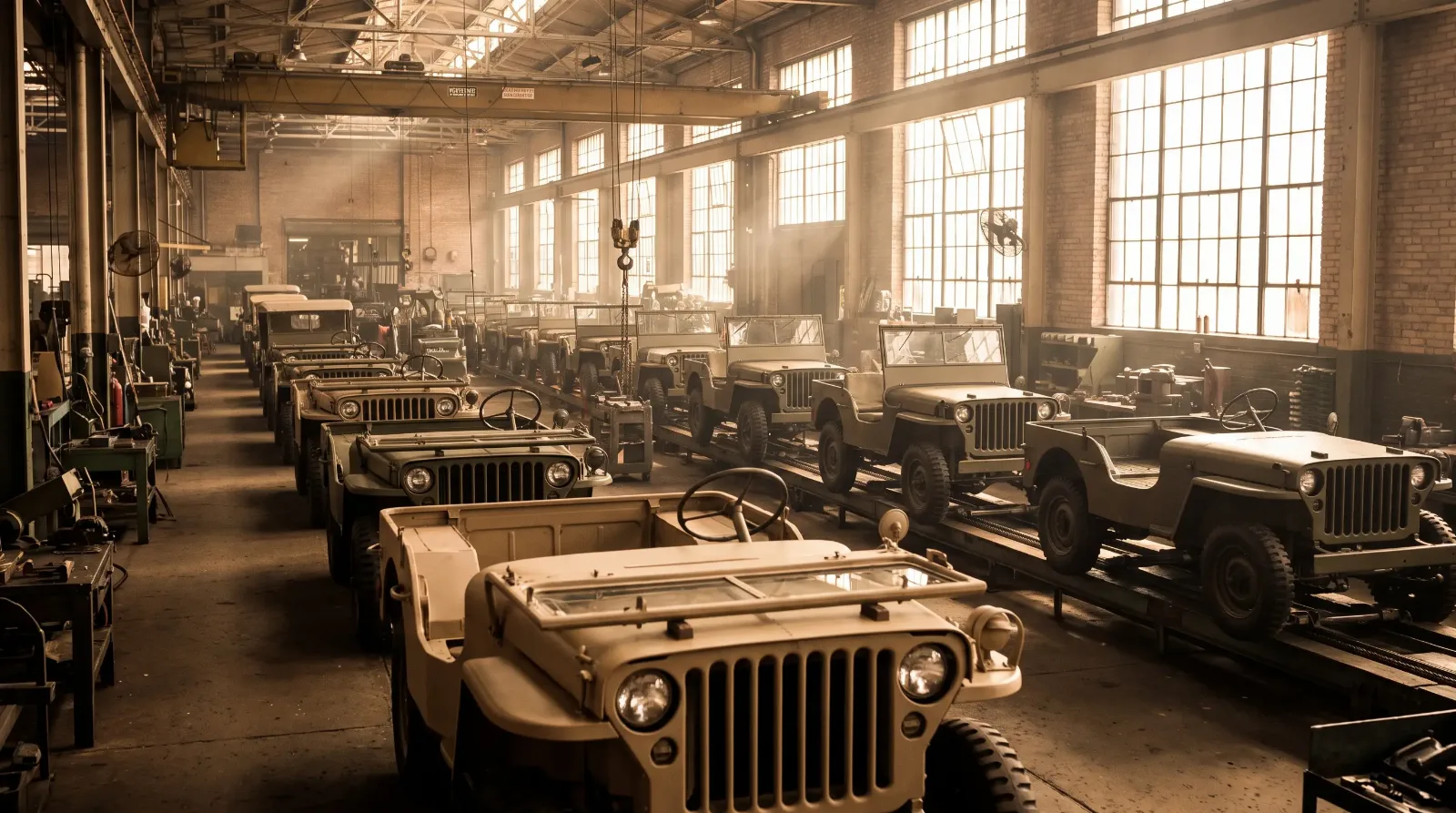
A carmaker built on volume, decades before the Jeep existed
By the 1910s, Willys-Overland was the second largest automaker in the United States, trailing only Ford. That's a fact that surprises most people who only know the name from the Jeep. Willys built conventional passenger cars for two decades, weathered the usual boom and bust cycles of the early auto industry, and by the late 1930s was a mid-tier manufacturer looking for its next big product, not a defense contractor angling for a military deal.
That changed almost overnight in 1940, when the U.S. Army solicited bids for a light reconnaissance vehicle. Willys-Overland, alongside American Bantam and Ford, entered the competition, and engineer Delmar "Barney" Roos built a prototype around a torquey four cylinder engine that outperformed the competition in Army field trials. Willys won the contract in 1941, and a company that had spent thirty years building sedans found itself building a wartime icon instead.
Roos brought a specific philosophy to the project that fit his career arc perfectly. He'd made his name before the war fixing overweight, underpowered engines at Studebaker, and the Army's brief, a light vehicle that needed to outpull heavier competitors, played directly to that background. Willys leadership took a gamble in 1940 betting the company's near-term future on a contract that had no guarantee of going their way, competing against two other manufacturers with their own legitimate claims to the design. It paid off, but it was a genuine risk taken by executives who had spent three decades building sedans and knew almost nothing about supplying the U.S. Army.
The trademark fight nobody remembers
Here's the part of the story that rarely makes it into the highlight reel. Willys-Overland didn't invent the word "Jeep." The name's origin is genuinely murky, tangled up in military slang and a Popeye cartoon character, and multiple manufacturers had legitimate claims to having built early jeep-type vehicles during the war. Willys spent years fighting for exclusive commercial rights to the name, finally securing the trademark in 1950, nearly a decade after the MB first rolled off the line. The company was selling Jeeps for five years before it fully owned the right to call them that.
The legal fight itself dragged through federal courts and patent offices for years, with Willys arguing that its sustained commercial use of the name after 1945, backed by real advertising spend and real sales volume, gave it superior claim over rivals who had built jeep-type vehicles under wartime contract but never marketed a civilian version under that specific word. It's an oddly bureaucratic footnote to attach to a vehicle so thoroughly associated with mud, war, and rural America, but the outcome of that trademark fight is the entire reason the word "Jeep" belongs to one company's product line today instead of sitting in the public domain as generic slang for any light military-style vehicle.
From car company to single-product identity
What makes the Willys-Overland story unusual among American automakers is how completely the Jeep swallowed everything else the company did. Willys kept building passenger cars into the postwar years, models like the Aero, but none of them captured public imagination the way the CJ line did. By the 1950s, the company had effectively become synonymous with one product category, four wheel drive utility vehicles, in a way that Ford or Chevrolet, each selling dozens of different models, never was with any single nameplate.
Willys-Overland leaned into that identity rather than fighting it. Advertising through the late 1940s and 1950s sold the Jeep as a farm tool, a construction vehicle, a rural necessity, marketing that had almost nothing to do with the passenger car business the company had spent its first three decades building. It was a company that had, in effect, reinvented itself around a product born out of a wartime emergency contract.
| Milestone | Year |
|---|---|
| Willys takes control of Overland | 1908 (renamed Willys-Overland, 1912) |
| Army reconnaissance vehicle contract won | 1941 |
| CJ-2A civilian Jeep introduced | 1945 |
| "Jeep" trademark secured | 1950 |
Financially, this narrowing focus was riskier than it looked from the outside. A company with one dominant product line has less to fall back on if that product falls out of favor, and Willys leadership through the late 1940s and 1950s watched competitors like Ford and Chevrolet hedge across dozens of models while Willys effectively bet its future on a single utility vehicle category. That bet worked for decades, through ownership changes and industry consolidation, precisely because the underlying product, the CJ formula built on a wartime chassis, kept finding new buyers generation after generation without needing a fundamental reinvention.
A name that outlived its founder's original business
John Willys died in 1935, years before his company's name became attached to the vehicle it's now remembered for entirely. He never saw the MB, never saw the CJ-2A, never saw a Jeep at all. The company he built as a struggling dealer turned major manufacturer went through repeated ownership changes for decades after his death, eventually passing through Kaiser, then American Motors, then Chrysler, each new owner inheriting a nameplate more valuable than most of what else was on the balance sheet. And yet the Willys name stuck to that one product line so firmly that even now, decades after the last factory bearing that name closed its doors, collectors still talk about "Willys Jeeps" as though the badge and the brand had always been inseparable, one word standing in for the other without anyone stopping to question it.
"Nobody at Willys-Overland in 1940 was planning to become a single-product company. They just built the best reconnaissance vehicle in the Army's trials, and the rest of the business quietly reorganized itself around that one win."
- Patrick Walsh
For the deeper mechanical and historical thread behind all of this, our willys jeep retrospective covers the vehicle side of the story in far more detail. And the marketing pivot that sold farmers on a former war machine is a related story worth reading on its own. If the company's improbable reinvention has you thinking about owning a piece of it, there are CJs for sale now carrying the name John Willys never expected to become this famous.
Sources and notes
Related Reading
Have a
Jeep CJ
for Sale?
Reach thousands of serious classic car collectors across the US.
Sell It Here →
Selling a classic? Here's how: sell my classic car
Are You a Classic Car Dealer?
List your full inventory and connect with targeted classic car buyers.
Join as a Dealer →

About the author
Patrick Walsh
Automotive journalist covering classic car shows, events, and the enthusiast community across North America.
Related Listings - Jeep CJ

Comments
Be the first to comment on this article.