
Delmar "Barney" Roos had a reputation for stubbornness inside the auto industry long before he ever touched a Jeep, and by 1941 that stubbornness had a name of its own attached to a real government contract. The engine he refined for Willys-Overland's entry into the Army's light reconnaissance vehicle trials was not the most sophisticated design sitting on the table that year, but it was the one that pulled hardest under sustained load, and pulling hardest under load was exactly what won the contract in the end. That engine became the Go-Devil, and the jeep cj willys go devil story is really the story of how a modest four cylinder outworked engines with more cylinders and more advertised power.
Car Features
6 min read
The Go-Devil Four: The Little Engine That Won a War
The Go-Devil didn't win the Army's 1941 trials on horsepower. It won by out-pulling everything else in the field, and that same torquey simplicity carried it straight into postwar farm work.
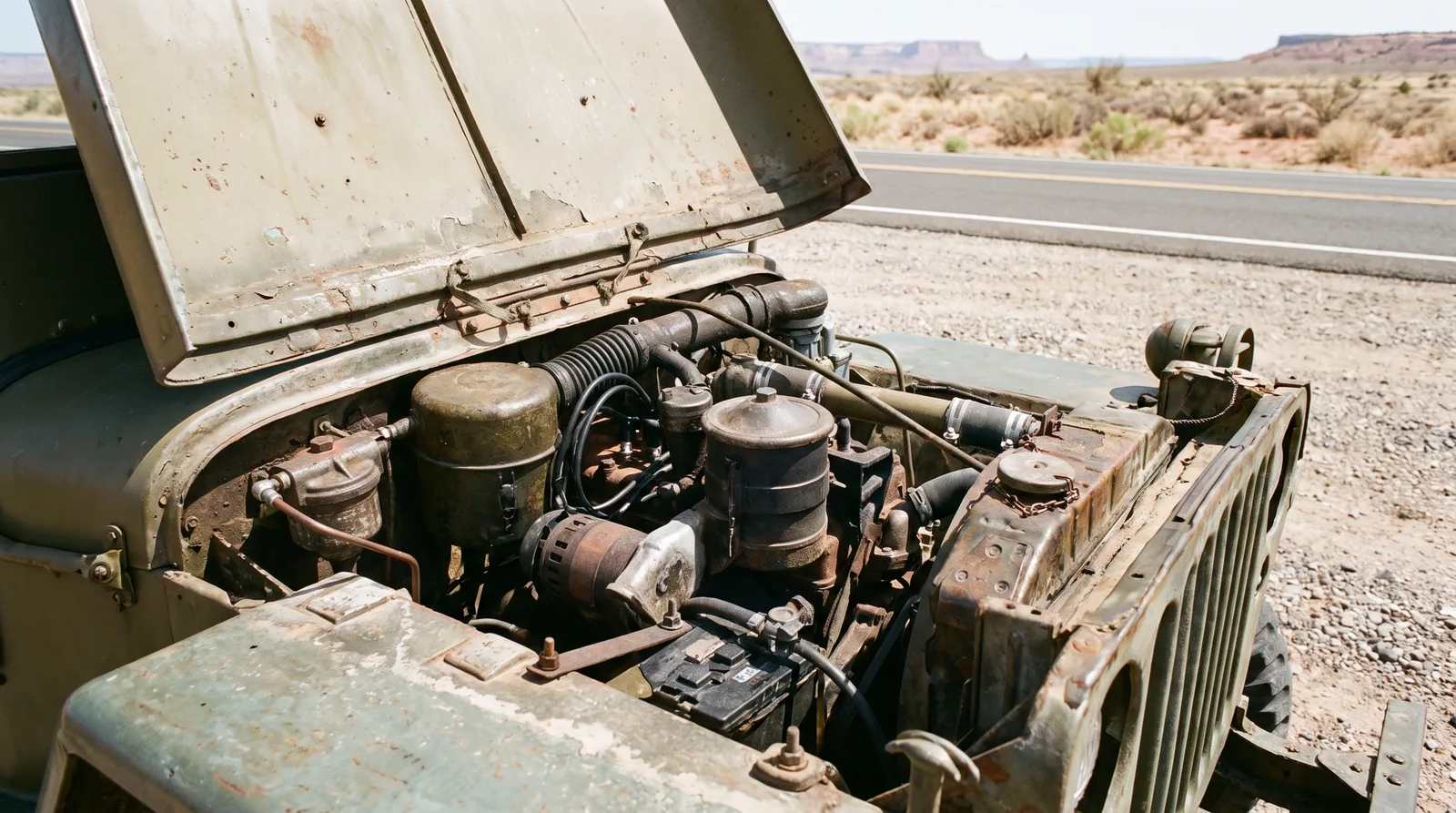
An engine that already existed, refined for a fight it hadn't been asked to enter
The Go-Devil wasn't built from scratch specifically for these military trials. Willys already had a version of this L-head four cylinder in production for its civilian passenger cars, and Roos took that existing architecture and reworked it for more low-end torque, the kind of grunt a military vehicle would actually need crossing rough terrain rather than simply cruising a paved highway at speed. Displacing 134.2 cubic inches and producing roughly 60 hp, the Go-Devil didn't win the Army's 1941 trials on horsepower numbers alone, and the testers running those trials made that fact clear in their own reports. It won because it out-pulled the Ford and Bantam entries in the field tests that actually mattered, hauling loads and climbing grades that stalled the competition.
The trials themselves were unforgiving in ways that flatter no manufacturer's marketing department. Testers loaded prototypes with sandbags to simulate a full complement of troops and equipment, then ran them repeatedly up graded hills at Camp Holabird until something failed. Bantam's lighter chassis handled the corners well but its engine bogged down under sustained load. Ford's entry ran cooler and more reliably than Bantam's but still lacked the low-end pull the Army wanted for towing light artillery. The Go-Devil, tuned specifically for torque rather than headline horsepower, simply kept climbing when the other two started to struggle.
An L-head, plainly explained
The Go-Devil used what's called an L-head, or flathead, valve arrangement, with both intake and exhaust valves sitting down in the engine block rather than up in the cylinder head. It's a simpler, cheaper design to manufacture and easier to service in the field with basic tools, both of which mattered enormously for an engine that needed to survive combat conditions on every continent Allied forces fought on. Simplicity wasn't a limitation here. It was the design brief, and every downstream decision about the engine, from valve spacing to bearing tolerances, was made with that brief firmly in mind rather than chasing whatever the most modern competing layout of the day happened to be.
| Spec | Go-Devil detail |
|---|---|
| Displacement | 134.2 cubic inches |
| Valve layout | L-head (flathead) |
| Horsepower | 60 hp |
| First application | Willys MB, 1941 |
| Service life | MB through early CJ-3A production |
That simplicity paid dividends far beyond the factory floor. A soldier with basic tools and a field manual could pull a cylinder head, replace a gasket, or adjust valve clearances on a Go-Devil without specialized equipment or a trip back to a rear-area depot. In combat conditions, where a broken-down vehicle could mean the difference between an evacuated unit and a stranded one facing enemy fire, that kind of field-serviceability mattered every bit as much as raw output ever did, arguably more. Willys engineers understood this tradeoff clearly and never chased the more sophisticated overhead valve layouts some competitors experimented with during the same period.
What it did once the shooting stopped
The Go-Devil's wartime record, proven across deserts, jungles, and European mud, earned it a second career the moment Willys pivoted to civilian production in 1945. The same torquey, low-stress engine that hauled soldiers and equipment across battlefields turned out to be exactly what a farmer needed to run a power takeoff, tow a loaded trailer, or climb a muddy field access road. Willys barely changed the engine for civilian duty because it did not need to. The qualities the Army valued, reliability under load and simple field maintenance, were precisely what postwar farmers and ranchers valued too.
Farmers who bought a CJ-2A in the late 1940s often had no formal mechanical training beyond what they'd picked up keeping older tractors running, and the Go-Devil rewarded that kind of self-taught competence. Its L-head layout meant a farmer could diagnose most common running problems by ear and eye alone, without diagnostic equipment no rural garage in 1947 could have afforded to stock in the first place. That accessibility, as much as the engine's actual pulling power, is why so many CJ-2A and CJ-3A owners kept their trucks running for decades on nothing more than a basic toolbox and a service manual passed down through a family, one generation teaching the next how to keep an old flathead alive.
Why the flathead eventually had to retire
The Go-Devil's L-head simplicity, the same trait that made it so easy to service in a foxhole, eventually became its ceiling. Flathead engines simply breathe worse than overhead valve designs at higher output levels, and by the early 1950s Willys needed more power out of its engine bay than the L-head architecture could reasonably deliver without a wholesale rework. That need produced the Hurricane F-head engine, introduced in Willys passenger models in 1950 and in the CJ with the 1953 CJ-3B, a direct descendant of the Go-Devil's basic displacement, built with a taller valve arrangement that in turn demanded a taller hood to accommodate it. The Go-Devil didn't disappear because it failed. It stepped aside because Willys had simply asked more of the platform, more towing power, more sustained load capacity, more grade-climbing ability, than a flathead architecture could reasonably give without further compromise.
"The Go-Devil never tried to be clever. It just pulled, in mud, in sand, under a loaded trailer, in weather nobody sane would drive a sedan through, and that reliability is why it's still the engine people mean when they talk about original Jeep character."
- Sarah Whitfield
The Go-Devil's story only makes full sense alongside everything else Willys was building around it during those years, the trials, the wartime contract, the postwar transition, which is why the full story of the Willys Jeep is worth reading start to finish rather than in isolated pieces. If that stubborn little flathead has earned your respect the way it earned the Army's respect back in 1941, you can go browse classic CJ listings and see which ones still carry it running under the hood today.
Sources and notes
Related Reading
Have a
Jeep CJ
for Sale?
Reach thousands of serious classic car collectors across the US.
Sell It Here →
Selling a classic? Here's how: the best sites to sell a classic car
Are You a Classic Car Dealer?
List your full inventory and connect with targeted classic car buyers.
Join as a Dealer →

About the author
Sarah Whitfield
Third-generation classic car collector specializing in pre-war American and European coachbuilt automobiles. Researcher and concours enthusiast.
Related Listings - Jeep CJ



Comments
Be the first to comment on this article.