
The rear power take-off on the Willys CJ-2A was not a dealer add-on. It was engineered into the platform from the first production drawings, and Willys-Overland's own factory documentation treated the Jeep CJ Willys PTO and implements system as central to the vehicle's identity, not a footnote. Willys-Overland built the postwar CJ around a simple premise: a vehicle that could drive itself to a field and then power the equipment already sitting in it. That premise shaped engineering decisions from the transfer case forward, and the factory record on it is more detailed than most enthusiasts realize.
Car Features
7 min read
Power Take-Off and the Working Willys Jeep
Willys-Overland engineered the CJ-2A's power take-off and implement line as a factory program, not an aftermarket add-on, and the surviving hardware still matters to collectors.
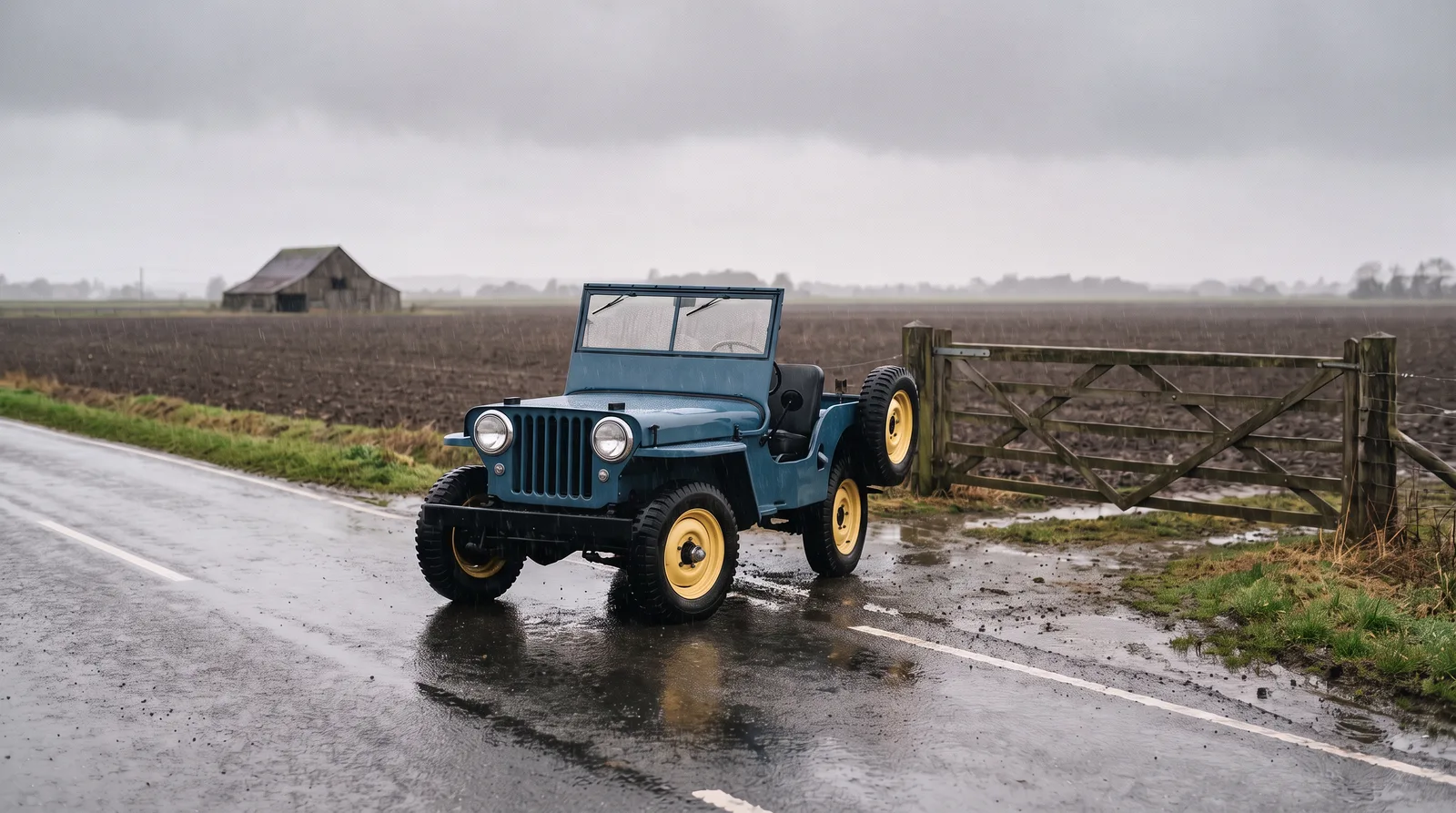
Engineering the PTO into the platform
Willys-Overland's engineers built the CJ-2A with a front-mounted power take-off pulley and a rear PTO shaft option, both driven off the transfer case rather than bolted on as an afterthought. Company records from 1945 and 1946 show the PTO system went through its own development and testing schedule, parallel to the vehicle's own road testing, because Willys treated stationary power output as a core requirement rather than an accessory.
The front pulley ran at a fixed speed relative to engine RPM and was designed to match common belt-driven farm equipment of the period, including buzz saws, water pumps, and grain augers. The rear PTO, by contrast, connected to towed or three-point equipment and followed agricultural industry standard shaft speeds so the CJ could run implements built for tractors without custom fittings. Getting that standardization right was a deliberate factory decision, made so farmers would not need Jeep-specific tools.
The implement catalog as a factory program
Beyond the PTO hardware itself, Willys-Overland ran a formal implement program through its Agricultural and Industrial Sales division. That division catalogued plows, disc harrows, mowers, post hole diggers, and snow blades engineered specifically to mount on the CJ-2A and CJ-3A chassis. These were not third-party accessories tolerated by the factory. They were designed, tested, and sold under the Willys name, with factory part numbers and factory service literature.
The scale of that program is easy to underestimate today. Willys-Overland published dedicated implement brochures separate from the vehicle brochures, and dealers trained specifically on implement fitment and operation. A farmer buying a CJ in 1948 was often buying it alongside a plow and a mower in the same transaction, financed together, because the factory sales structure was built to sell the whole package. For the fuller account of how this platform came together in the first place, the whole picture traces the CJ back to its wartime roots.
Why the PTO mattered more than the horsepower figure
On paper, the CJ-2A's four-cylinder Go Devil engine produced a modest 60 horsepower, a number that looks unimpressive next to contemporary tractors. But the PTO system changed how that horsepower got used. Because the transfer case allowed low-range gearing while running the power take-off, the CJ could deliver usable torque to stationary equipment at low, controlled engine speeds, which is a very different engineering problem than moving the vehicle down a road.
Factory technical bulletins from the period spent real attention on PTO gear ratios and belt pulley speeds, evidence that Willys-Overland's engineering staff saw this as a legitimate second function for the vehicle, not a marketing gimmick layered on top of the "real" design. The transfer case, the reduction gearing, and the driveline components were all specified with implement operation in mind alongside on-road and off-road driving.
"Willys-Overland's own engineering files treat the PTO system with the same seriousness as the drivetrain. That is not how a company documents an afterthought."
- Tom Ramirez
Training dealers to sell a machine, not just a car
Willys-Overland's Agricultural and Industrial Sales division did not stop at printing catalogs. Company records show organized dealer training sessions covering implement fitment, PTO speed matching, and basic operation, treating the sales staff more like farm equipment representatives than automobile salesmen. That level of investment in dealer education is a strong signal of how seriously the factory took the implement business as a genuine revenue line rather than a marketing prop attached to the vehicle sale.
This training mattered because implement fitment was not always a simple bolt-on job even with factory parts. Matching PTO shaft speed correctly to a specific piece of equipment, setting the front pulley belt tension, and confirming a plow or disc harrow was mounted at the correct height all required a dealer who actually understood the system, not one reciting a script from a car brochure. Willys-Overland's willingness to build out that training infrastructure across a dealer network that stretched into small agricultural towns is further evidence the PTO and implement program was core business, not an afterthought bolted onto the CJ's marketing.
How the system compared to dedicated farm equipment
It is worth being honest about the limits of the PTO system alongside its strengths. A dedicated farm tractor of the same era typically offered more sustained power output and gearing specifically tuned for continuous field work, and a farmer running a large operation would still likely need a tractor as the primary machine. Willys-Overland's own literature did not claim otherwise. The pitch was always about versatility and cost for smaller operations, not raw output for large-scale farming, and that honest positioning is part of why the implement program built lasting credibility with the buyers it was actually aimed at.
That said, for the specific niche Willys-Overland targeted, small to mid-size farms and general property owners who needed occasional mechanized power rather than constant field work, the PTO system delivered genuine, documented utility. The factory technical bulletins on gear ratios and belt speeds were not written for a product nobody used seriously, they were written because dealers and customers were actually running implements off these vehicles in meaningful numbers, and the factory needed to support that use case properly.
What survives, and what it tells collectors
Original PTO hardware and matching implements are increasingly rare on surviving CJ-2A and CJ-3A examples. Many implements were sold off, worn out, or scrapped once a farm moved on to a dedicated tractor, and the PTO shaft components themselves were often removed by later owners who had no agricultural use for them. A CJ that retains its original front pulley, rear PTO shaft, and correct-period implement mounts represents a documented piece of Willys-Overland's factory program, not a modification.
Collectors researching a specific vehicle's history should treat surviving PTO hardware as a meaningful originality point, on par with matching-numbers drivetrain components. The factory built the system deliberately, catalogued it formally, and sold it as part of the CJ's core identity, which means a complete example tells a more accurate story about how Willys-Overland actually positioned this vehicle in 1945 and 1946. Buyers who want to see what is currently available with that kind of documentation intact can shop classic CJ listings and look closely at what implement hardware, if any, has survived with each vehicle.
Sources and notes
Related Reading
Have a
Jeep CJ
for Sale?
Reach thousands of serious classic car collectors across the US.
Sell It Here →
Selling a classic? Here's how: sell my classic car
Are You a Classic Car Dealer?
List your full inventory and connect with targeted classic car buyers.
Join as a Dealer →

About the author
Tom Ramirez
Corvette researcher and historian based in Bowling Green, Kentucky. Two decades documenting Corvette production history from original factory records.
Related Listings - Jeep CJ


Comments
Be the first to comment on this article.