
Walk around a 1978 Mustang II hatchback with a body man's eye and the roof is the first thing that gets you. It leaves the top of the windshield, holds level for about one seat's worth of headroom, then falls in a single line to the tail. The glass at the back is not a window. It is a door, hinged at the top, and the whole rear of the car comes up with it. By 1978 Ford had also cut two holes in the top of that roof and filled them with tinted glass. That is a lot of opening for a small unibody car, and it is the reason the three-door Mustang II deserves a closer look than it usually gets.
Car Features
8 min read
Hatchback, T-Top and the Mustang II's Fastback Roof
The Mustang II three-door: where its fastback roof came from, who bought it each year, and the T-top that arrived for 1977.
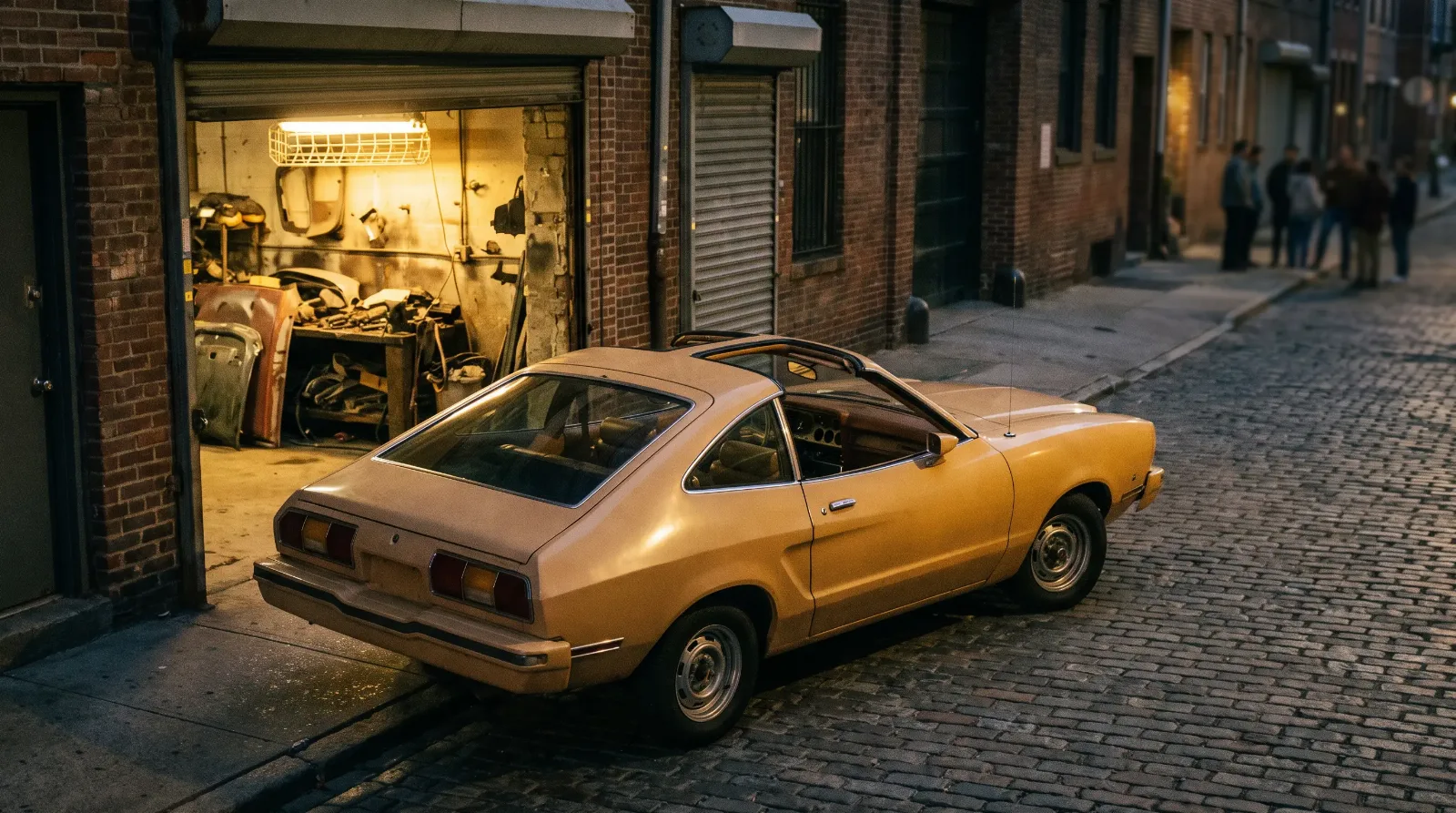
This is not the full history of the downsized Mustang years. It is about one body: the three-door 2+2 hatchback, the fastback roof that defined it, and the T-top that showed up late in its life.
Two bodies, and the one with the hatch
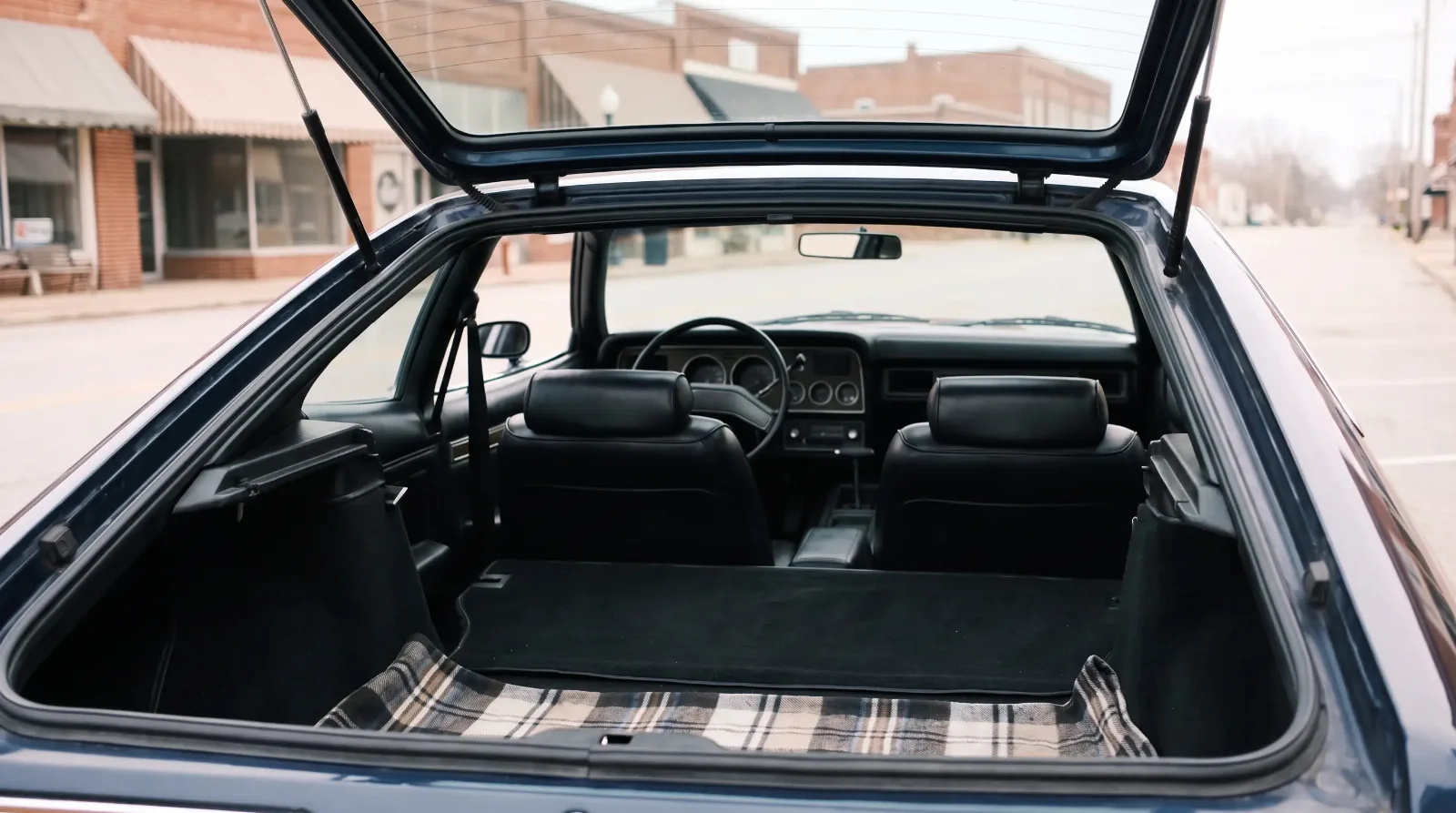
From 1974 through 1978 the Mustang II came in two shapes. One was a two-door notchback that Ford called the hardtop. The other was the three-door 2+2 hatchback. There was no factory convertible. Both bodies rode the same 96.2-inch wheelbase and both ran 175.0 inches long, so the difference is all above the beltline. The hatchback stands 50.0 inches tall against 50.3 for the notchback. On paper that is nothing. In person the hatchback looks lower and longer than it is, because the roof starts falling right behind your head.
The hatch itself was new for the Mustang. The Mustang II was the first production Mustang with a lifting hatch. Every fastback before it, from the 1965 2+2 to the 1973 SportsRoof, kept fixed rear glass over a conventional trunk lid. The hatch turned the back of a fastback into something you could actually load. For a car Ford was selling as a small, sensible pony, that mattered.
It also cost something. Every opening you cut in a unibody shell takes away a panel that was holding the structure together. A notchback has a fixed rear window and a short trunk lid. A hatchback has a big hole framed by the roof rails and the quarters, sealed by one long weatherstrip, and the whole back of the car depends on those hinges, the latch and that seal staying in good shape.
Where the fastback roof came from
The roof was not an afterthought. When Ford asked its Ghia studio for proposals in mid-1971, Ghia sent a fastback and a hardtop, and the Ghia hatchback set the sleeker theme, molded-in false side scoops and all. In the internal competition Ford set up in August 1971, the Lincoln-Mercury studio's fastback came out on top, and the fastback Lee Iacocca approved was drawn by Howard "Buck" Mook. The notchback came later, developed by Dick Nesbitt.
I won't retell that design fight here, but there is one detail worth pointing out from the bodywork side. Those side scoops are stamped into the quarter panels, not bolted on. They are part of the metal. When you are fixing rust in the lower quarter of a Mustang II hatchback, you are working right under a shape that has to come out crisp, and a quarter that has been patched by somebody in a hurry shows it from 20 feet away.
"People call the Mustang II a Pinto with a pony on the grille. Stand behind a hatchback and look down the roof to the tail. That line was drawn by somebody who cared, and you can see it in the steel. The notchback is the sensible one. The hatchback is the one with an opinion."
Jim Vasquez
Who bought the hatchback, year by year
The notchback outsold the three-door every single year. That surprises people who only know the car from the Cobra II posters. But the hatchback's share of the line grew after the first two years, and the reason is plain once you line up the numbers. The figures below are worked out from the published body-style production numbers. They count the notchback hardtop and the Ghia as notchbacks, and the 2+2, the Mach 1 and the Cobra II as hatchbacks.
| Model year | Notchbacks (hardtop and Ghia) | Hatchbacks (2+2, Mach 1, Cobra II) | Hatchback share |
|---|---|---|---|
| 1974 | 267,148 | 118,845 | About 31% |
| 1975 | 137,475 | 51,100 | About 27% |
| 1976 | 116,023 | 71,544 | About 38% |
| 1977 | 97,293 | 55,880 | About 37% |
| 1978 | 116,034 | 76,376 | About 40% |
In 1974 and 1975 the hatchback's selling point was mostly the Mach 1, which Ford built only on the three-door body with the 2.8 V6 as standard (the Mach 1 has its own story here). Then 1976 brought the Cobra II, a hatchback-only appearance package with a black grille, a simulated hood scoop, front and rear spoilers, quarter-window louvers and dual stripes. The same year Ford offered the Stallion group on either body. If you want the full rundown of those dress-up packages, Stallion and Rallye each get their due in a separate piece. The point here is that the loudest of them, the Cobra II, was hatchback only, and buyers followed the stripes.
One caution on the 1978 row. It includes 8,009 Cobra IIs, and that number is disputed: another published count, in Old Cars Weekly, puts 1978 Cobra II production at 4,049. Ford never broke Cobra II sales out on its own, so treat the 1978 hatchback total as close rather than exact.
The T-top arrives in 1977
Partway through the 1977 model year, Ford added a T-roof option for the three-door: two removable tinted glass panels on either side of a fixed center bar. In 1977 it listed at $629 on the 2+2 and $587 on the Cobra II. Ford offered it on the hatchback, which makes sense once you think about where the strength in a roof comes from.
From the shop side, a T-top is a compromise you can see. The roof skin loses most of its middle, so the center bar and the reinforced rails around the openings have to do the work the steel used to do. The panels seal against weatherstrip on all four edges, and after nearly 50 years most of that rubber has given up. Every T-top car I have had my hands on leaked somewhere, usually at the rear corners of the panels, and the water goes where it always goes, into the floor pans. If you own one, store the panels flat and padded, and check under the carpet before you trust the floor.
How many Mustang IIs got the T-top is a question I can't answer, and I have not seen a production count I would put my name to. The roof was popular enough in its day to be the thing people remember about a late Mustang II, and that is as far as the record goes.
Why the 1978 Mustang II hatchback is the one to study
If you want to understand the hatchback at its fullest, 1978 is the year. It was the last Mustang II season, and the three-door had more going on than in any year before it. The T-top was available for a full model year. The Mach 1 was in its final season, with 7,968 built before the badge was dropped for the Fox car. The Cobra II carried on. And the King Cobra, a 302 V8 package with 4,313 built, gave the 1978 line its loudest look, with a deep air dam, flares, a reverse-facing hood scoop and a big cobra on the hood. Meanwhile the one new 1978 package aimed at the notchback, the Fashion Accessory Package, was a coupe-only option, which tells you where Ford was putting its dress-up money.
The engines were the same three the car had carried since 1975: the 2.3 four (VIN code Y), the 2.8 V6 (Z) and the 302 V8 (F), which was rated at 139 hp in 1978, though some tables list 134. In the VIN, the two digits after the plant letter give the body: 03 for a plain hatchback and 05 for a Mach 1, with 02 for the notchback and 04 for the Ghia. The door tag uses a different system, 69F for the hatchback and 69R for the Mach 1. MustangSpecs lists the 1978 base price of the hatchback at $4,088, against $3,824 for the notchback.
Look through a few surviving 1978 Mustangs and you will notice how many of the hatchbacks still wear their T-tops, stripes and louvers, while the notchbacks tend to be plainer survivors. That fits the numbers. The hatchback was never the best seller, but by the end it was the body Ford used whenever it wanted the Mustang II to look like a Mustang. When the Fox car arrived for 1979, it kept the idea of a three-door hatchback alongside the notchback, and the long sloping roof stayed part of the Mustang lineup for years after the Mustang II itself was gone.
Sources and notes
- MustangSpecs: 1978 Ford Mustang (prices and production by body)
- MustangSpecs: 1977 Ford Mustang (T-roof option and prices)
- Mac's Motor City Garage: Preserving the breed, the 1974-78 Mustang II
- MustangSpecs: the second-generation Mustang overview
- Old Cars Weekly: 1978 Ford Mustang Cobra II
- Wikipedia: Ford Mustang (second generation)
Related Reading
Have a
Ford Mustang
for Sale?
Reach thousands of serious classic car collectors across the US.
Sell It Here →
Selling a classic? Here's how: where to sell your classic car online
Are You a Classic Car Dealer?
List your full inventory and connect with targeted classic car buyers.
Join as a Dealer →

About the author
Jim Vasquez
Southern California hot rod and custom car builder with roots in the traditional kustom kulture scene.
Related Listings - Ford Mustang
Comments
Be the first to comment on this article.