
Willys-Overland sold roughly 346,000 CJ-2A and CJ-3A Jeeps between 1945 and 1953, and the company's own sales literature credited a huge share of that volume to farmers, not weekend adventurers. The Jeep CJ Willys farm marketing campaign that ran through the late 1940s treated the vehicle less like a car and more like a tractor that happened to have a windshield. That framing was not an accident. It was a survival strategy for a company that needed a civilian buyer base the moment World War Two contracts dried up.
Car Features
7 min read
The Jeep as Farm Machine: Willys Sells the CJ to Agriculture
Willys-Overland pitched the postwar CJ as a tractor substitute, not a car, and the sales numbers show the strategy saved the company.
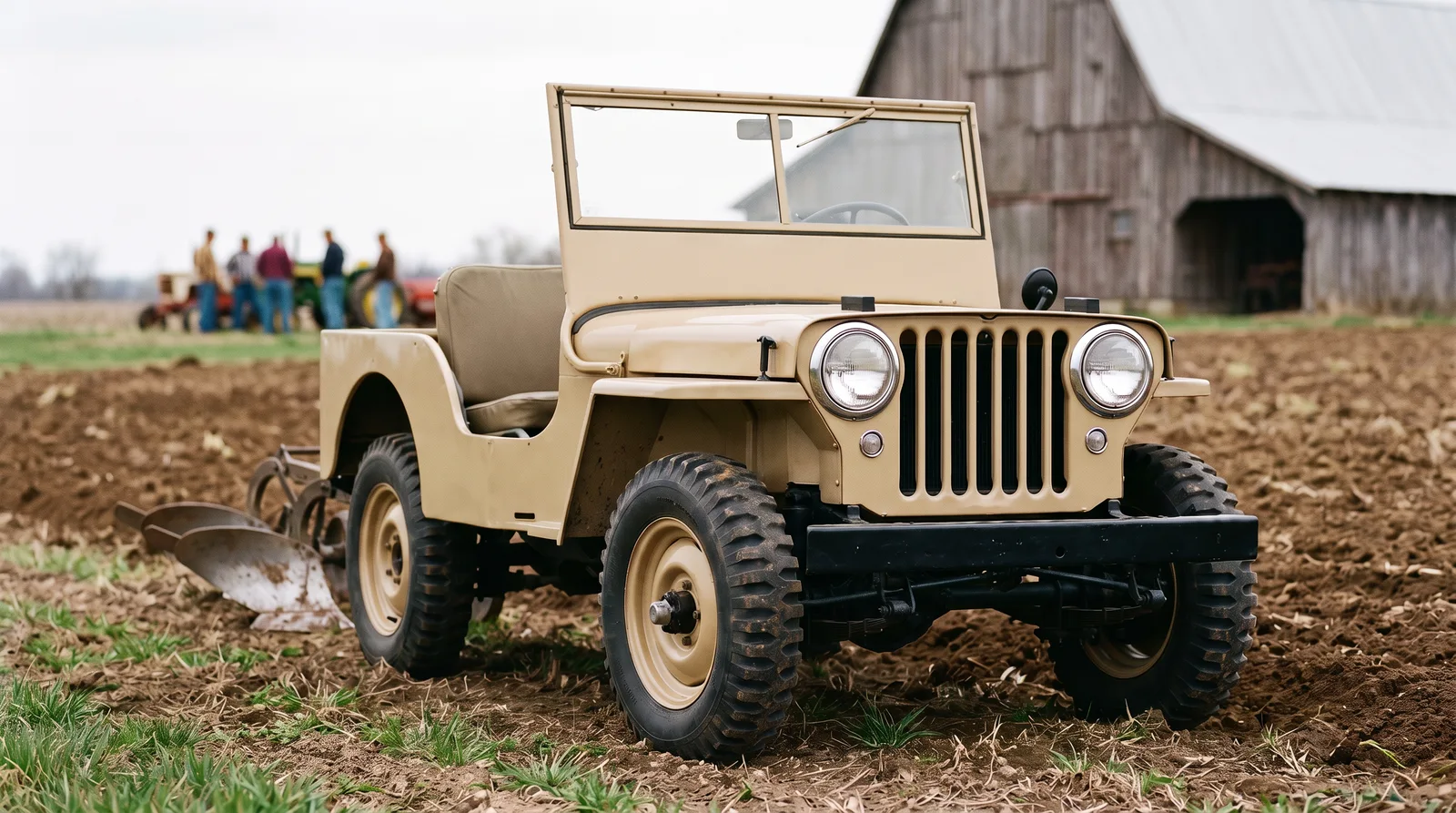
The numbers tell the story plainly. Willys-Overland built roughly 360,000 military Jeeps during the war and then faced a hard question in 1945: who buys a stripped-down, four-wheel-drive utility vehicle in peacetime. The company's answer was agriculture, and it backed that answer with real advertising spend, not a slogan.
A company betting its future on the farm
Willys-Overland's postwar leadership, starting with Charles Sorensen after Joseph Frazer left during the war, understood the arithmetic. Passenger car demand after 1945 was already crowded with Ford, Chevrolet, and a resurgent Chrysler, all with deeper dealer networks and more capital. Willys could not out-compete Detroit on sedans. What it could do was own a category nobody else was chasing: a low-cost, general-purpose farm vehicle that could plow, haul, run a belt-driven saw, and still drive to town on a Saturday.
The company printed farm-focused brochures showing the CJ-2A pulling a two-bottom plow, running a mower, and powering a water pump, each image paired with plain, working-class copy about cost per acre and hours saved. This was not lifestyle advertising. It was a spec sheet dressed up as a pitch, aimed at a buyer who read Farm Journal, not Motor Trend. For readers who want the origin of that vehicle itself, [you can] read the background on how the CJ platform came out of the wartime MB in the first place.
Selling a tractor substitute, not a sport utility
The marketing pitch worked because it solved a real postwar problem. Small and mid-size farms, especially those that had gone without new equipment during the war, needed affordable horsepower. A new tractor was a major purchase. A CJ-2A, priced well under a comparable tractor and able to double as family transportation, was a rational buy for a farmer running under 200 acres. Willys leaned into that math relentlessly, publishing comparison charts of CJ operating cost against horse-drawn equipment and against dedicated farm tractors.
The campaign also targeted rural dealers who had never sold a Willys product before. Farm equipment dealers, feed stores, and even some hardware suppliers were recruited to carry the CJ line, widening distribution well beyond the traditional auto dealer network. That distribution strategy mattered as much as the advertising copy itself, because it put the Jeep in front of buyers who were never going to walk into a conventional car showroom.
The implements did the selling
Farm marketing for the CJ leaned heavily on attachments: plows, mowers, disc harrows, snow blades, and a rear power take-off that let the Jeep run stationary equipment like a threshing machine or a buzz saw. Willys did not just sell the vehicle, it sold an ecosystem of implements engineered to bolt onto it, and that ecosystem was the actual argument for why a farmer should choose a CJ over a used truck or a small tractor. A single CJ, the pitch went, could replace several pieces of dedicated equipment.
That value proposition shows up clearly in surviving period pricing. A base CJ-2A retailed for a little over one thousand dollars in the late 1940s, undercutting entry-level tractors by a meaningful margin while offering road-legal transportation the tractor could not. Farmers bought that trade-off in large numbers, and Willys tracked and publicized the sales results as proof the strategy was working.
"Willys was not selling nostalgia. It was selling a return on investment to a buyer who did the math on every dollar, and the sales figures back up that the pitch landed."
- David Mercer
What the farm strategy means for value today
This history matters to buyers now because it explains why so many surviving CJ-2A and CJ-3A examples show up with mismatched implement mounts, added drawbars, and PTO modifications rather than pristine original spec. A large percentage of the surviving population lived a working life first and a collector life second. That is not a flaw in the market, it is the reason these Jeeps exist in the volumes they do.
For a buyer weighing an early CJ, the farm-marketing lineage is actually a point in favor of the platform's durability reputation, but it also means originality carries a real premium. A CJ-2A with its factory implements, unmolested sheet metal, and clean provenance sells at a distinct level above a working survivor with decades of farm modifications. Know which one you are looking at before you negotiate. If you are ready to look at what is actually on the market, you can find a classic CJ and compare condition against price yourself.
Reading the postwar farm economy correctly
Willys-Overland's timing mattered as much as its message. American farms coming out of the war were, in many cases, running equipment that was a decade or more old, since wartime rationing had limited new farm machinery production almost entirely. That created pent-up demand across the whole agricultural equipment sector, not just for tractors but for any tool that could add mechanized capacity at a price a mid-size farm could actually afford. Willys-Overland positioned the CJ-2A directly into that gap, and the timing explains a good part of why the campaign worked as fast as it did.
The company also understood something about farm buying decisions that a purely urban advertising strategy would have missed: farmers bought equipment based on demonstrated results from neighbors, not glossy brochures alone. Willys-Overland leaned into that by sponsoring county fair demonstrations and agricultural exhibitions where a CJ-2A would plow a field or run a saw in front of a crowd of prospective buyers. Seeing the machine work, rather than reading about it, closed sales in a way print advertising never could on its own, and dealers who hosted these demonstrations reported some of the strongest regional sales results in the company's own internal figures.
Willys-Overland's rural dealer expansion ran in parallel with this demonstration strategy. By the early 1950s, the company had built out a distribution network that reached well past the traditional metropolitan auto market, putting CJ dealers and farm implement retailers in small towns that a conventional car company would never have prioritized. That network became one of Willys-Overland's most durable assets, one that outlasted the specific farm marketing campaign itself and fed directly into the broader postwar growth of the Jeep brand.
The bottom line on the farm campaign
Willys-Overland's decision to market the CJ as farm equipment first and a car second was not a marginal branding choice. It was the difference between a company folding after the war and a company that built a nameplate still recognized more than seventy years later. The campaign's success is measurable in unit volume, in dealer expansion into rural markets, and in a surviving population of vehicles that still carries the scars, and the value, of that working history.
Sources and notes
Related Reading
Have a
Jeep CJ
for Sale?
Reach thousands of serious classic car collectors across the US.
Sell It Here →
Selling a classic? Here's how: where to sell your classic car online
Are You a Classic Car Dealer?
List your full inventory and connect with targeted classic car buyers.
Join as a Dealer →

About the author
David Mercer
Classic car market analyst with two decades of experience tracking collector car valuations, auction results, and investment trends.
Related Listings - Jeep CJ

Comments (1)
L
Larry D.
1 week ago
My uncle had a CJ-2A on his place outside Springfield and he ran a buzz saw off the back of it every November and he'd come into the diner with sawdust in his collar telling anybody who'd listen that the Jeep cost him less than the tractor his neighbor bought and did more of the chores, and he kept that Jeep till the floor rusted clean through.