
Chevrolet's advertising archive for 1972 shows a company that had not yet fully decided what the K5 Blazer was supposed to be, and that uncertainty shows up directly in how the truck got marketed that year. Print ads leaned hard into outdoor recreation imagery, mountains, campsites, open trails, while trade publications aimed at fleet buyers emphasized durability and cost of ownership in far more sober language. The 1972 K5 Blazer ad campaign was, in effect, two different pitches running in parallel, and comparing them tells you a lot about who Chevrolet actually thought would buy this truck.
Car Features
6 min read
How Chevrolet Sold the 1972 K5 Blazer
Chevrolet ran two different 1972 K5 Blazer ad campaigns at once, one selling recreation to consumers, the other selling cost to fleet buyers.
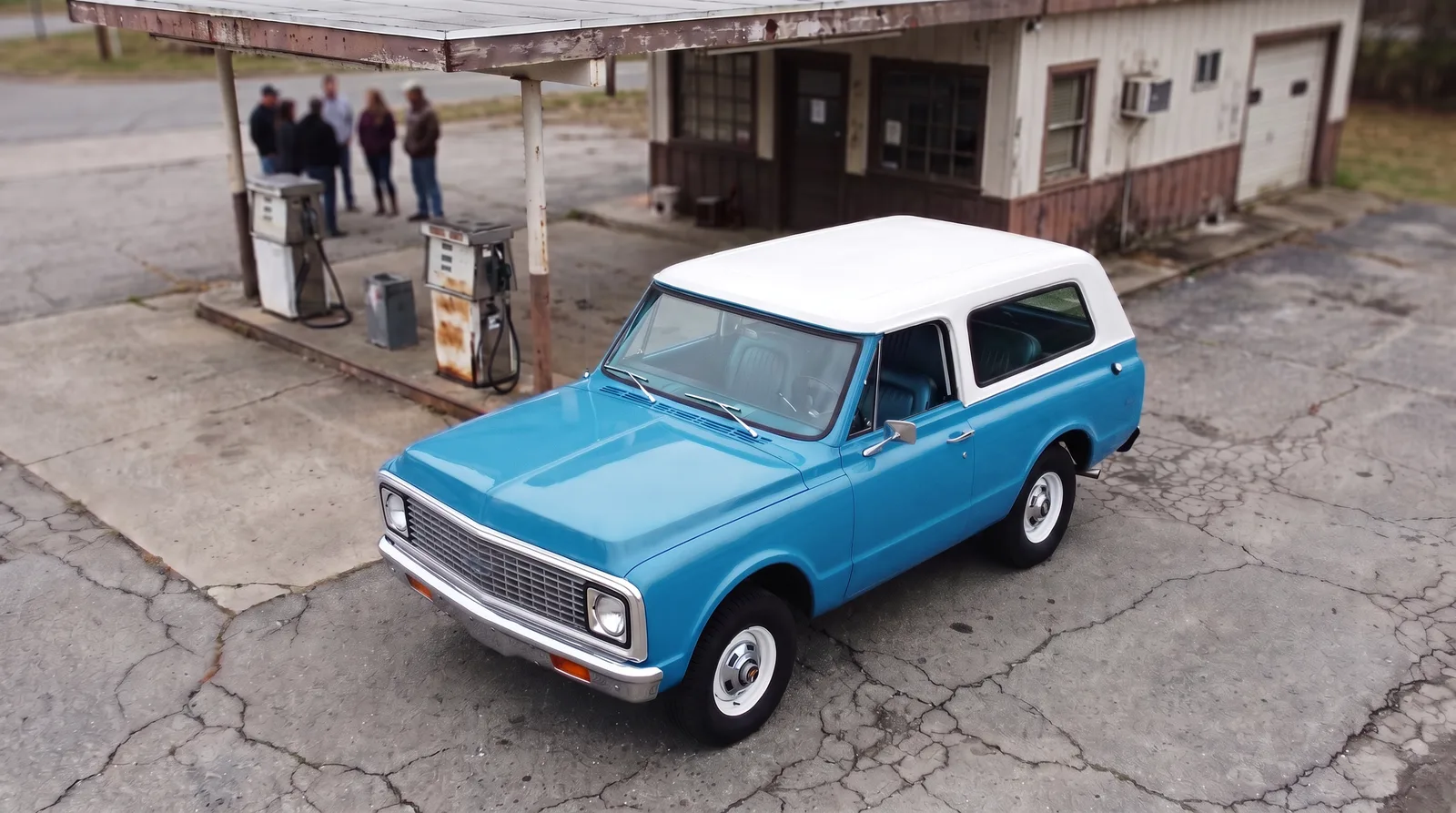
The consumer pitch: recreation and freedom
Consumer-facing print ads from 1972 photographed the K5 Blazer with its top removed, parked at overlooks and trailheads, often with camping or sporting equipment visible in the cargo area. The copy in these ads emphasized versatility, the idea that one vehicle could handle a work week and a weekend trip without compromise, a message aimed squarely at a growing suburban and exurban customer base with disposable income and a genuine interest in outdoor recreation as leisure activity rather than necessity.
This was a relatively new positioning for a Chevrolet truck. Pickups had long been marketed on capability and value for working buyers. The K5 Blazer's recreation-focused advertising represented Chevrolet testing whether a truck could be sold as a lifestyle vehicle, years before that idea became standard practice across the industry.
The fleet pitch: numbers, not scenery
Advertising aimed at fleet and commercial buyers looked almost nothing like the consumer campaign. Trade publication ads emphasized cost per mile, parts commonality with existing Chevrolet truck lines, and the practical benefits of the removable top for utility applications like forestry, construction, and municipal service. There was no mountain scenery in these ads. There was a truck, a spec sheet, and an argument about total cost of ownership pitched directly at a purchasing manager rather than an individual consumer chasing a feeling.
Running both campaigns simultaneously required Chevrolet's marketing division to essentially split the K5 Blazer's identity in two, selling the same physical truck as an adventure vehicle to one audience and a cost-effective utility platform to another, without either campaign contradicting the other too obviously.
Dealer-level promotion added a third layer beneath the two national campaigns, with individual Chevrolet dealers often producing their own local newspaper ads that borrowed imagery and language from the national consumer campaign while adding regional specifics, financing terms, or trade-in offers tailored to their own market. These local variations are harder to research today since they were never centrally archived the way national print campaigns were, but the surviving examples that turn up in newspaper archives show dealers leaning almost entirely on the recreation angle rather than the fleet-focused messaging, suggesting individual showrooms saw more selling power in the lifestyle pitch than in cost arguments.
What the ads got right, and where reality diverged
The recreation-focused campaign was not pure fantasy. The K5 Blazer genuinely could handle the dual role Chevrolet was selling, removable top for weekend adventure, solid drivetrain for daily use, and that authenticity is part of why the campaign worked as well as it did. But the fleet pitch was arguably closer to how most 1972 Blazers were actually used in period, hauling equipment, working ranch and forestry routes, serving as a practical utility vehicle far more often than as a recreational escape pod parked at a scenic overlook.
Reading period advertising alongside actual fleet purchase records makes clear which version of the truck's identity was doing the heavier lifting commercially, even if the recreation imagery is what modern collectors remember and romanticize decades later.
| Campaign | Audience | Central message |
|---|---|---|
| Consumer print | Suburban, outdoor recreation buyers | Versatility, freedom, lifestyle |
| Trade publication | Fleet and commercial buyers | Cost per mile, parts commonality |
"Chevrolet's 1972 ad copy was really two products being sold under one nameplate, and the truck itself had to be honest enough to back up both stories."
- Tom Ramirez
The visual language both campaigns shared
Despite the split audience, both the consumer and fleet campaigns relied on similar visual cues, the truck photographed from a low angle to emphasize its stance, the removable top treated as a genuine selling point in nearly every image regardless of which publication ran the ad. Chevrolet's art directors clearly understood that the removable top was the K5 Blazer's single most distinctive feature, the one detail the ads could build a whole image around, even though Bronco, Scout, and CJ owners could take their tops off too, and both campaigns leaned on it even while talking to completely different buyers about completely different priorities.
Typography and layout differed more than imagery did. Consumer ads used looser, more casual type treatments and shorter copy blocks built around a single emotional idea. Trade publication ads packed in dense paragraphs of specification and cost data, formatted closer to an engineering data sheet than a piece of persuasive writing, because the fleet buyer reading it was evaluating a purchase order, not shopping for a feeling.
Why the advertising still matters to collectors
Period advertising is a useful research tool today for anyone trying to understand how a 1972 K5 Blazer was originally equipped and marketed, since factory brochures often listed available colors, trim levels, and option packages more clearly than surviving dealer paperwork does. Collectors researching a specific truck sometimes use period ads to confirm whether a color or trim combination was genuinely offered that year, treating decades-old marketing material as a primary source rather than mere promotional ephemera.
Modern collectors reproducing period ads for garage displays or club newsletters have inadvertently become part of preserving this history, since original Chevrolet promotional materials from 1972 were printed for a single publication cycle and were never intended to last five decades. What survives today often comes from private collections of automotive ephemera rather than any official Chevrolet archive, another reminder that the community's own record-keeping has done more to preserve this material than the manufacturer ever planned to.
Anyone researching a specific truck today would do well to look past the glossy consumer imagery and dig into the trade publication ads as well, since the fleet-focused material often documents options, pricing structures, and configuration details the recreation-focused campaign never bothered mentioning at all. Both halves of the story, taken together, give a far more complete picture of the truck than either campaign offers on its own.
For the fuller context behind the 1972 model year that this advertising was built to sell, 1972 k5 blazer history covers the trucks these campaigns were promoting in detail. If the restomod side of the K5 Blazer story interests you, a related story looks at how builders reinterpret these trucks today. And if the recreation imagery has you wanting one for your own weekend trip, K5 Blazers for sale now is a good starting point.
Sources and notes
Related Reading
Have a
Chevrolet Blazer
for Sale?
Reach thousands of serious classic car collectors across the US.
Sell It Here →
Selling a classic? Here's how: compare the places to sell classic cars
Are You a Classic Car Dealer?
List your full inventory and connect with targeted classic car buyers.
Join as a Dealer →
#vintage car ads
#Chevrolet advertising
#K5 Blazer
#1972 Blazer
#Chevrolet Blazer history
#fleet marketing

About the author
Tom Ramirez
Corvette researcher and historian based in Bowling Green, Kentucky. Two decades documenting Corvette production history from original factory records.
Related Listings - Chevrolet Blazer




Comments (1)
T
Tammy R.
2 weeks ago
Ads had the top off. Most I have welded kept it on.
K
Karen P.
2 weeks ago
In my experience, the tops stayed on because removing one was a two-person job with a coffee can of bolts, and then it needed somewhere dry to live. Most owners tried it once. After that it was simply a hardtop truck.