
Most 1972 K5 Blazers that survive today did not survive because someone set out to preserve history. They survived because a rancher kept using one past the point most trucks got scrapped, or because a family never sold the truck their father bought new, or because a shop somewhere held onto a rough example long enough for the market to catch up to it. The k5 blazer 1972 notable examples worth knowing about are less about celebrity ownership and more about documentation, originality, and the rare case of a truck that never left its original owner.
Car Features
7 min read
Famous 1972 K5 Blazers and Standout Survivors
The most notable surviving 1972 K5 Blazers are not defined by fame but by documentation, from fleet maintenance logs to untouched factory originals.
The low-mileage survivor problem
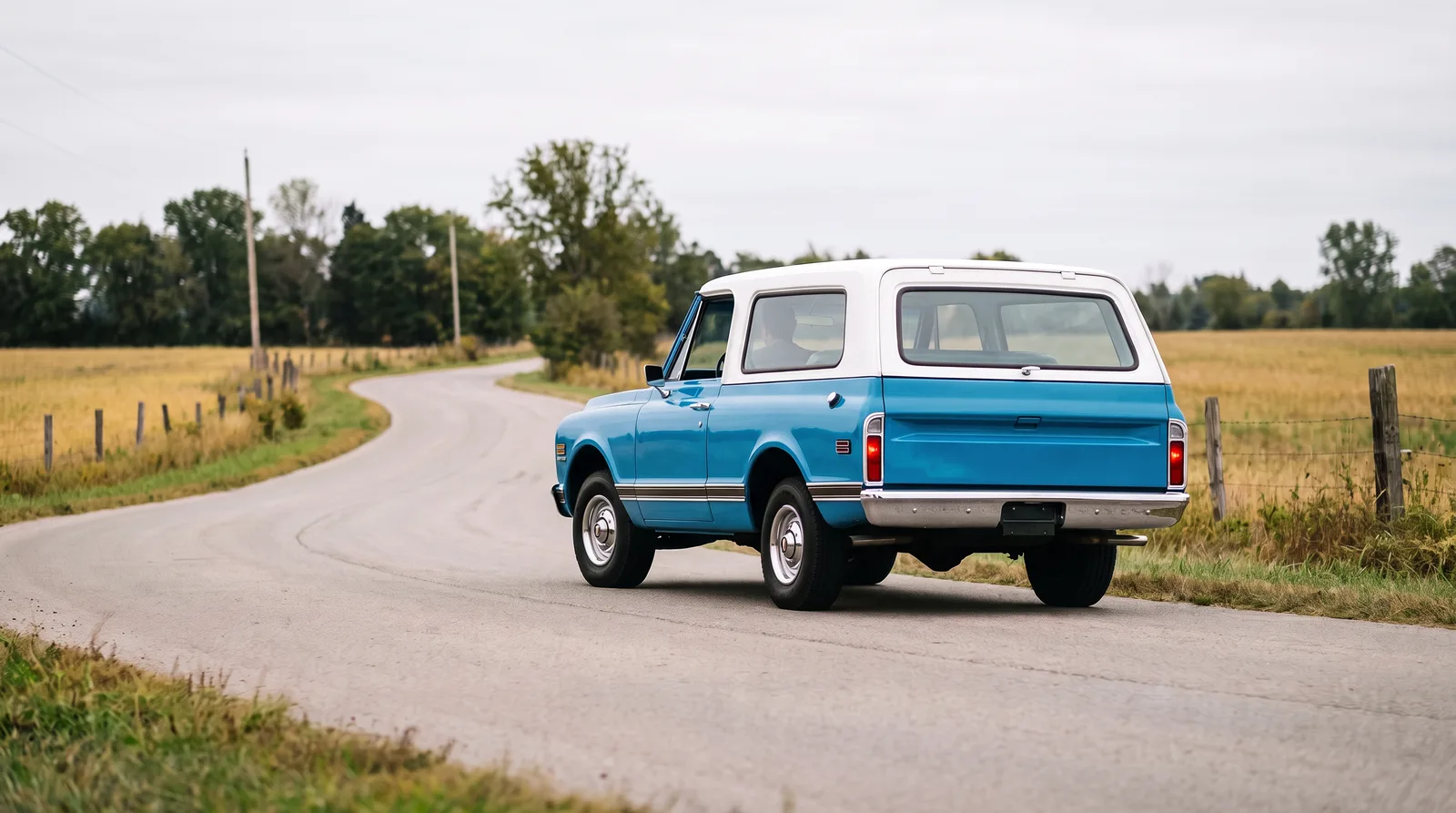
Finding a genuinely low-mileage, unmodified 1972 K5 Blazer is harder than finding one with a big-name history. These were work trucks first. Ranches, forestry departments, small municipalities, and rural families bought them to do a job, and that job usually meant regular use in conditions that ate paint, ate frames, and ate original interiors. A truck that shows under 50,000 original miles with its factory drivetrain, factory paint code, and a clean build sheet is genuinely uncommon, and when one surfaces at auction it draws attention specifically because so few were ever babied.
What makes an example notable in this world is not flash. It is a matching numbers engine, an original title chain, factory-installed options that can be cross-checked against a build sheet, and photographic or written history that confirms the truck was not modified, wrecked, or re-bodied at some point. Provenance carries real weight with 1972 K5 Blazers precisely because so many were altered, off-roaded, or partially restored using parts from other trucks over the decades.
Government and municipal fleet trucks
A meaningful share of surviving documented 1972 K5 Blazers trace back to fleet use rather than private ownership. Forest services, county road departments, and utility companies bought four-wheel-drive Blazers specifically for the removable top and the ability to work as both a patrol vehicle and a light hauler. Fleet trucks tend to have thorough maintenance records because someone was accountable for the budget line, and that paperwork trail is exactly what collectors look for when trying to confirm a truck's history decades later. A fleet-history 1972 K5 Blazer with intact maintenance logs is often considered more trustworthy than a privately owned truck with no paper trail at all, even if the private truck looks nicer in photos.
These trucks were rarely garaged and rarely babied, so finding one in strong original condition is unusual. When a documented fleet truck does turn up clean, it tends to draw serious interest specifically because the paperwork removes most of the guesswork buyers normally have to do with a fifty-year-old truck.
The unmodified originals still wearing factory paint
The other category worth knowing is the truck that simply never got touched. No repaint, no drivetrain swap, no replaced interior, just decades of light use and careful storage. These are the rarest 1972 K5 Blazers on the market because originality this complete usually requires a single caretaking family, a dry climate, and enough luck to avoid the collision or mechanical failure that ends most trucks' original-parts status. A Blazer wearing its factory paint, factory interior, and factory drivetrain in 2026 has typically spent most of its life under a roof, and that history is usually well known to whoever is selling it, because it tends to pass through very few hands.
"Every unmodified 1972 K5 Blazer still has a build sheet number stamped somewhere on it, and that number does not lie. I have seen trucks marketed as rare special orders that the paperwork proved were base trucks with aftermarket parts added later. The documentation is the whole story, not the story someone tells you at a show."
- Tom Ramirez
Why these examples matter to the broader market
Notable surviving 1972 K5 Blazers do more than satisfy curiosity. They function as reference points for what a correct truck actually looked like from the factory, which matters enormously to restorers working on rougher trucks. When a shop needs to know the correct interior color combination for a specific trim level, or whether a particular option was actually available in 1972, a documented original truck is often the fastest way to settle the question, faster than relying on dealer literature alone, since literature sometimes listed options that were announced but rarely built.
These reference trucks also tend to anchor pricing at the top of the market. A buyer trying to understand what a genuinely correct 1972 K5 Blazer is worth benefits from seeing what documented, unmodified examples have actually sold for, rather than guessing based on a modified truck with unclear history. For anyone trying to understand where this started, looking at the surviving originals is often more instructive than reading a spec sheet, because the trucks themselves show what Chevrolet actually built rather than what the brochure promised.
Buyers looking to get into a 1972 K5 Blazer, whether chasing a documented original or a solid driver with room to improve, should shop classic K5 Blazer listings regularly, since the well-documented trucks tend not to sit on the market long once word gets around.
The trucks that get misidentified
Not every truck marketed as a notable 1972 K5 Blazer holds up under scrutiny, and that is worth saying plainly. It is common for a seller to describe a truck as a rare factory special order or a documented original when the actual paper trail is thin or missing entirely. Sometimes this comes from genuine confusion rather than intent to mislead. Ownership passes through several hands over fifty years, family stories get simplified or exaggerated along the way, and by the time a truck reaches its fourth or fifth owner, the version of its history being told may bear only a loose resemblance to what actually happened at the factory or in its early years of use.
Serious buyers learn to separate the story from the documentation early in the process. A compelling history that cannot be backed by a build sheet, title chain, or period photographs should be treated as interesting context rather than established fact. That does not mean the truck is not worth buying. It means the price and the expectations should reflect a truck with an unverified history rather than a documented notable example, and those two categories often sell at very different price points once a buyer starts comparing similar trucks side by side.
What to ask before believing a truck is special
Anyone shopping a 1972 K5 Blazer described as rare, original, or historically significant should ask for specifics before taking the claim at face value. A build sheet, a title history, service records, or period photographs carry far more weight than a seller's memory of what they were told when they bought the truck. The trucks that end up genuinely notable are the ones where the paperwork and the metal agree with each other, and that alignment is rarer than most listings would have a buyer believe.
Sources and notes
Related Reading
Have a
Chevrolet Blazer
for Sale?
Reach thousands of serious classic car collectors across the US.
Sell It Here →
Selling a classic? Here's how: compare the places to sell classic cars
Are You a Classic Car Dealer?
List your full inventory and connect with targeted classic car buyers.
Join as a Dealer →

About the author
Tom Ramirez
Corvette researcher and historian based in Bowling Green, Kentucky. Two decades documenting Corvette production history from original factory records.
Related Listings - Chevrolet Blazer




Comments
Be the first to comment on this article.