
Every change Chevrolet made to the K5 Blazer for 1973 happened at GMC too. The 1973 K5 Blazer Jimmy twin relationship is one of the more overlooked pieces of squarebody history, largely because the GMC Jimmy has spent decades living in its sibling's shadow despite being, mechanically and structurally, the same truck wearing a different badge. As someone who spends a lot of time tracing factory production records, I think the Jimmy deserves more credit in this story than it usually gets.
Car Features
7 min read
The 1973 GMC Jimmy Goes Squarebody Too
The K5 Blazer 1973 Jimmy twin relationship put the same squarebody redesign into GMC showrooms, badge differences aside, as a genuinely identical truck.
One truck, two dealer networks
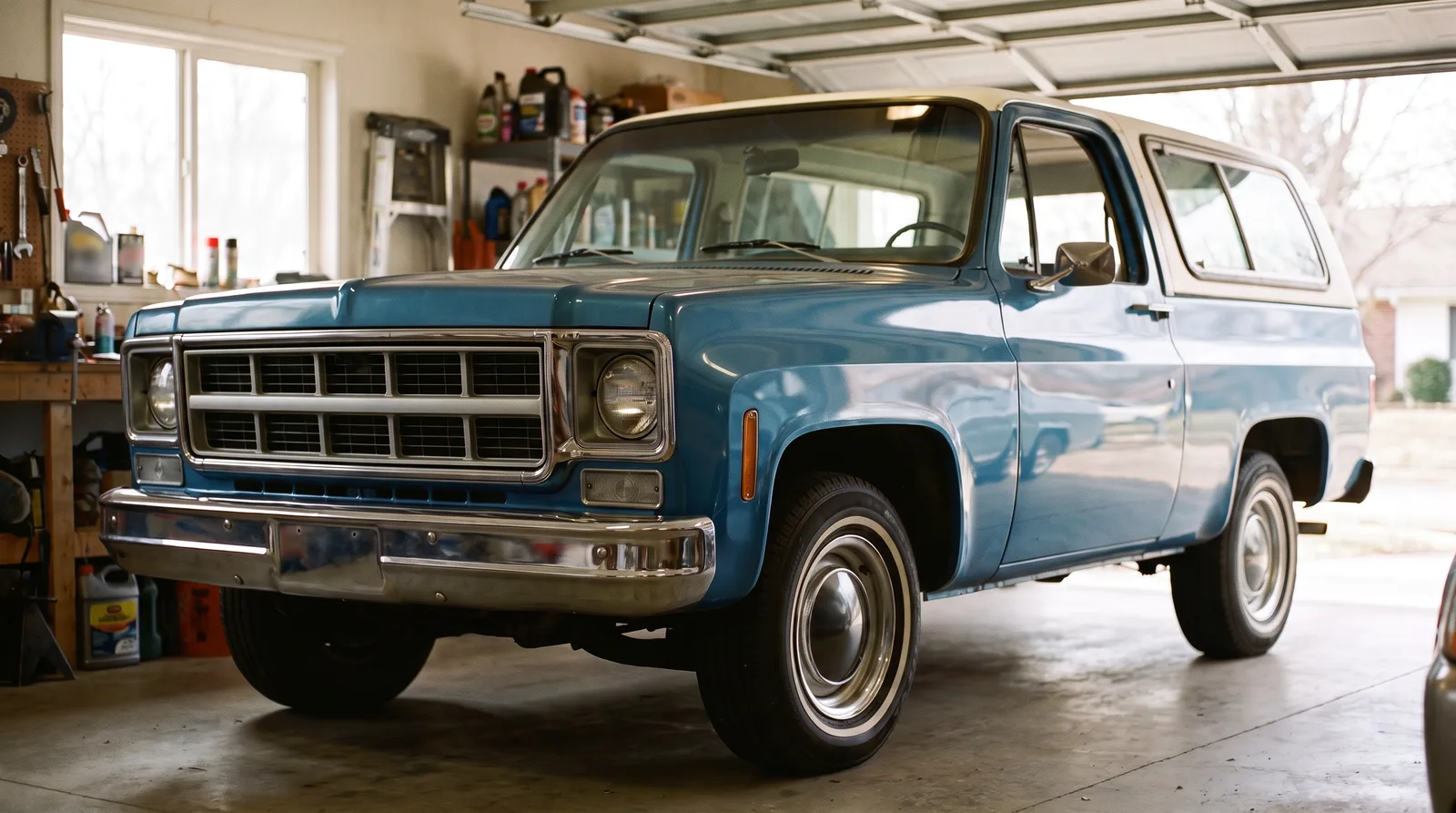
General Motors built the K5 Blazer and GMC Jimmy on shared tooling almost from the start of the nameplate, with the Blazer launching for 1969 and the Jimmy following a year later for 1970, a practical arrangement that let the corporation sell essentially the same vehicle through two separate dealer networks without duplicating engineering costs. When the squarebody redesign landed for 1973, that arrangement continued without interruption. The Jimmy received the same larger squarebody, the same longer wheelbase and stiffer frame, and the same revised front sheet metal shared with the C/K pickup line, along with the same removable top option that both trucks kept on the order sheet through 1975. Buyers walking into a GMC dealership in 1973 were looking at the identical redesign Chevrolet dealers were showing, just wearing GMC badging and trim details.
This dual-badge strategy was not unique to the Blazer and Jimmy. General Motors used the same approach across its pickup lineup for decades, letting Chevrolet and GMC dealers each offer a full truck range without GM building two entirely separate vehicles. The Blazer and Jimmy simply extended that logic to the SUV segment.
What actually differed between the two
The differences between a 1973 K5 Blazer and its Jimmy twin were largely cosmetic and came down to grille design, badging, and some trim-level naming conventions that varied between the two brands. Mechanically, the two trucks shared engines, transmissions, transfer cases, and frames, meaning a 1973 Jimmy buyer got the identical squarebody, the same 4x4 and newly available 2wd configurations, and the same interior architecture as a Blazer buyer, just filtered through GMC's slightly different trim and options naming.
The Jimmy carried its own grille texture and GMC script rather than the Chevrolet bowtie, along with trim names pulled from the GMC pickup side of the lineup instead of Chevrolet's Custom Deluxe, Cheyenne, and Silverado ladder, but the underlying cab, glass, and door stampings were shared between the two badges. Dealers marketed the two trucks to serve their respective, sometimes regionally distinct, customer bases, since GMC and Chevrolet dealerships did not always exist in the same towns, giving General Motors broader market coverage without building a genuinely separate vehicle.
Why the Jimmy sells for less today
Despite the near-identical engineering, the GMC Jimmy consistently commands lower prices than a comparable K5 Blazer on the collector market. Part of that gap comes down to brand recognition. Chevrolet's marketing muscle and cultural presence, particularly in film and television of the era, gave the Blazer name a visibility the Jimmy never matched, even though the trucks underneath were mechanically the same vehicle. Part of it also comes down to production volume assumptions, with many collectors believing, correctly in most years, that Chevrolet dealers moved more Blazers than GMC dealers moved Jimmys, which shapes both perceived rarity and market demand in ways that do not always track the actual engineering quality of either truck.
For a buyer purely interested in the driving experience, the reliability, and the parts commonality of the squarebody platform, that price gap represents a genuine opportunity. A well-documented 1973 Jimmy offers essentially the same truck as a K5 Blazer of the same specification, often for meaningfully less money, simply because the market has not caught up to how identical the two really are underneath the badges.
"Strip the badges off a 1973 Blazer and a 1973 Jimmy and you would need the build sheet to tell them apart. The market treats them differently, but the factory built them as the same truck."
- Tom Ramirez
Researching a Jimmy the same way you would a Blazer
Because the two trucks share so much hardware, the documentation and verification process for a 1973 GMC Jimmy follows the same principles as researching a K5 Blazer. Cowl tags, build sheets, and dealer paperwork all confirm original configuration the same way, and the same rules about matching drivetrain codes and correct trim components apply. Collectors who specialize in the Jimmy side of this twin relationship often note that because fewer people are actively researching and restoring Jimmys compared to Blazers, well-documented examples can be harder to cross-reference against known production data, making careful record-keeping even more valuable for anyone taking on a Jimmy project.
For the complete account of the 1973 redesign both trucks share, the full story covers everything that changed that year across the shared platform. And if the Jimmy's value proposition has you shopping either badge, classic K5 Blazer for sale listings are a good starting point for comparing what is currently available.
A twin worth taking seriously
The GMC Jimmy is not a lesser Blazer. It is the same engineering effort, the same redesign, and the same 1973 leap into the squarebody era, distributed through a second dealer network to reach a broader swath of American buyers. Anyone researching the full history of what Chevrolet accomplished in 1973 is doing incomplete work if the GMC side of that story gets left out.
How badge engineering shaped GM's whole truck strategy
The Blazer and Jimmy relationship is a useful case study for understanding how General Motors ran its truck divisions through the 1970s and beyond. Rather than developing competing platforms, GM concentrated engineering resources on a single architecture and let Chevrolet and GMC differentiate through trim, marketing, and dealer relationships rather than mechanical substance. That approach shows up across the corporation's pickup lineup of the same era, where Chevrolet and GMC trucks shared cabs, frames, and drivetrains while wearing distinct grilles and nameplate scripts. The 1973 K5 Blazer and Jimmy redesign simply extended a strategy GM had already proven on the pickup side into the growing SUV segment.
For collectors today, understanding this shared-platform strategy changes how you think about originality and correctness. A 1973 Jimmy is not an imitation Blazer built to lesser standards. It came off adjacent production lines using largely the same components, assembled to the same specifications, and any differences in fit, finish, or reliability between a given Blazer and a given Jimmy of the same era generally come down to individual vehicle history rather than any real gap in how GM engineered the two badges.
Where surviving Jimmys tend to be found
Because GMC dealer networks historically skewed toward different regions than Chevrolet dealers, particularly in parts of the rural West and certain agricultural markets, surviving 1973 Jimmys sometimes cluster geographically in ways that differ from where Blazers of the same year tend to turn up. Buyers specifically hunting for a Jimmy rather than settling for whichever badge happens to be available locally may need to widen their search radius accordingly, another reason careful production and regional sales research pays off for anyone serious about the GMC side of this twin nameplate.
Sources and notes
Related Reading
Have a
Chevrolet Blazer
for Sale?
Reach thousands of serious classic car collectors across the US.
Sell It Here →
Selling a classic? Here's how: sell my classic car
Are You a Classic Car Dealer?
List your full inventory and connect with targeted classic car buyers.
Join as a Dealer →

About the author
Tom Ramirez
Corvette researcher and historian based in Bowling Green, Kentucky. Two decades documenting Corvette production history from original factory records.
Related Listings - Chevrolet Blazer

Comments
Be the first to comment on this article.