
Old truck advertisements tell you a lot about what a company thought it was actually selling, and the k5 blazer convertible top ad campaigns from the early 1970s are a good example of Chevrolet reading its own customer better than most people give the marketing department credit for. They were not selling a truck with a removable roof as a novelty feature. They were selling a whole way of spending a weekend, and the top was just the mechanism that made it possible.
Car Features
7 min read
How Chevrolet Sold the Open-Air K5 Blazer
How Chevrolet's early 1970s advertising sold the K5 Blazer's removable top, and why the campaign still resonates with owners decades later.
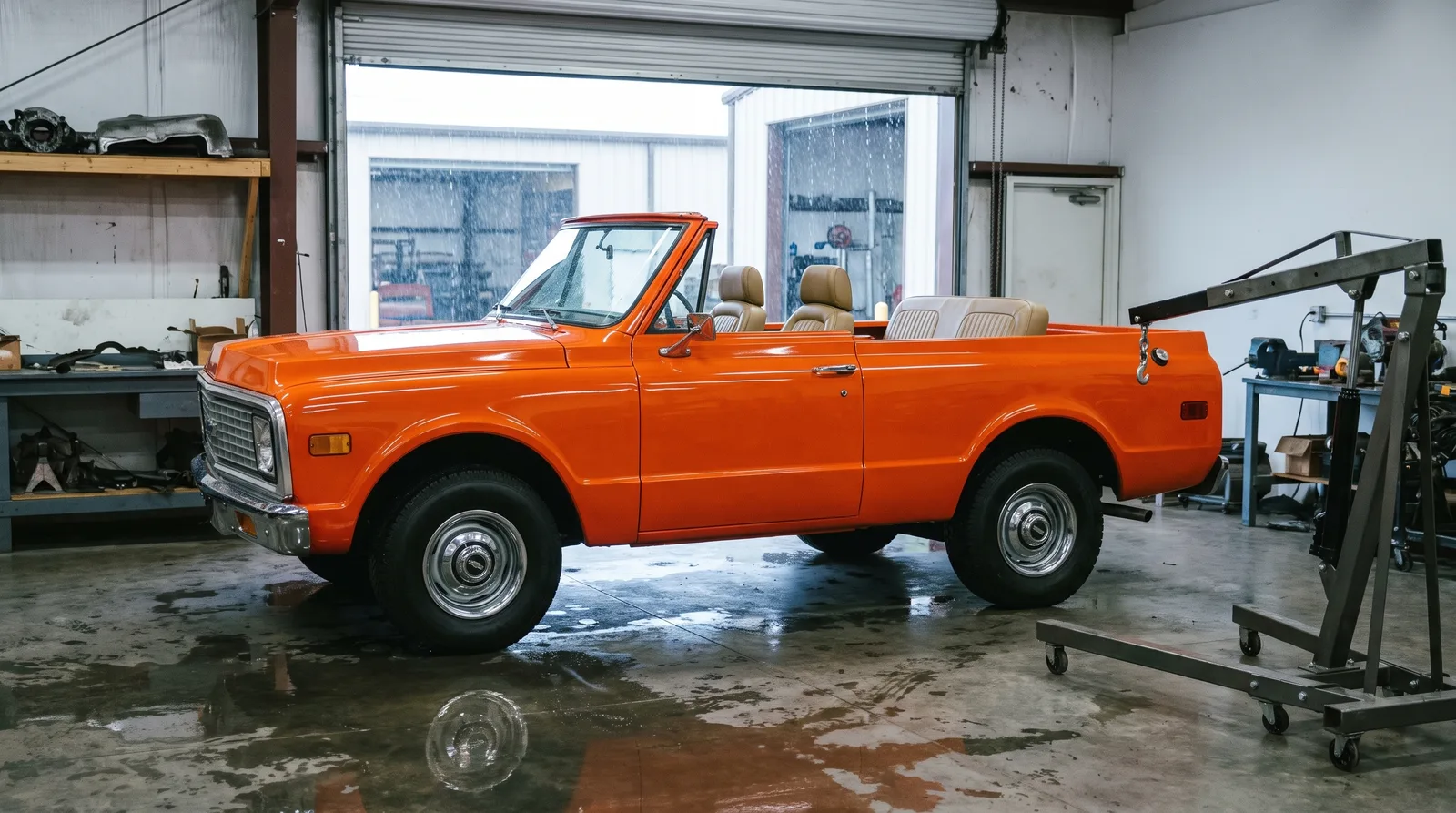
Selling capability first, freedom second
Look at period print ads for the K5 Blazer and a pattern shows up fast. Chevrolet leaned hard on the truck's toughness, its four-wheel drive capability, and its shared bones with the full-size pickup line, before it ever got around to talking about the top coming off. That ordering was deliberate. The company was competing against a market that already associated open air trucks with recreation only, smaller vehicles like the early Bronco that read as fun first and useful second. Chevrolet's pitch flipped that hierarchy, positioning the Blazer as a genuine work truck that also happened to shed its roof, rather than a toy that also happened to be somewhat useful.
Once that capability case was made, the copywriting would open up into the lifestyle angle, showing the truck loaded with camping gear or parked at some scenic overlook with the top stowed away. The message underneath all of it was consistent. You are not choosing between a practical truck and a fun one. You are getting both, and Chevrolet wanted every reader to understand that tradeoff simply did not exist with the K5.
The visual language of the campaigns
Photography in these ads almost always framed the K5 topless, even when the copy was describing a feature that had nothing to do with the roof. That was not an accident. Chevrolet understood that the removable top was the single most visually distinctive thing about the truck, the one detail a reader would remember after flipping past dozens of other vehicle ads in the same magazine. A closed K5 looked like a slightly larger Bronco competitor. A topless K5 looked like nothing else on the road, and the marketing team leaned into that difference at every opportunity.
Settings mattered too. Rarely did these ads show the truck parked on pavement or in a suburban driveway. Lakes, mountain roads, open desert, and campsites did most of the visual work, reinforcing the idea that this was a truck built for a specific kind of destination rather than a daily commute, even though plenty of owners used it exactly that way.
Print media and the limits of the message
Magazine advertising in the early 1970s had real constraints that shaped how much of the K5 story a single ad could actually tell. A full page spread had room for one dominant image and a short block of copy, which meant every campaign had to choose its single strongest selling point and lean on it hard rather than trying to cover every feature the truck offered. That constraint is part of why the removable top shows up so consistently as the visual anchor across so many different ads, even ones technically focused on selling a different feature like the drivetrain or the interior.
Television spots of the era, where they existed for trucks at all, faced a similar problem but solved it differently, using motion to show the top actually coming off rather than relying on a static photograph to imply it. Few of those early spots survive in good quality today, but the ones that do reveal a marketing team clearly aware that the physical act of removing the roof was more persuasive on film than any amount of written copy could manage on a printed page.
What the ads got right about the buyer
The genius in this campaign approach, if you can call it that, was how accurately it read the actual K5 buyer rather than an imagined one. These were not primarily wealthy hobbyists buying a second recreational vehicle. Many were families and working owners who needed one truck to do everything, haul lumber during the week and take the family camping on the weekend, and Chevrolet's advertising spoke directly to that reality instead of pretending the K5 existed in some fantasy recreational world separate from actual truck ownership.
That honesty shows up in small details across the period materials, work gloves sitting on a tailgate next to camping gear, a truck shown towing a boat in one shot and hauling firewood in the next. It was a marketing strategy built on the idea that a buyer's life did not separate neatly into work and leisure categories, and the K5 was pitched as the one vehicle that did not force that separation either.
"Whoever wrote that copy understood the truck better than half the restorers I meet today. They weren't selling a convertible. They were selling one truck that did everything, and the top coming off was just proof of it."
- Jim Vasquez
Dealer materials versus national campaigns
National magazine ads told one part of the story, but a lot of the real persuasion happened closer to the ground, in the brochures and showroom handouts individual dealers used to close a sale. Those local materials often leaned even harder into the lifestyle imagery than the national campaigns did, sometimes pairing the K5 with regional activities specific to a dealer's own market, hunting and fishing in one region, beach and boat towing in another. That localized approach let dealers sell the same fundamental idea, one truck for everything, while tailoring the specific fantasy to whatever their own customers actually cared about.
Salesmen of the era reportedly leaned on the removable top as a demonstration tool as much as a talking point, walking a prospective buyer around the truck and physically showing how the top came free, letting the mechanism itself do part of the selling. That kind of hands-on demonstration is hard to capture in a printed ad, but it shaped how a lot of buyers experienced the truck for the first time, turning an abstract feature into something tangible before they ever signed the paperwork.
Why the campaign still resonates
Decades later, those original ads circulate constantly among K5 owners, reprinted on shop walls, shared in club newsletters, and referenced by restorers trying to nail a period correct presentation. Part of that staying power comes from nostalgia, sure, but a bigger part comes from how accurately the imagery still matches what people actually want from these trucks today. The camping trip, the open trail, the loaded tailgate, none of that has aged the way a lot of period advertising does when you look back at it now.
For anyone who wants the deeper k5 blazer convertible history behind why this particular top became such a short lived but memorable feature, that full account fills in what the advertising only hinted at. There is also a related story worth reading for anyone curious how that same open top design gets reinterpreted by builders working on these trucks today. And if the old campaigns have you thinking about owning one yourself, there are K5 Blazers for sale now worth a look, several of them still wearing the exact kind of top those advertisements were built around.
Sources and notes
Related Reading
Have a
Chevrolet Blazer
for Sale?
Reach thousands of serious classic car collectors across the US.
Sell It Here →
Selling a classic? Here's how: compare the places to sell classic cars
Are You a Classic Car Dealer?
List your full inventory and connect with targeted classic car buyers.
Join as a Dealer →

About the author
Jim Vasquez
Southern California hot rod and custom car builder with roots in the traditional kustom kulture scene.
Related Listings - Chevrolet Blazer




Comments
Be the first to comment on this article.