
A man in Flagstaff once told me he remembered the exact Saturday his father lifted the top off their new Blazer for the first time, in a driveway still damp from an April rain, with the neighbors watching like it was a magic trick. It kind of was. Understanding k5 blazer convertible top how it worked means understanding that Chevrolet engineered a genuine disappearing act into a full-size truck, and did it so cleanly that ordinary owners, not mechanics, could pull it off in their own driveways.
Car Features
7 min read
How the Full Convertible Top Actually Worked
The story behind the engineering that let ordinary owners lift the entire roof off a full-size K5 Blazer in their own driveway, and why it only lasted a few model years.
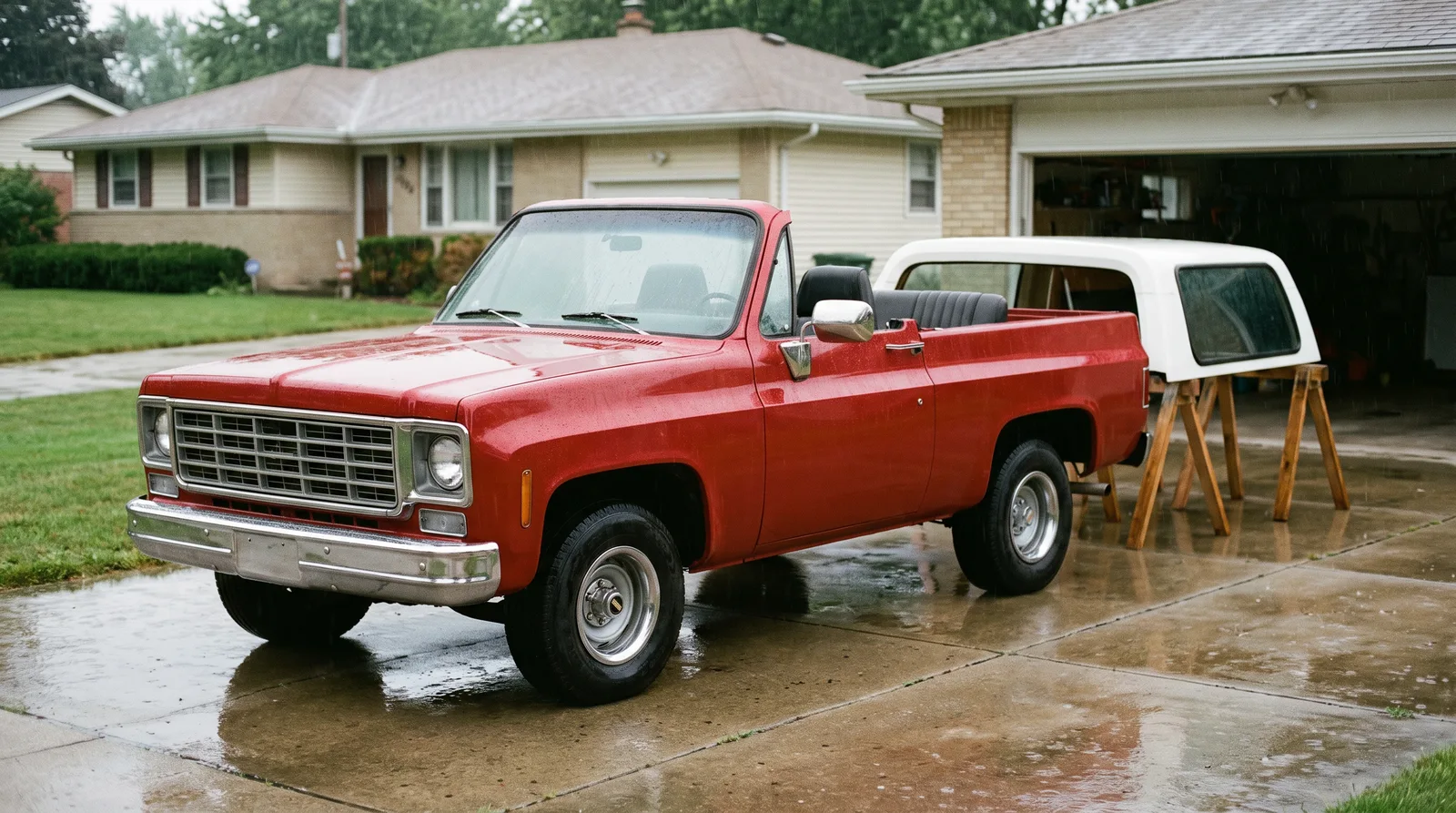
The mechanism itself was not exotic. It was smart, simple, and built to survive years of amateur hands doing exactly what the factory intended.
The idea behind a one-piece removable roof
When Chevrolet's engineers sketched the first K5 Blazer for 1969, they were not solving a styling problem. They were solving a market problem. Buyers wanted the rugged capability of a truck and the open-sky appeal of a Jeep, and nobody had married the two at full size. The solution was to treat the entire top structure, from the windshield frame back over the cab and cargo area, as a single removable shell rather than a fixed body panel welded to the frame. That single decision is the whole story. Everything else, the latches, the seals, the reinforced rails underneath, existed to support that one idea.
The shell sat on a ring of mounting points running along the body sides and rear, cushioned by weatherstripping thick enough to keep a highway-speed cabin quiet and dry. It was not a tent stretched over a frame. It behaved structurally like a real roof until the moment someone chose to take it off.
What actually happened when the top came off
The removal itself was less complicated than owners expected the first time. A handful of latch fasteners along the beltline released the shell from the body, two connectors under the front edge disengaged the dome light and the windshield wiper motor, and from there the panel simply lifted straight up and away. Two adults could manage it without special tools, which was the entire point. Chevrolet was not selling a show truck. It was selling a truck that could go from enclosed cab to open air between a Friday night and a Saturday morning drive, then back again before Monday.
What made it feel remarkable was not any single step. It was the transformation itself, the way a truck that looked completely conventional at a stoplight could, an hour later, look like nothing else on the road. Owners who lived near lakes and trailheads treated the top like a seasonal decision, on for winter, off for the months when the weather cooperated.
Why the engineering held up better than expected
Trucks built to be taken apart by their owners tend to loosen over time, yet a well-kept original top still seats with surprising precision decades later. The tolerances at the mounting rail were generous enough to forgive minor misalignment but tight enough that a properly seated top did not rattle or whistle at speed. That balance, forgiving to install yet solid once installed, is the part modern reproduction parts struggle to match exactly, which is why an original, unmolested top commands real respect among people who know these trucks.
The design also had to survive weather it was never going to see with the top on. Sun cracked the fiberglass variants if they were stored improperly. Steel tops, left off through wet seasons without care, rusted at the very rail where the seal met the body. None of that reflects a flaw in the concept. It reflects what fifty years does to any removable structure that owners actually used the way it was meant to be used.
"There is something almost domestic about it, a family deciding each spring whether the truck gets its roof back on. That decision, repeated for years, is as much a part of these trucks as any bolt or bracket."
- Nora Beckett
How weather and terrain shaped daily use
Owners did not treat the top as an all-or-nothing seasonal ritual everywhere. In the desert Southwest, some kept it off for most of the year and reserved reinstallation for the rare stretch of winter rain. In the Pacific Northwest, the calculation ran the other way, top on nearly year round, off for a handful of dry summer weekends that felt earned rather than routine. The truck adapted to the climate because the whole system was designed around a genuine choice rather than a fixed configuration, which is not something you can say about most vehicles from that decade or this one.
Camping trips and beach runs are where the design earned its reputation. A family could load the cargo area, drive to a lake with the top already off, and have full headroom for gear that would have been awkward to wrestle past a fixed roofline. That practicality, not just the novelty of the open-air look, is why the feature stuck in people's memory long after the trucks themselves moved on to new owners.
A short window before the design changed for good
Chevrolet built the truck this way from 1969 through the 1975 model year, carrying the one-piece top over into the redesigned 1973 squarebody chassis before finally dropping it for 1976. Read our complete history of the full convertible K5 Blazer for how the story unfolded from there, including why the company moved to a fixed-cab design with the 1976 model year. The short answer is that a truck with a permanently welded cab and only a removable rear section was cheaper to build, stiffer structurally, and safer in a rollover, but it also meant the true one-piece removable top, the thing that made those early trucks feel like nothing else on the road, only exists on a seven-year run of model years.
That scarcity is part of why the mechanism still gets talked about with a kind of reverence among people who never even owned one. It was a small, clever piece of engineering that asked something unusual of its owners, trust that a truck could be a truck and something closer to a convertible on the same afternoon, and it delivered on that promise for as long as it lasted.
If that story has you looking for an original example, you can find a classic K5 Blazer and see how many still carry an untouched top after all these years. It is fewer than you might think, and that is exactly why the ones that do stand out the moment the top comes off.
The man in Flagstaff sold that Blazer decades ago. He still talks about the sound the latches made, a series of small clicks before the whole roof lifted free, like the truck itself was exhaling.
Sources and notes
Related Reading
Have a
Chevrolet Blazer
for Sale?
Reach thousands of serious classic car collectors across the US.
Sell It Here →
Selling a classic? Here's how: sell my classic car
Are You a Classic Car Dealer?
List your full inventory and connect with targeted classic car buyers.
Join as a Dealer →

About the author
Nora Beckett
Automotive features writer and photographer who tells the human stories behind the cars, from show fields to cross-country road trips.
Related Listings - Chevrolet Blazer




Comments
Be the first to comment on this article.