
Everybody wants to talk about the L78. Nobody wants to talk about the L35 and L34, and that's backwards, because those two engines are what most SS396 buyers actually drove home from the dealership. I've pulled apart enough of these to tell you the L78 gets the magazine covers and the L35/L34 get the actual daily use, and there's a real argument that the middle-ground cars are the smarter buy for most people reading this right now.
Car Features
6 min read
L34 and L35: The Middle-Ground 396s
The L35 and L34 396 were what most SS396 Chevelle buyers actually drove home. Here's how they differ from each other and from the rarer L78.
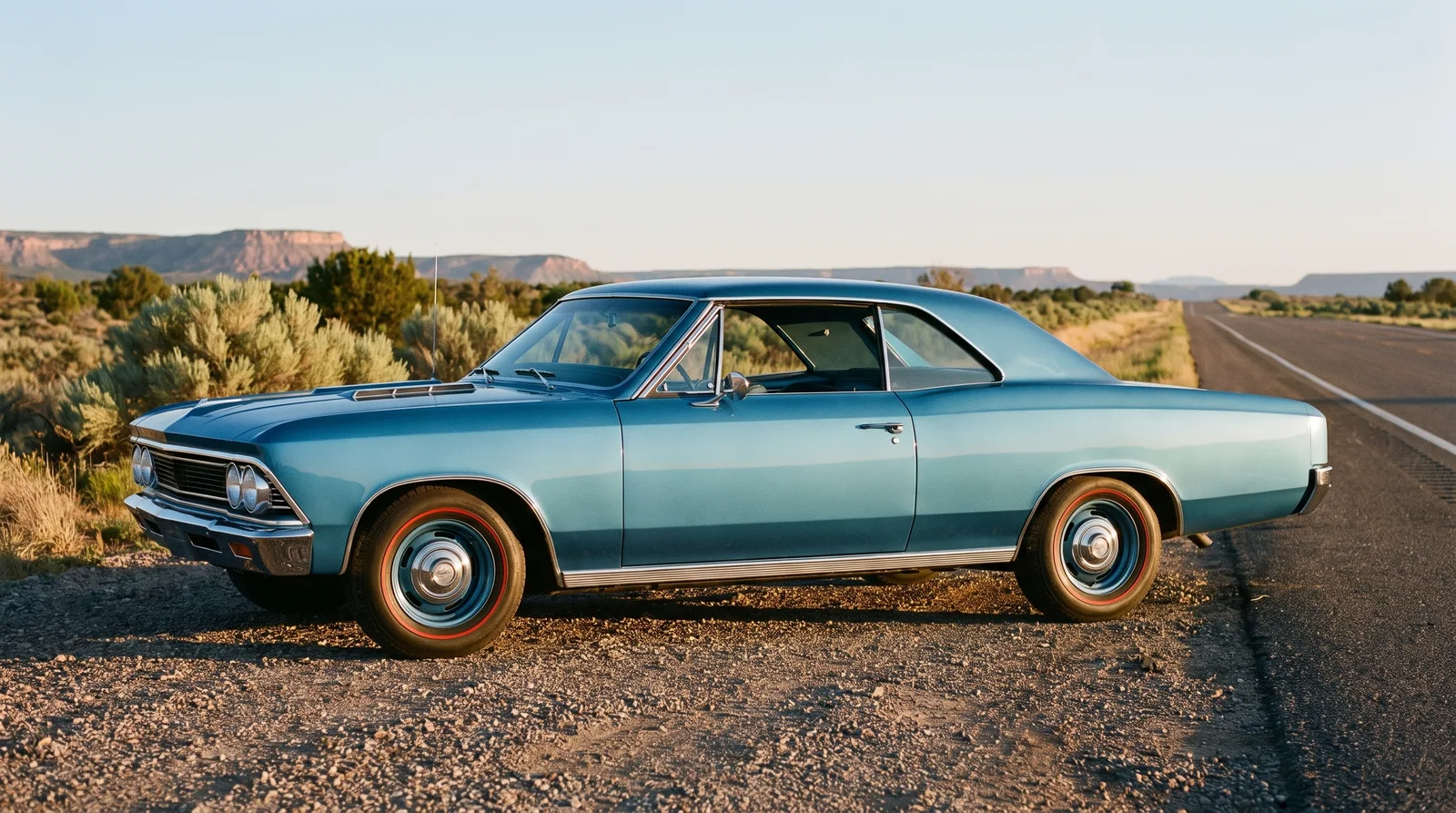
These aren't consolation-prize engines. They're the 396 doing what a 396 is supposed to do for a normal owner, and understanding what separates them from each other, and from the L78 sitting above them in the LS6 454 legacy that eventually replaced the 396 entirely, matters if you're actually trying to buy the right car instead of just the right badge.
L35: the base 396, and there's nothing wrong with that
The L35 was the entry point into 396 power, rated at 325 gross horsepower at 4800 rpm on hydraulic lifters with a Rochester Quadrajet or Holley carburetor and a 10.25:1 compression ratio. Hydraulic lifters mean no periodic lash adjustment, which is a real quality-of-life difference from the L78's solid-lifter demands. This is the 396 you buy if you want big-block torque and sound without turning ownership into an ongoing maintenance project.
Most SS396 Chevelles that left the factory carried an L35 or L34, not an L78. That's just math. The high-output solid-lifter engine was always a smaller slice of production, and the L35 was the volume seller. If you're restoring a car to original spec and it left the factory with an L35, putting an L78 in it isn't a restoration, it's a different car wearing the original's VIN tag.
L34: the step up that still lives with you
The L34 split the difference, rated at 350 to 360 gross horsepower depending on year (360 hp at 5200 rpm in 1966), still on hydraulic lifters, at the same 10.25:1 compression as the L35 but with a more aggressive cam profile and forged internals. It's the engine for somebody who wanted more than base-level 396 power but didn't want the solid-lifter maintenance and rougher idle that came with the L78.
I'll be honest, the L34 is probably my favorite of the three from a livability standpoint. It's got real bite over the L35, enough that you notice it in normal driving, not just at wide-open throttle, and it doesn't punish you with valve adjustments every few thousand miles the way the L78 does. It's the engine that splits the difference smartly instead of splitting the difference and losing what made both options good in the first place.
| Engine | Approx. horsepower | Valvetrain | Carburetor |
|---|---|---|---|
| L35 | ~325 hp | Hydraulic lifters | Rochester Quadrajet |
| L34 | ~350-360 hp | Hydraulic lifters | Rochester Quadrajet |
| L78 (for reference) | ~375 hp | Solid lifters | Holley 4-barrel |
Why these get overlooked, and why that's a mistake
People chase the L78 because it's the number that shows up in the magazine articles and the auction headlines. That's fine, chase what you want, but it means the L35 and L34 market is quieter, more honest, and frankly easier to shop in without somebody trying to sell you a story along with the car. Fewer people are faking an L35 into something it isn't, because there's no premium in doing it. That's actually a buyer's advantage if you know where to look.
The other thing nobody mentions: an L34 with good gearing is not a slow car by any real-world measure. It's a genuinely quick, torquey big-block that will embarrass plenty of small-block cars people assume are faster because they've got a bigger reputation. Don't let the absence of a famous engine code make you think you're settling. You're buying the 396 that most original owners actually chose, and there's nothing wrong with that.
🔧 Inspection Priorities
- Confirm the engine code matches the build sheet. An L35 with an L34 cam swapped in isn't an L34, and the casting numbers will tell you the truth even when the seller doesn't know it.
- Check for a modified L35 posing as an L34. Cam swaps are common and cheap, and a modified L35 idling rough isn't automatically the real thing.
- Quadrajet condition and originality. A tired, rebuilt-wrong Quadrajet will make either engine feel weaker than its real output, and buyers mistake that for a bad engine instead of a bad carb.
Values and what to actually pay
L35 and L34 Chevelles run well behind documented L78 cars in the market, and that gap is only going to matter to you if you're chasing investment value over driving enjoyment. For a daily driver or weekend cruiser, the money you save buying an L34 over an L78 covers real maintenance costs down the road, and you're not carrying the solid-lifter upkeep burden that comes with the higher-output engine. Buy the L35 or L34 that's honestly documented and mechanically sound over an L78 with a shaky paper trail every time. A real L34 beats a fake L78 in every way that matters once you're actually driving the thing.
"Most of these Chevelles that came through my shop over the years weren't L78 cars. They were L35s and L34s that somebody's grandfather bought new because it was a good, strong engine that didn't ask for babysitting, and that's still a good reason to buy one today."
Mike Sullivan
Once you understand where the L35 and L34 sit in the lineup, the story of what came next, when the 396 quietly became something slightly different under the hood, makes a lot more sense. Next: The 396 That Became a 402 covers exactly that.
Sources and notes
- Chevy 396 & 402 Big Block Guide - Complete Specs and History - Muscle Car Club
- Differences between 396 L34 & L35 - Team Chevelle
- Chevy 396 V8 Engine - Engine Facts
- 1966 Chevrolet Mid-Size Cars Fact Sheet - Over-Drive Magazine
- 1967 Chevrolet Mid-Size Cars Fact Sheet - Over-Drive Magazine
- 1966 396 Engine Factory Specifications - It Still Runs
Related Reading
Have a
Chevrolet Chevelle
for Sale?
Reach thousands of serious classic car collectors across the US.
Sell It Here →
Are You a Classic Car Dealer?
List your full inventory and connect with targeted classic car buyers.
Join as a Dealer →

About the author
Mike Sullivan
Detroit-area muscle car enthusiast and restoration specialist with three decades of hands-on experience working on American iron.
Related Listings - Chevrolet Chevelle

Comments (1)
E
Eddie Carlisle
2 months ago
The insurance section is worth a separate article. A lot of people reach claim time before realizing agreed value coverage is completely different from what they bought.