
In early February 1942, the War Production Board's ban on civilian automobile production took effect, and every American assembly line went quiet within days of one another. Not slow down, stop. Whatever rolled off a given line that week was, in most cases, the last civilian car that plant would build for the duration. Records from the period show the order came with almost no grace window, and a handful of factories were still finishing partial builds when the shutdown notice arrived.
Car Features
6 min read
The Last Cars Built Before the WWII Freeze
When the War Production Board ordered every assembly line stopped in February 1942, a small number of cars became accidental milestones. Here is how to identify and document them.
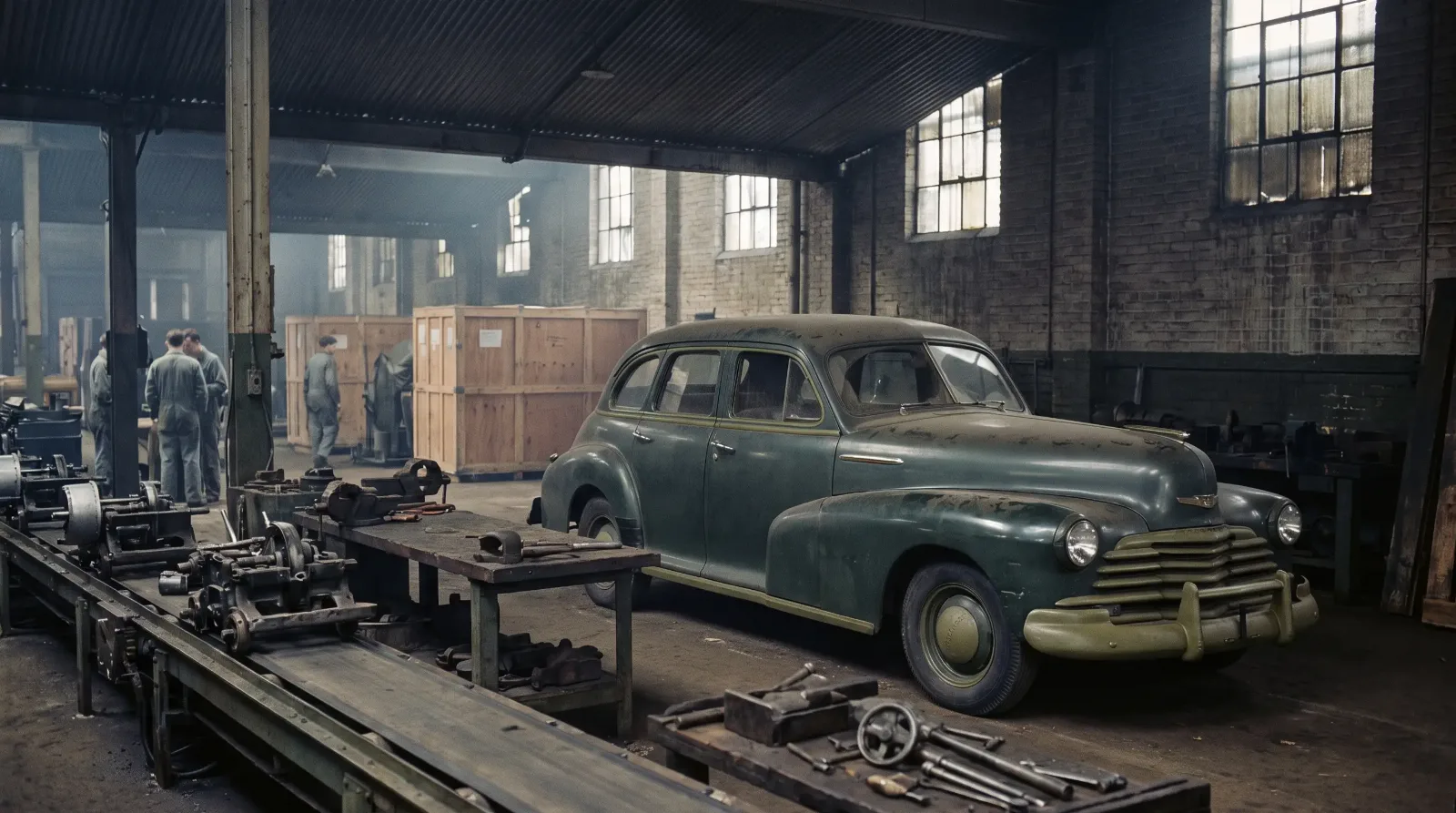
That abruptness is why the "last cars before the freeze" carry a specific kind of documentation interest today. They were not the end of a model run in the normal sense, planned obsolescence, a new design waiting in the wings. They were simply the cars that happened to be on the line when the government pulled the plug. Tracing which cars those were, and how their build sheets differ from the ones built a few weeks earlier, is a narrow but rewarding corner of production history.
The order that stopped Detroit
The freeze did not appear out of nowhere. Through late 1941, the War Production Board had already been rationing chrome, rubber, and other materials needed for the war effort, and automakers had been building out remaining parts inventories rather than sourcing new stock. When the formal order came in early 1942, it was less a shock than a deadline everyone in the industry had been watching approach.
Plants responded differently depending on how much material they had on hand. Some finished the day's scheduled production and closed. Others had already begun converting tooling and floor space to war work before the order was even issued, since contracts for military production had been signed months earlier. The result is that "last car" dates vary by factory and even by shift, which is part of why pinning down an exact final unit for a given nameplate is often harder than collectors expect.
What was still on the line in early 1942
Most 1942 model year cars had gone into production in the fall of 1941, so by February they were only a few months into their run. That means many "last" 1942 cars are mechanically and visually close to the bulk of the model year, distinguished mainly by a build date and sometimes small running changes made as parts substitutions became necessary.
Chrome trim is the detail most often cited. As chrome-plated steel was redirected to war production, some late-production 1942 cars used painted trim instead, a stopgap that later became formalized in the dedicated blackout models built in the final weeks before the freeze. A car with painted rather than plated trim, combined with a documented early-1942 build date, is one of the stronger signals that it came from the very end of the run rather than the general 1942 production pool.
Which cars carry the "last one" story
Several manufacturers have documented claims to a specific "last car before the freeze," though the paper trail behind these claims is uneven. Ford's Rouge complex, Packard, and a handful of independents each have a car or two associated with the final day of production, usually preserved because a plant manager or line worker recognized the moment's significance and set the vehicle aside rather than shipping it to a dealer.
These survivors tend to carry outsized documentation, factory photographs, newspaper clippings from the period, sometimes a company letter noting the occasion, because the people who saved them understood they were saving something specific. That documentation is what separates a verified "last car" from a car that merely has an early-1942 build tag. Collectors should treat undocumented claims with some skepticism; the number of cars informally described as "one of the last built" is larger than the number that can actually be traced to a specific closing shift.
Reading the dates on a genuine early-1942 car
Verifying a car's place in the production timeline starts with the build tag or data plate, which typically records a date or a sequential body number that can be cross-referenced against factory shipping records where they survive. A tag alone rarely proves finality, since it only shows the car was built during the window, not that it was among the very last units.
Original invoices, dealer delivery paperwork, and period newspaper coverage of a plant's closure add the context a data plate cannot. Where those documents exist, they turn a car from "an early-1942 example" into something closer to a dated historical marker. Owners chasing this kind of provenance often find factory archives, where they still exist, more useful than club registries, since the archives sometimes retain shift logs from the closure itself.
| Detail | What it suggests |
|---|---|
| Painted trim in place of chrome | Late-production 1942 build, materials substitution underway |
| Sequential body number near end of run | Possible late-shift production, needs cross-reference |
| Factory or dealer paperwork dated Feb 1942 | Strong supporting evidence of a final-week build |
| Family or company letter noting the occasion | The strongest documentation type, though rare |
For readers digging into this period generally, the last cars before wwii guide lays out how the freeze fit into the broader decade, and it is worth read on for how the ban itself was administered once the lines went quiet.
Why these cars still matter
Interest in the last pre-freeze cars is not really about performance or design; most are ordinary 1942 models mechanically. What makes them worth studying is that they mark a hard stop in an industry that had been building cars continuously since before most of their owners were born. That stop lasted more than three years, and it reshaped the industry that resumed afterward.
Understanding the freeze also helps place these cars in the longer arc that produced them, a period some historians trace back to the golden age of the automobile, when American manufacturing scaled up to the point where an order like the 1942 freeze could shut down an entire national industry in a matter of weeks. Studying the final cars off the line is, in a small way, studying how completely that industry had grown.
"The paperwork matters more than the paint on these cars. Anyone can claim a 1942 model is one of the last ones built. Very few can actually show you the shipping ticket that proves it."
Tom Ramirez
For collectors, the lesson is patience. A documented last-off-the-line car is a genuine piece of production history, but the documentation has to come first, before the story does.
Sources and notes
- Seton Hall World War II Blog - government bans U.S. auto production
- MotorCities - World War II and the interrupted 1942 model production
- Wikipedia: War Production Board
- TeachingHistory.org - the auto industry goes to war
- Mac's Motor City Garage - Dodge in peace and war, 1942-46
- Defense Media Network - automobile factories switched to war production
Related Reading
Have a
Classic Car
for Sale?
Reach thousands of serious classic car collectors across the US.
Sell It Here →
Are You a Classic Car Dealer?
List your full inventory and connect with targeted classic car buyers.
Join as a Dealer →
#pre-war classics
#1942 production freeze
#wwii car history
#wartime automaking
#production dating
#classic car documentation

About the author
Tom Ramirez
Corvette researcher and historian based in Bowling Green, Kentucky. Two decades documenting Corvette production history from original factory records.
Comments
Be the first to comment on this article.