
Candy paint is the reason people walk up to a lowrider and go quiet. From ten feet it reads as one deep color. Get closer and it moves. The color has depth you can look into, like the difference between a painted red door and a glass of wine held to the light. That effect is not one coat of anything. It is a system of layers, and every layer is a chance to ruin the last one. That is why a real candy job costs what a used car costs.
Car Features
8 min read
Lowrider Candy Paint and Flake
Candy layered over a metallic base, flake buried flat under clear, patterns and fades metered coat by coat. Inside the craft that makes candy paint cost so much.
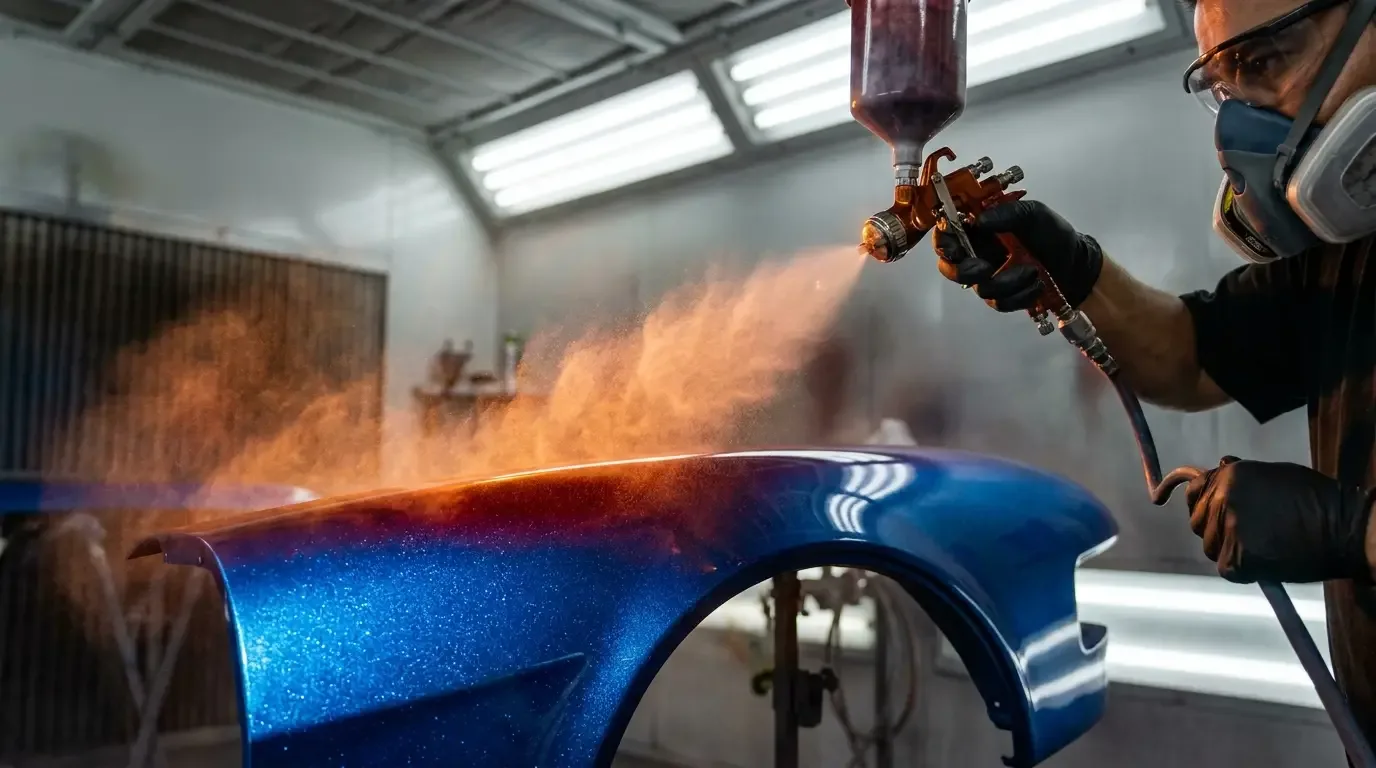
People lump candy in with any shiny custom finish, but it is a specific thing with specific chemistry. If you want the wider picture of how paint fits alongside murals, patterns, and leaf, start with lowrider paint as a whole. Here I want to stay on the candy itself, and on the flake, because those two are the hardest to fake and the easiest to spot when they are done wrong, and because getting them right the way our shops do is a point of real pride.
Why candy has depth and regular paint does not
A standard color coat is opaque. Light hits it and bounces straight back off the surface. Candy is translucent, which is the whole trick. You spray a bright, reflective base first, almost always a metallic silver or gold. Then you lay a transparent tinted coat over it, the candy, and light passes through that tint, hits the metallic underneath, and bounces back out through the tint again. The eye reads that double pass as depth. The color looks like it has a floor several inches below the surface.
The catch is that translucent coats build color as they stack. One pass looks pale. Six passes look rich. Ten passes look almost black. So the painter is not just laying color, he is metering it, coat by coat, trying to land every panel at the exact same number of passes. Miss it on the roof by a coat and a half and the roof reads a shade different from the doors in direct sun. There is no fixing that with a touch-up. You do not touch up candy. You redo the panel, and often the panels next to it, so the count matches.
Metalflake, and why more is not better
Flake is the other half of the sparkle you see on a show car. It is exactly what it sounds like, tiny flat pieces of aluminum or polyester, sized in microns and thousandths, sprayed suspended in a clear or tinted binder so each fleck sits in the film and catches light at its own angle. Big flake, the old bass-boat stuff, throws hard chunky sparkle. Micro flake reads almost like fine sugar and plays better under candy because it does not fight the color.
Here is what separates a builder from a hobbyist. Flake has edges, and edges make texture. Spray a heavy flake coat and the surface feels like sandpaper. If you shoot candy or clear straight over rough flake, you get a bumpy finish that never lays flat no matter how hard you buff. The fix is boring and expensive: bury the flake in clear, let it cure, then block-sand that clear dead flat so the flake edges are drowned and the surface is glass. Only then does the candy go on. That burying-and-blocking step is a whole extra round of material and days of labor, and it is the step cheap jobs skip.
"I can tell in about two seconds whether somebody buried their flake or just shot over it. Run your hand across the panel with your eyes closed. If you feel the sparkle, they skipped a step, and that panel is going to look like an orange peel forever. Real candy is smooth as a mirror and cold like glass."
Hector Morales
Patterns, fades, and the parts that take a real hand
Straight candy over flake is already a lot of work. Then people start taping. Patterns are the taped-off shapes, the fans, the seaweed, the spiderwebs, laid down so that some areas get more candy coats than others and the color shifts across the shape. A fade is the same idea with no hard line, where the painter walks the gun to build color heavier at one end of a panel and lighter at the other so the color melts from deep to bright.
None of that is forgiving. Because candy builds color by coat count, every taped section has to be sprayed to a planned number of passes, and the tape has to come up clean without a ridge, because a ridge shows under clear. A patterned roof might be masked and unmasked a dozen times, each round adding a layer that has to key to the one below without lifting it. This is where the hours pile up, and it is why two lowriders with the same base color can be worlds apart in price. One is a clean single-color candy. The other has forty hours of tape work living under the clear.
- Base: reflective metallic that sets the tone. A silver base makes candy bright, a gold base makes the same tint warmer and darker.
- Flake: optional, buried and blocked flat before any color, never sprayed rough under candy.
- Candy: the translucent tint, built in even passes, metered to a coat count that must match across every panel.
- Patterns: taped shapes and fades that change the coat count locally to shift color across the body.
- Clear: the thick protective top, sprayed heavy so it can be cut and buffed to a mirror without burning through.
The clear coat is the part that survives
The candy is the color, but the clear is the armor. Candy and flake are both fragile on their own. Flake edges want to corrode, and candy tint has no protection from sun or stone chips by itself. So the finish is buried under multiple heavy coats of clear that get sanded and polished. That top layer is what you actually touch, what you wax, what takes the wash-brush scratches at a show.
Builders shoot the clear thick on purpose, because the whole surface then gets color-sanded, wet-sanded with fine paper to knock every speck of dust and every hint of orange peel out of it, and then machine-buffed back to full gloss. You can only sand and cut what you have. Shoot the clear thin and you burn through to the candy on the first buff, and burning through candy means starting that panel over. This is also why lowriders are notoriously nervous about anything touching the paint. There are thousands of dollars of labor sitting in a film a few thousandths of an inch thick.
Why the whole car has to agree
Paint does not live alone on a lowrider. The color has to answer the wheels, the interior, and the stance, or the car reads as a parts pile. A deep candy tangerine wants the right spokes under it, which is its own craft worth understanding through Lowrider Wire Wheels, and it wants to sit at the right height for the light to play across the panels. The paint is the loudest single statement on the car, but it is a statement inside a much older conversation about pride, family, and neighborhood that you can follow through the story of the lowrider.
That is the honest reason candy costs what it does. It is not markup. It is base, flake, burying, blocking, color, patterns, clear, cutting, and buffing, each one a day or more, each one able to send you back to the start. When you see a candy job that stays even from roof to rocker and looks wet under a cloudy sky, you are looking at somebody who refused to skip the boring steps. That is the craft, and it does not photograph. You have to stand next to it.
Sources and notes
- Custom paint and refinishing references on candy, base coat, and clear coat systems.
- Builder and painter interviews on flake preparation, coat metering, and pattern masking.
- Period custom-car press documenting early dye-based candy finishes and their fading.
- Lowrider club and show records on judging criteria for paint and finish.
Related Reading
Have a
Classic Car
for Sale?
Reach thousands of serious classic car collectors across the US.
Sell It Here →
Are You a Classic Car Dealer?
List your full inventory and connect with targeted classic car buyers.
Join as a Dealer →

About the author
Hector Morales
East LA lowrider builder and lifelong member of the car-club scene, writing lowrider culture, hydraulics and custom paint from the inside.
Comments
Be the first to comment on this article.