
Ask ten people what a lowrider is and most will describe the wrong thing. They picture a car bouncing on three wheels in a music video, or they mix it up with a hot rod, or a slammed import on air. A lowrider is none of those by accident and all of it on purpose. It is a car laid down close to the pavement, dressed in color you can see your reflection in, and driven slow enough that everyone gets a good look. It came out of Mexican-American neighborhoods in East Los Angeles, and the whole point was never speed. The whole point was the opposite of speed.
Car Features
15 min read
The Lowrider Story
Low, slow, clean and rooted. The full story of the lowrider, from East LA barrios to candy paint, hydraulics, wire wheels and the clubs that keep it alive.
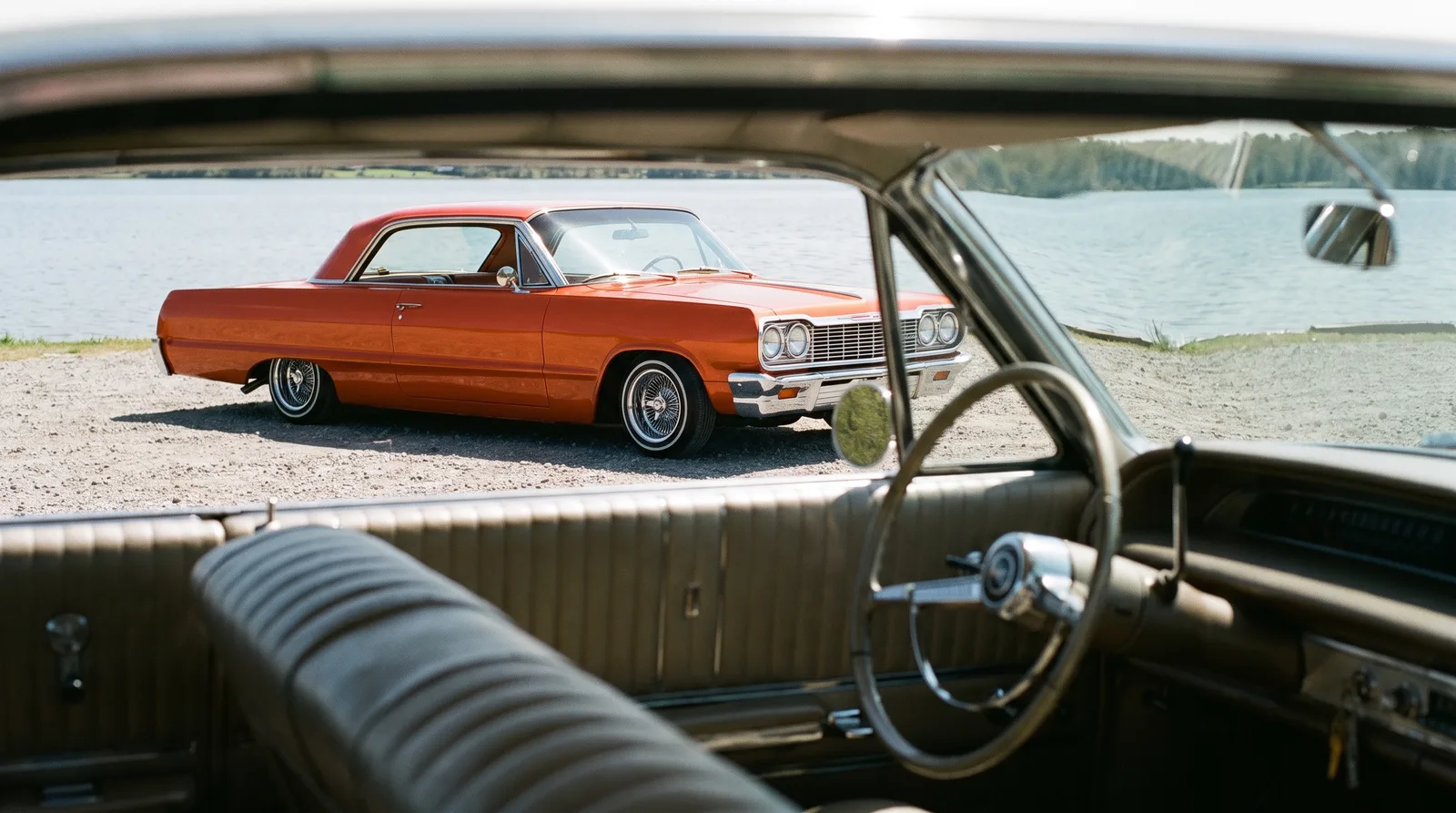
I've been building and painting these cars my whole life, and the thing outsiders miss is that the style is inseparable from where it came from. You cannot lift the look off the culture and expect it to mean anything. So this is the hub piece, the one that lays out the whole idea before we go deep on paint, hydraulics, platforms and the people who built the movement. If you want the shorthand: low, slow, clean, and rooted.
Low and slow is a philosophy, not a setting
Hot rodders wanted their cars fast and their bodies high enough to clear big tires. Lowriders did the exact reverse. The idea was to drop the car as close to the ground as the law and the pavement would allow, then roll through the neighborhood at a walking pace so the car could be seen and the driver could be seen in it. "Low and slow, mean and clean" is the old line, and it holds up. Cruising was the event. The destination barely mattered.
That value system explains almost every build decision that follows. You do not need a big-block if you are never going to race it. You do put months into a candy paint job because people are going to be standing three feet away studying it. You do put real money into wire wheels and a tucked interior because the car is a rolling statement about who put it together. The engineering serves the presentation, not the stopwatch. Once you understand that inversion, the rest of the culture reads clearly.
There is a contrast worth drawing out here, because people mix these worlds up constantly. A muscle car is built to leave you behind in a straight line. A hot rod is built to be loud, light and quick, sitting nose-down with big rear tires. A lowrider does the opposite of both. It sits its body down, keeps the wheels small, and is meant to be looked at, not chased. When someone slams an import on air and calls it a lowrider, they are borrowing the stance without the story. The stance came from a specific place and a specific people, and that is the difference between a style and a costume.
Slow also had a practical side. Cruising the boulevard was social. Two lanes of cars crawling past each other on a Friday night meant you could talk, trade looks at each other's work, and be part of a scene that ran for miles. Speed would have killed the whole thing. The car that could crawl the longest and cleanest, the one people leaned out of their windows to see, was the one that won the night. No trophy required.
Chicano roots in East Los Angeles
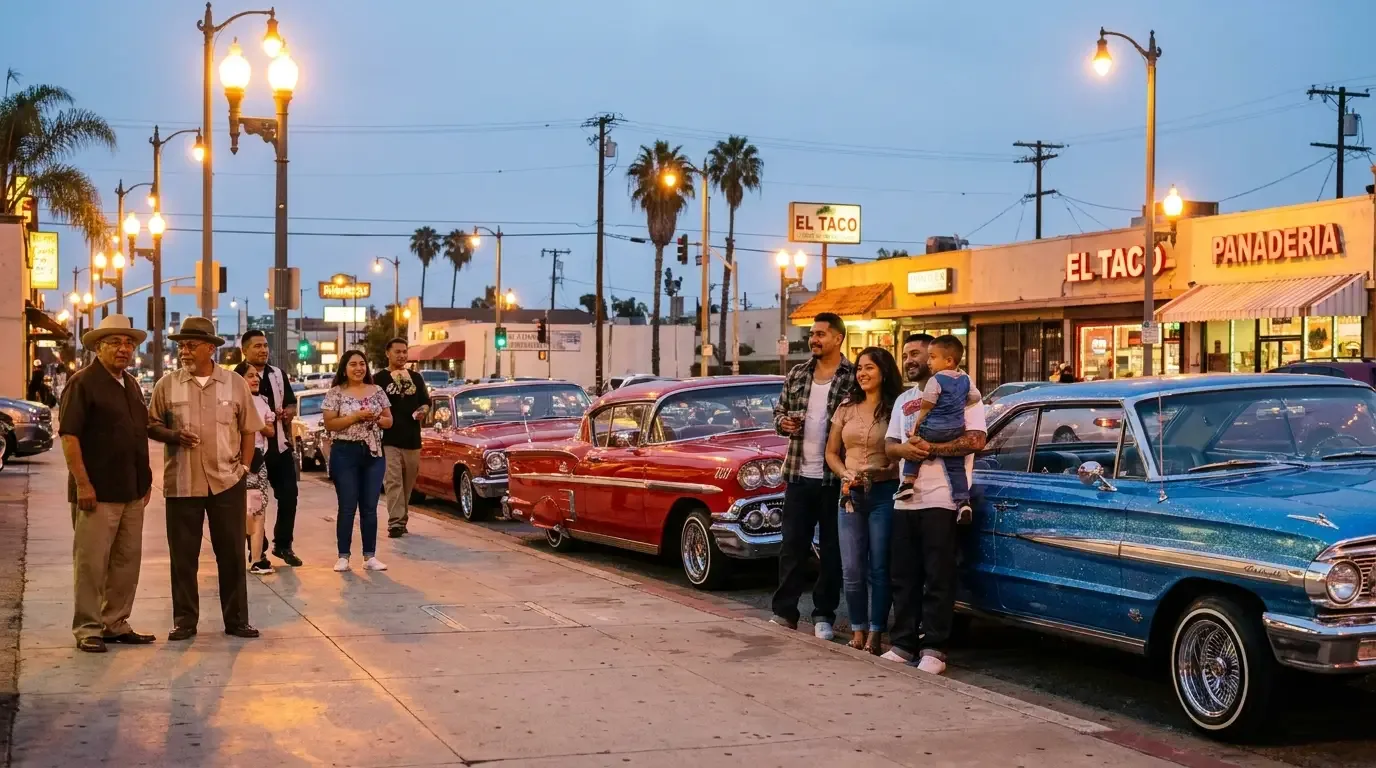
You cannot separate the lowrider from the Chicano community that created it. After World War II, young Mexican-Americans in East LA and the surrounding barrios wanted cars that looked nothing like the tall, chrome-heavy hot rods coming out of white suburban garages. Working with modest budgets and secondhand sedans, they lowered the cars, filled them with sandbags or cement in the trunk to sit them down, and made the family car into a canvas. It was a way to claim public space and show craft and pride at a time when both were in short supply for the community.
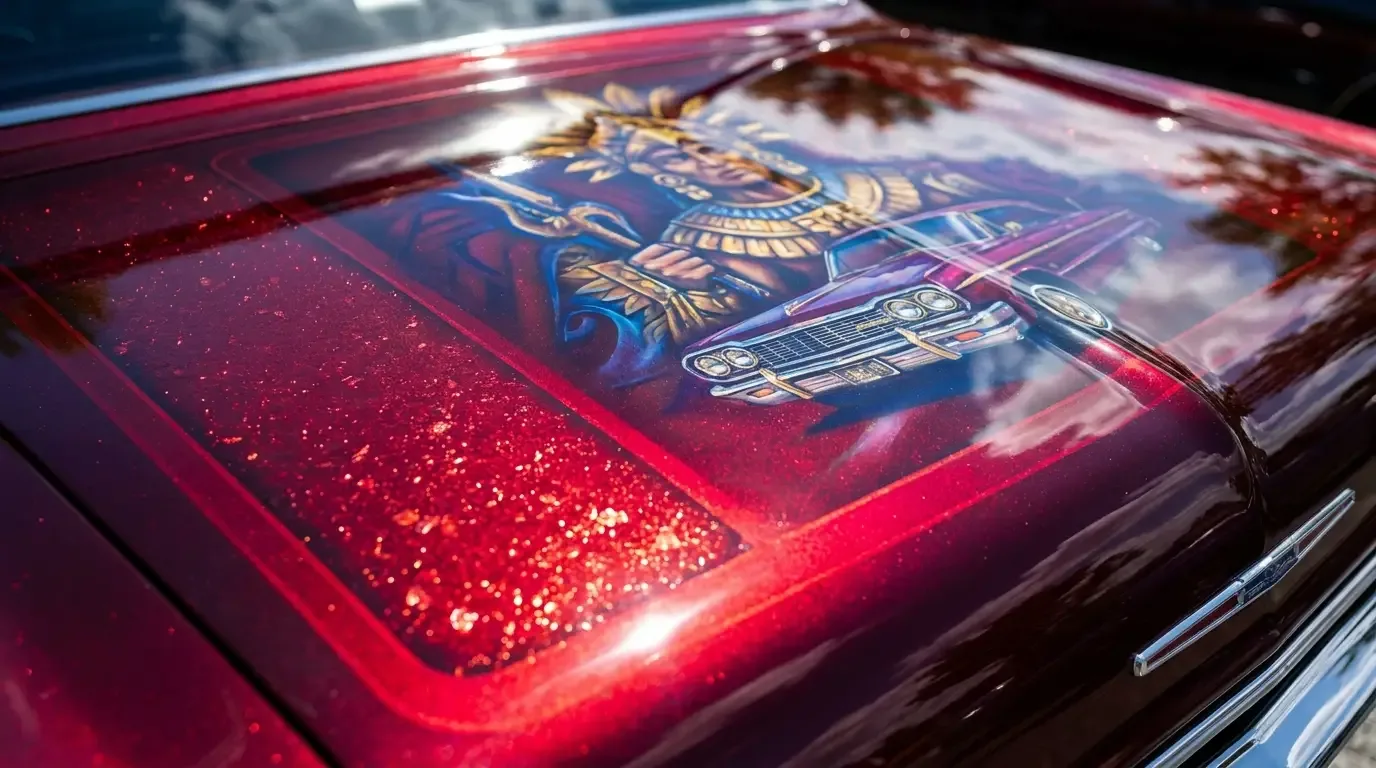
The imagery that came with it was never random. Murals of the Virgin of Guadalupe, Aztec warriors, family portraits and neighborhood scenes turned quarter panels into storytelling. Pinstriping, plaques and club names tied a car to a specific crew and a specific place. This is the deep well the whole style draws from, and I'd send anyone serious about it to read the full account of lowrider history before they ever pick up a spray gun. The build makes no sense without the story underneath it.
Some of the roots go back further than the cars themselves, to the pachuco style of the 1940s: the zoot suits, the sense of dressing sharp and moving with confidence in a society that did not make room for you. That attitude carried straight onto four wheels. Dropping the family Chevy and cruising it clean was a way of saying this neighborhood has taste, has skill, and is not going anywhere. It was pride expressed in chrome and lacquer, and it was often the family car, borrowed and reworked, not some throwaway toy. That is why so many of these builds are handed down. A lowrider is frequently a family heirloom with an engine.
It matters to say plainly that this is Mexican-American culture at the center, and it deserves to be represented accurately rather than flattened into a cliché. The music-video version, all bouncing cars and nothing else, sells a caricature. The real thing is a decades-long tradition of craftsmanship, family, faith and community organizing, expressed through the automobile. Treat it as the folk art form it is and everything about the cars starts to make sense.
The hydraulics that changed everything
For years the trick was to sit a car low and leave it there, but a car scraping frame on every driveway apron is a problem, and it was also about to become illegal. In 1958, California put Vehicle Code Section 24008 into effect, which made it unlawful to drive a car modified so any part of the body sat lower than the bottom of the wheel rims. That single law aimed squarely at lowered cars, and it forced a brilliant workaround.
In 1959, a customizer named Ron Aguirre debuted a 1956 Corvette he called the X-Sonic with hydraulic cylinders adapted from aircraft surplus pumps and valves. With a switch on the dash he could raise the car to legal height when a patrol car appeared and drop it again once the coast was clear. That was the birth of adjustable lowrider suspension. What started as a way to beat a ticket turned into an entire sport of hopping and dancing. If you want the mechanical side done properly, our piece on lowrider hydraulics walks through pumps, cylinders and the trade-off against modern airbags.
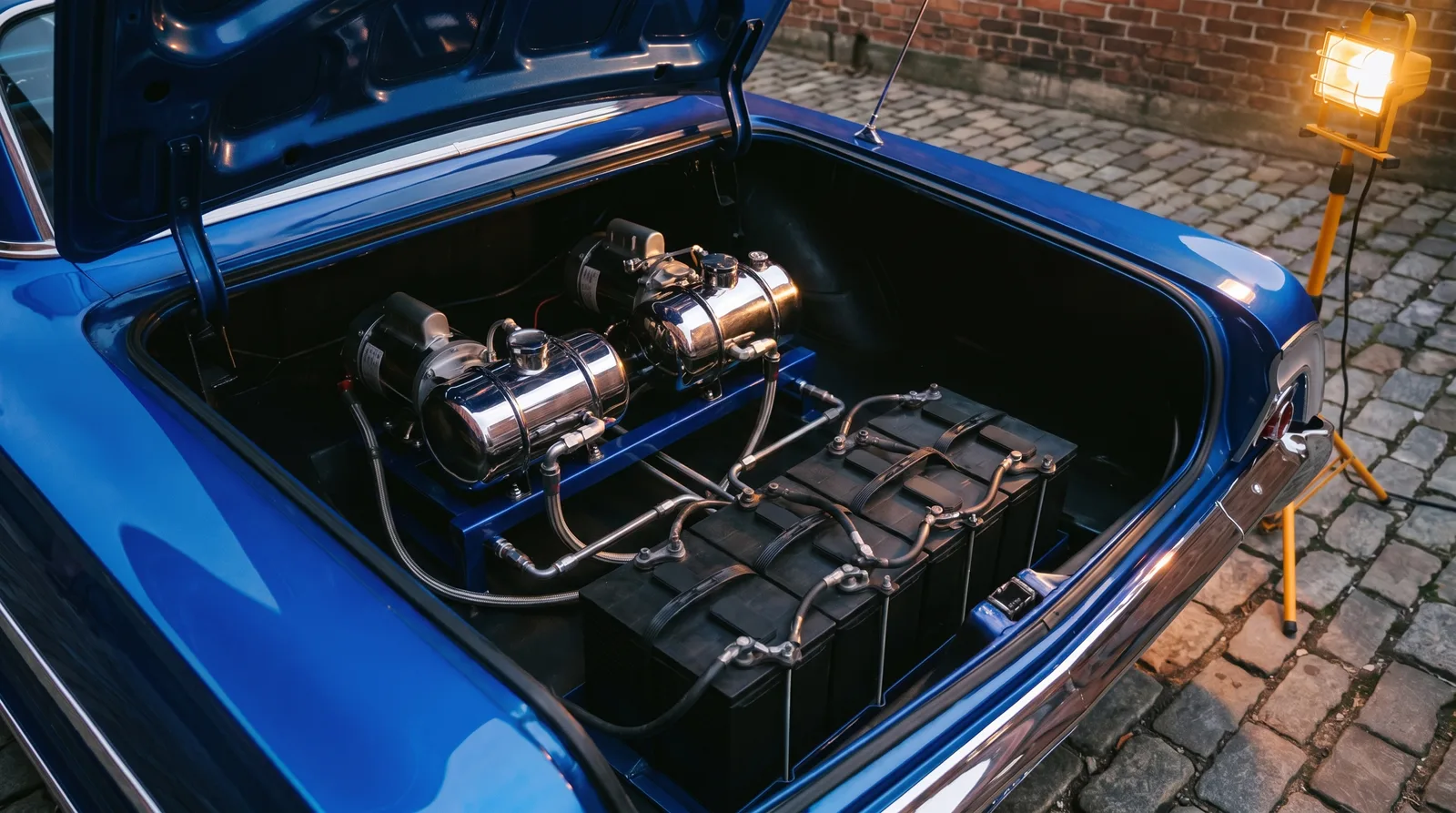
The basic idea has not changed much since then. A hydraulic setup puts a pump, a bank of batteries and a set of cylinders in place of the springs at each corner. Hit a switch and fluid pressure pushes the cylinder out and lifts that corner; dump the pressure and the corner drops. Run enough voltage and enough pumps and you can throw the front end up hard enough to bounce the car off the pavement, which is where hopping comes from. It was never designed as a trick. It was a legal dodge that turned into a competition all its own, judged on inches of lift.
Airbags arrived later as the softer, quieter alternative. Instead of fluid, a compressor fills rubber bladders with air, giving a smooth ride and an easy adjustable height without the violence of a hydraulic hit. Purists still argue about it. Hydraulics are the tradition and the only way to hop; bags ride nicer and are kinder to a nice paint job. Neither is wrong. They are two answers to the same original question of how to lay a car down and still drive it home.
| Element | Traditional approach | What it does for the car |
|---|---|---|
| Suspension | Hydraulic pumps and cylinders, or airbags | Raises and lowers the car at a switch; enables hopping |
| Paint | Candy color over metallic base, often with flake and murals | Depth and color shift that changes with the light |
| Wheels | Wire-spoke wheels, commonly 13 or 14 inch | The signature small-wheel, chrome-spoke stance |
| Interior | Tuck-and-roll upholstery, often crushed velour or leather | Rolled and pleated pattern, a craft tradition of its own |
| Stance | Body dropped close to the pavement | The low silhouette the whole thing is named for |
Candy paint, flake and murals
Paint is where a lowrider earns its reputation, and it's where I've spent most of my working life. Candy paint is a translucent color sprayed over a bright metallic or gold base, so light travels through the color, bounces off the metal underneath and comes back out. That is why a candy apple red looks lit from inside rather than painted on. Metalflake adds glitter suspended in clear coat, and on the top builds you get layer after layer of clear cut and buffed until the surface reads like glass.
Then there is the artwork. A real lowrider mural is airbrushed by hand, and the good ones are fine art on sheet metal. Patterns, fades, leafing and pinstriping stack up in ways that take a skilled painter weeks. This is not a wrap and it is not a rattle can. It is a discipline, and it separates a built car from a poser's weekend project faster than anything else on the vehicle. The full breakdown lives in our guide to lowrider paint, murals and the finish work that defines the look.
Wire wheels and tuck-and-roll interiors
The details finish the statement. Chrome wire-spoke wheels are close to mandatory, and a serious set with true spokes and knock-off caps is expensive on purpose. Inside, tuck-and-roll upholstery, rolled and pleated panels in velour or leather, is its own craft handed down through generations of trimmers, much of it traceable to shops in Tijuana and East LA that specialized in the work. Get either of these wrong and the whole car reads cheap no matter how good the paint is.
The tuck-and-roll tradition is older than the lowrider itself, going back to hot-rod and kustom interiors of the 1950s, but the lowrider scene took it furthest. A top trimmer builds each pleat by hand, rolls it over foam, and matches the pattern across seats, door panels, headliner and often the trunk that houses the setup. Color has to agree with the paint outside. Done right, opening the door on a finished car is its own reveal, and it is one of the clearest signs of how much time and money went into the build.
- Wire wheels: 13x7 or 14x7 reversed, chrome spokes, knock-off caps, narrow whitewalls.
- Tuck-and-roll: hand-rolled pleats, matched to the exterior color, often carried into the trunk over the hydraulic setup.
- Chrome and gold: undercarriage, suspension arms and engine bay plated so the car looks finished from every angle.
"People think the paint is the flex. The flex is the discipline. A candy job that stays flat and clean for years, wheels that were expensive when you bought them and are still right, an interior a trimmer sweated over. That's what tells me a car is real and not just loud."
Hector Morales
The platforms: Impalas, bombs and G-bodies
Certain cars became the canvas of choice, and the reasons are practical as much as aesthetic. The 1958 through 1964 Chevrolet Impala is the crown jewel, prized for its long body, its X-frame that sits well when dropped, and a shape that carries paint beautifully. Values on clean Impalas have climbed for years, which is one reason people start browsing classic lowriders for sale long before they commit to a full build.
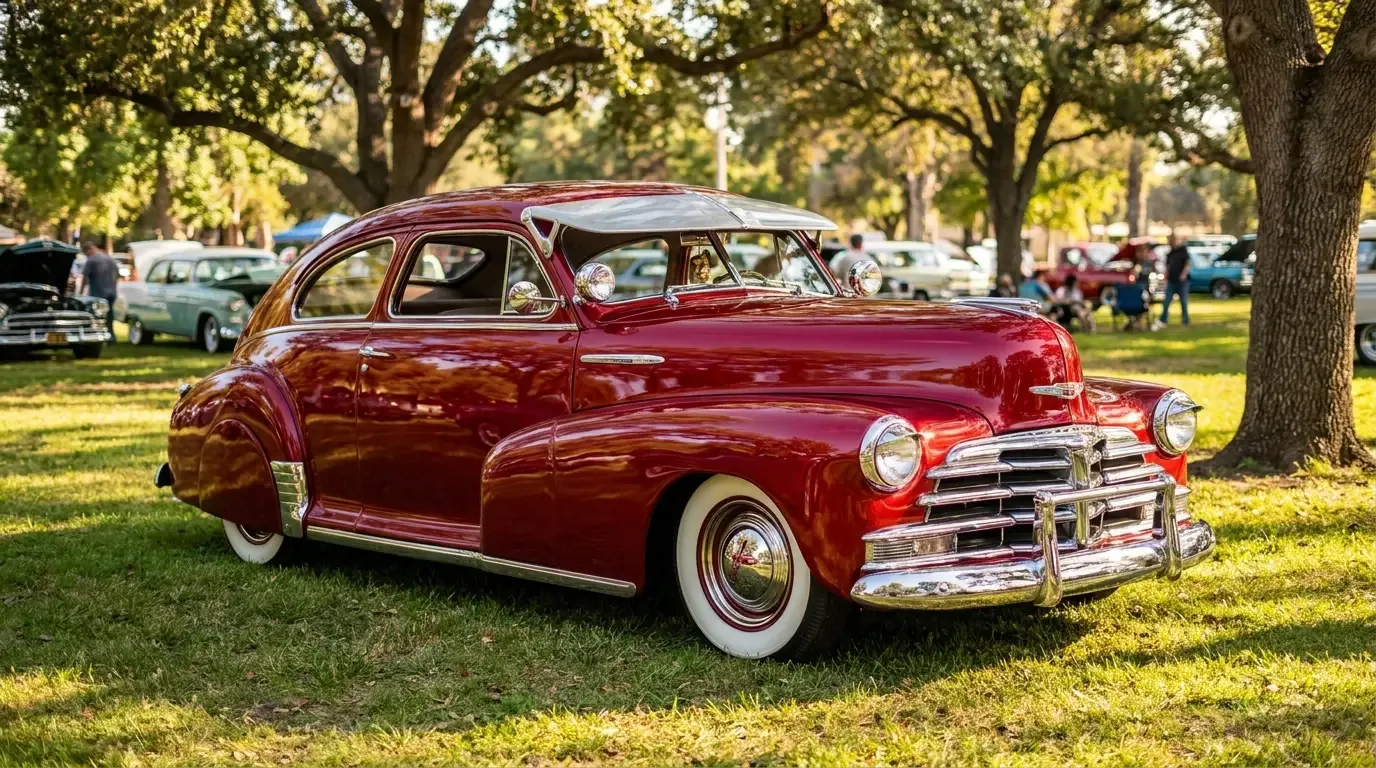
Before the Impala there were the bombs, the pre-war and early postwar Chevrolets from the late 1930s and 1940s with their rounded fenders and heavy chrome, still one of the most respected corners of the culture. Later, the rear-wheel-drive GM G-body cars of the late 1970s and 1980s, the Regal, Cutlass and Monte Carlo, became the affordable entry point for a new generation. Each platform carries its own etiquette. Our full look at lowrider bombs and the classic chassis covers which cars earn respect and why.
Why those cars and not others comes down to bones. Body-on-frame construction with a separate chassis gives you something solid to mount cylinders and reinforce, which is why the culture leaned on full-frame American cars for so long. A long, flat roofline carries murals and patterns better than a short, fussy one. Rear-wheel drive keeps the front end clean and simple to lift. The Impala checks every box, which is why a clean 1964 hardtop is the car people chase for a lifetime, and why prices reflect it.
The G-body deserves its own respect. When Impalas got expensive, the Regal and the Cutlass gave a whole generation a car they could actually afford to build, and plenty of legendary lowriders sit on that platform. It is the honest working-class chassis of the modern scene. Between the pre-war bombs at one end, the Impalas in the middle, and the G-bodies coming up behind, you have the three pillars of what people mean when they picture a classic lowrider.
Car clubs and the community
None of this happened in isolation. Car clubs are the backbone of the culture, and the plaque in the back window is a serious thing. Clubs like Dukes and Imperials go back decades, and membership means you represent a name, keep your car to a standard, and show up for the community. Clubs organize the shows, run the toy drives, and pass the craft from older builders to younger ones. A lowrider without a club behind it is a car; a lowrider with one is part of a lineage.
That community has also spent decades fighting for the right to exist in public. Cruising bans across California and the Southwest targeted lowriders directly, and the same discriminatory logic that produced Section 24008 shaped how the cars were policed. It took until 2023 for California to sign Assembly Bill 436, repealing the old frame-height law and clearing the way for cities to lift their cruising bans. That is not ancient history. The fight over these cars is recent, and it is part of what makes them mean so much.
The shows are where all of it comes together. A lowrider show is not just cars on a lawn. It is families, food, oldies playing, kids taking in the paint, and older builders explaining a setup to whoever asks. The car is the reason everyone gathers, but the gathering is the point. When you understand that, the phrase "low and slow" stops sounding like a slogan and starts sounding like a way of living: take your time, do it right, and do it with the people who taught you. That thread runs from the first dropped bomb in the 1940s straight through to whatever a kid is building in a garage this weekend.
"I've watched a kid learn to lay flake next to his uncle in the same garage where his grandfather laid flake. That's what a club is. It's not a logo. It's how the whole thing survives, one build and one Sunday cruise at a time."
Hector Morales
Sources and notes
- Period Southern California car-culture press and lowrider magazine archives.
- California Vehicle Code records and legislative history for Section 24008 and Assembly Bill 436.
- Custom-car and hydraulic-suspension reference histories, including documentation of Ron Aguirre's X-Sonic.
- Car club histories, registry and show records, and builder and trimmer interviews.
Related Reading
Have a
Classic Car
for Sale?
Reach thousands of serious classic car collectors across the US.
Sell It Here →
Are You a Classic Car Dealer?
List your full inventory and connect with targeted classic car buyers.
Join as a Dealer →

About the author
Hector Morales
East LA lowrider builder and lifelong member of the car-club scene, writing lowrider culture, hydraulics and custom paint from the inside.




Comments
Be the first to comment on this article.