
A fellow at a meet once told me his Model A had "won everything." I asked to see the score sheet. He had a ribbon, a photo and a strong memory, but no sheet, and when we looked up the class he had entered, the ribbon color told a smaller story than he did. That is the first lesson of Model A judging: the paperwork outranks the legend. The second lesson is that the paperwork is unusually good, because two rival clubs have spent more than fifty years writing it together.
Car Features
7 min read
How Model A Judging Works: MAFCA and MARC Standards
Model A judging explained: the shared MAFCA and MARC rulebook, four classes, the 500-point score, award bands and how judges earn rank.

This is how the system works at a MAFCA national meet, where the scoring rules are published in detail, and how the shared book behind it came to be. For the clubs, museums and people around it, see our Model T and Model A hobby guide.
One rulebook for two Model A clubs
The Model A Ford Club of America (MAFCA) and the Model A Restorers Club (MARC) are separate organizations, and their members can be rivals. On judging they agree on a single document: the Model A Restoration Guidelines & Judging Standards. The current edition, Revision 5, runs to 590 pages, sells for $65, and took the two clubs' Judging Standards Committees five years to produce. It added two new supplements, one for the Town Car and one for the Victoria.
The book grew a page at a time. Here is the record as MAFCA gives it.
| Year | Edition | Size |
|---|---|---|
| 1961 | One-page judging sheet (Meet Rules Committee) | 1 page |
| 1974 | First joint MAFCA and MARC pamphlet, Model "A" Ford Judging Standards | 26 pages, 26 areas |
| 1981 | Expanded edition | 109 pages, 24 areas |
| 1982 | Revision 1 | 13 pages, 67 changes |
| 1989 | Model A Judging Standards & Restoration Guidelines, ring binder | 23 areas |
| 1994 to 1997 | Updates, together counted as Revision 2 | |
| 2011 | Revision 3, title reversed to Restoration Guidelines & Judging Standards | |
| December 2016 | Revision 4 | |
| Current | Revision 5 | 590 pages, $65 |
The title swap in 2011 says something. "Restoration Guidelines" moved to the front. The book is meant to be read in the garage before the car ever reaches a show field, not just pulled out by a judge with a clipboard.
The four classes and the colored ribbons
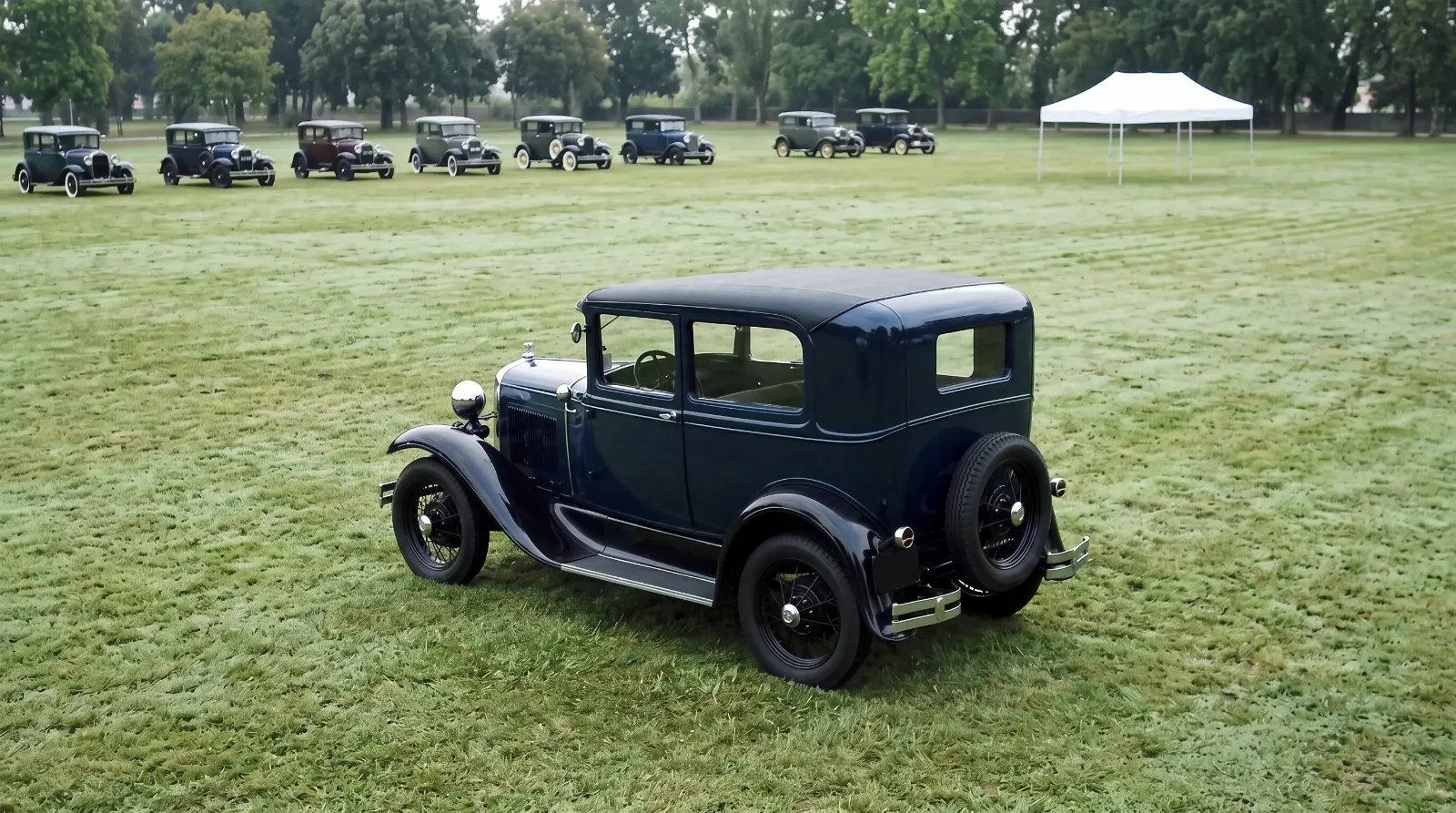
MAFCA judges each car in one of four classes, and the ribbon color tells you which one.
Restored cars compete for the Blue Ribbon. Original, unrestored cars compete for the White. Touring cars, restored and driven regularly with limited changes, compete for the Red. Modified cars, which must carry at least five approved era alterations, compete for the Green.
The Touring class is the practical one. A Touring car may carry up to ten listed non-original parts, such as a torque-tube overdrive or a 12-volt conversion, and each of those components can earn at most half its normal points. Some safety and convenience items carry no deduction at all: turn signals, seatbelts, gauges, fuses, a radio, a second tail lamp and cast-iron brake drums. That is the club saying, in writing, that a driven car is worth encouraging.
How a Model A judging score adds up
Before the detailed judging, a car passes a 14-point preliminary check. Six items must be original: the Model A or AA four-cylinder engine and drivetrain, the engine mounts, a Holley, Zenith or Ford carburetor, mechanical brakes, the horn, and steel-spoke wheels. Eight more must be "original type": electrics with the battery under the floor, a two-blade fan, the correct top and upholstery, steel sheet metal with no fiberglass, correct paint and stripe, correct tires, metal valve stems, and shocks.
Then the judges score the car, in the manual's own words, "against an arbitrarily established maximum of 500 points." The Blue, White and Red classes share the same award bands:
- 400 to 500: Award of Excellence
- 375 to 399: first place
- 350 to 374: second place
- 325 to 349: third place
- Below 325: a ribbon or plaque
Best of Show goes to the highest-scoring Blue or White Ribbon car. The Modified class works differently. It is scored over 23 areas (the 22 standard areas less Tools, plus overall appearance) totalling 500 points, with 400 and up for first, 375 to 399 for second and 325 to 374 for third. Modified cars get no Award of Excellence and cannot take Best of Show. MAFCA's web page mentions 24 areas for that class, but the manual says 23, and I go with the manual.
"Every owner has a story about his car. The judges have a score sheet, and when the two disagree, I have never once seen the story win."
Wayne Coburn
The fine detail lives in the book. It covers things like Ford-authorized accessories, where the standards name spring covers, a clock, draft deflectors and tire locks with matched keys. It covers the instrument panel, where the judged list has a speedometer, ammeter, gas gauge, ignition switch and dash lamp, and no factory oil pressure or temperature gauge. An owner who adds a period-looking oil gauge to a Blue Ribbon car is buying a deduction.
Who does the judging
MAFCA judges earn rank by passing tests on the book's 23 areas and by working national meets. An Apprentice has passed one area test. A Judge has passed five and worked two national meets. A Senior Judge has passed ten and worked three. A Master Judge has passed all 23, worked five nationals, and met team-captain and teaching requirements. A national Chief Judge must be a Master Judge.
MAFCA national meets are held every two years, in even years, with divisional meets possible in odd years. MARC runs its own annual national meet under the same shared standards, with its own top prize. The Henry Ford Award goes to the highest-scoring car in MARC's Fine Point judging, also on a 500-point scale, provided it reaches at least 465 points, and to any car within 10 points of it at that meet. Since 2011, every car scoring 480 or more gets a Henry as well. MARC's Touring Class uses a 500-point tally too, but it is judged more leniently, so a Touring score and a Fine Point score are not the same number.
What a score means when the car changes hands
Buyers ask about awards, and they should. A documented Award of Excellence tells a buyer that trained judges went over the car against a published standard. But a score is a snapshot. It describes the car on one day, in one class, under one revision of the book. A car judged under Revision 3 was measured against an older, shorter rulebook than the current 590 pages.
So when a seller says his car "scored 400," ask three things: which class, which year, and may I see the sheet. If the answers come back clean, the score is part of the car's provenance. If they do not, it is a story. How much any of this moves the price is a separate question, one that the long record of values over the decades answers better than any ribbon.
Sources and notes
Related Reading
Have a
Ford Model A
for Sale?
Reach thousands of serious classic car collectors across the US.
Sell It Here →
Selling a classic? Here's how: where to sell your classic car online
Are You a Classic Car Dealer?
List your full inventory and connect with targeted classic car buyers.
Join as a Dealer →

About the author
Wayne Coburn
Longtime Corvette owner, judge and club figure who knows the cars, the records and the people behind them.
Related Listings - Ford Model A
More in Car Features



Comments
Be the first to comment on this article.