
The Ford Model AF is the Model A that Britain asked for: the same car on the outside, with a smaller engine under the hood so its owner could afford the tax disc. It is the clearest example of how Ford's 1928 car changed when it crossed the Atlantic. In Europe the Model A was built in Manchester, then at the new Dagenham works, in Berlin and finally in Cologne, and each of those places left a mark on the record that a careful buyer can still read.
Car Features
6 min read
The Model A in Europe: Dagenham, Cologne and the Model AF
The Ford Model AF, the small-bore British Model A, and the plants that built Model As in Manchester, Dagenham, Berlin and Cologne.
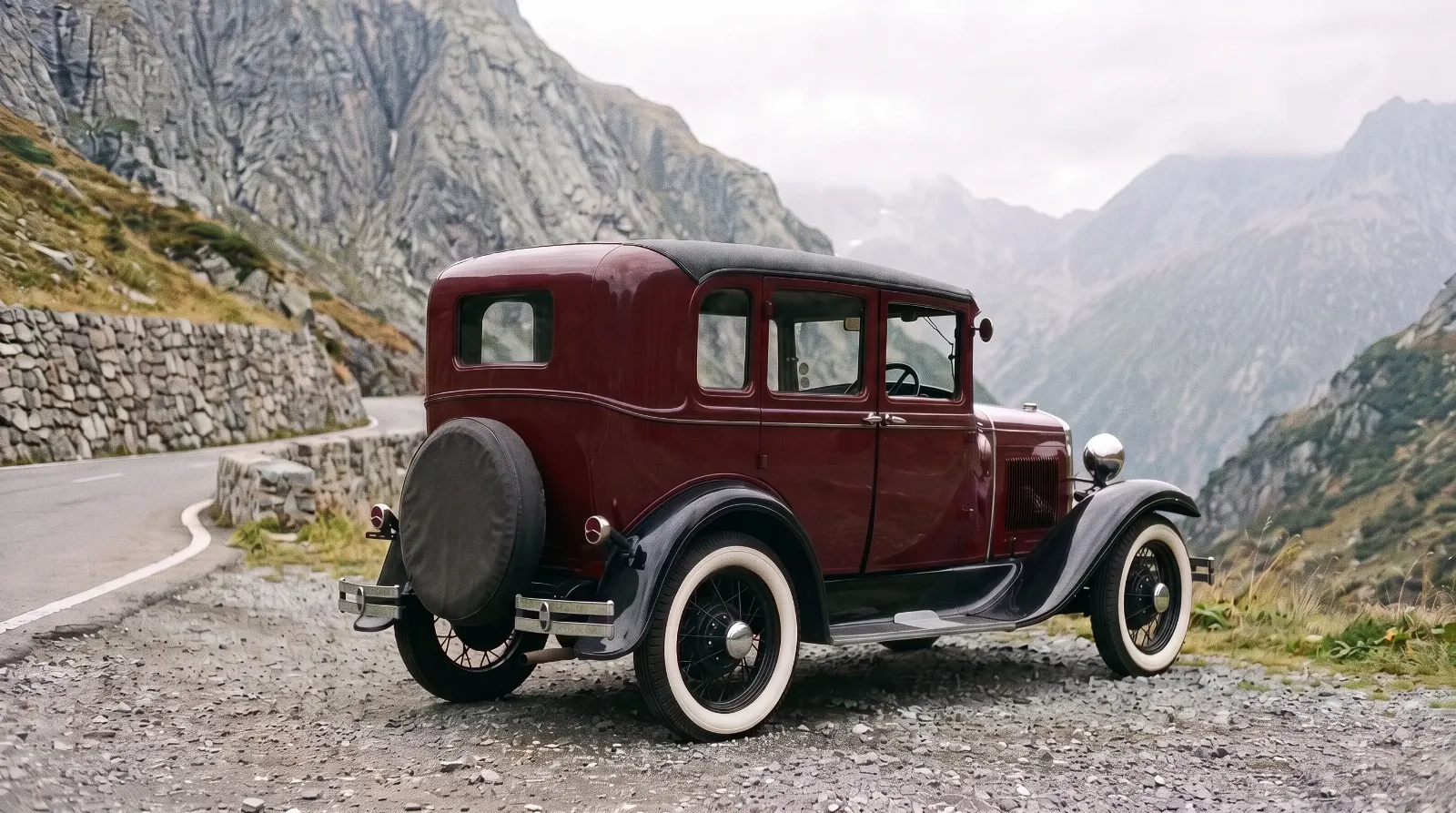
This article stays with the European side of the story. The American launch, the yearly changes and the production totals are covered elsewhere; for the details of the car as Detroit built it, start with the full history.
What the Ford Model AF was, and why it existed
Britain taxed cars on a rated horsepower, the RAC figure, which was calculated from the cylinder bore and the number of cylinders alone. The stroke did not count, and neither did what the engine actually produced. A wide bore meant a high rating, and a high rating meant a large annual bill. The standard Model A engine, at 3.3 litres, carried an RAC rating of 24 hp. For a British buyer that put the car in an expensive class.
Ford's answer was a small-bore version of the same four. The AF engine displaced 2,043 cc, gave about 28 bhp and carried an RAC rating of 14.9 hp. That cut the tax considerably. It also cut the power from the 40 hp the American car was known for, so the AF was a slower car, and noticeably so with a full load of passengers.
The Ford Garage records describe the AF as right-hand drive, as you would expect for British roads. Beyond the engine and the steering position, the AF shared its body styles and its general appearance with the Model A. A visitor at a British show would recognise the car at once; the difference was on the chassis plate and in the tax book.
| Engine | Displacement | Output | RAC rating |
|---|---|---|---|
| Model A (US standard) | 3.3 litres | 40 hp | 24 hp |
| Model AF (UK small bore) | 2,043 cc | About 28 bhp | 14.9 hp |
Manchester first, then Dagenham
Ford had built cars in Britain since 1911, when the Trafford Park works opened in Manchester as the company's first factory outside North America. The Model T was made there in large numbers. The Model A followed in the same building, and the club's plant table gives Manchester totals of 3,419 cars in 1928, 8,608 in 1929 and 8,528 in 1930.
Meanwhile a far larger plant was going up on the Thames. Edsel Ford cut the first turf at Dagenham on 17 May 1929. The works opened in October 1931, and the first vehicle off its line was not a car at all but a Model AA, the commercial chassis. Model A cars followed, and the same plant table credits Dagenham with 4,909 Model As in 1931. That table shows nothing for Manchester in 1931, yet Dagenham only opened in October, so how that year's British output split between the two plants is not clear.
The European business was moving quickly by then. In March 1929 Percival Perry told shareholders that Ford and its European associates had delivered "upwards of 50,000" Model A vehicles. That figure covers more than Britain and more than cars, so it should not be read as AF production.
Berlin and Cologne: the German Model A
In Germany the Model A began as an assembly job in Berlin, where Ford had been putting cars together since 2 January 1926. The club's plant table records 14,957 Berlin Model As between 1928 and 1930.
The move to Cologne was a civic project as much as an industrial one. Ford signed a contract with the city on 28 October 1929, with Konrad Adenauer as mayor. The foundation stone was laid on 2 October 1930 with Henry Ford present, to designs by the architect Edmund Körner. Production started on 4 May 1931 with the Model A and a workforce of 619. Berlin assembly ended the same year.
The Cologne count is where the record gets untidy. A German heritage source credits the plant with more than 6,000 vehicles in 1931. The club's table lists 2,633 Cologne Model As for the year. The two figures may not measure the same thing, since the larger one can include trucks, and for now neither should be quoted as the number of German Model A cars.
"With a European Model A, the plant of origin matters as much as the body style. Manchester, Dagenham, Berlin and Cologne each kept their own books, and none of those books is complete."
Sarah Whitfield
Counting the European cars
Anyone researching a British or German Model A should treat every production figure as provisional. The compiler of the club's plant table says plainly that it is incomplete. Add its Manchester and Dagenham columns and you reach 25,464 Model As for 1928 to 1931. A separate British reference gives 14,516 British-built Model As of all types. Those totals cannot both describe the same population, and no source on hand separates the AF small-bore cars from those with the full 3.3 litre engine.
| Plant | Years | Model A figure | Note |
|---|---|---|---|
| Manchester (Trafford Park) | 1928 to 1930 | 3,419; 8,608; 8,528 | Club plant table |
| Dagenham | 1931 | 4,909 | Club plant table; plant opened October 1931, so the figure may include Manchester cars |
| Berlin | 1928 to 1930 | 14,957 | Club plant table |
| Cologne | 1931 | 2,633 | Club plant table; a German source gives over 6,000 vehicles |
| All British-built | 1928 to 1931 | 14,516 | Separate British reference, all types |
For a collector, the practical consequence is simple. A European Model A is judged first on what it can document: a chassis number, a plant, an engine type. A car sold as a "Dagenham AF" deserves the same scrutiny as any claim of rarity, because the figures behind such claims are soft.
Where the European Model A led
The AF solved the tax problem only in part. Even with the small-bore engine, British opinion held the Model A too expensive to tax and run, and Ford of Britain answered in 1932 with the much smaller 933 cc Model Y. That is where the Model A's European chapter ends.
The car's influence travelled east as well. In the Soviet Union the GAZ-A, built at Nizhny Novgorod from December 1932, was a licensed copy of the 1930 Model A, and 41,917 were made by 1936. That story belongs to a separate article. So does the American milestone of the same spring Cologne opened: the 20 millionth Ford, a 1931 Model A Town Sedan, left the Rouge line on 14 April 1931, three weeks before the first Cologne car.
Seen from Europe, then, the Model A was never one car. It was a Detroit design adapted to British tax law, assembled in a German capital and then rebuilt in a new Rhineland factory, with a record that still has gaps in it. Those gaps are where the research remains to be done.
Sources and notes
Related Reading
Have a
Ford Model A
for Sale?
Reach thousands of serious classic car collectors across the US.
Sell It Here →
Selling a classic? Here's how: sell my classic car
Are You a Classic Car Dealer?
List your full inventory and connect with targeted classic car buyers.
Join as a Dealer →

About the author
Sarah Whitfield
Third-generation classic car collector specializing in pre-war American and European coachbuilt automobiles. Researcher and concours enthusiast.
Related Listings - Ford Model A
More in Car Features

Comments
Be the first to comment on this article.