
Strip the Model A story down to its numbers and it reads like a turnaround case. In 1927 Ford built 356,188 cars in the US and lost first place to Chevrolet. In 1929 it built 1,507,132 and took first place back. The Model A 1928 reception sits between those two figures, and it explains how a company that had spent a year with almost nothing to sell got its customers to wait, then to buy. The interesting part is not that the car sold. It is how long the recovery took, and how fragile it turned out to be.
Car Features
6 min read
How the Model A Won Back Ford's Customers
From 356,188 cars in 1927 to first place in 1929: how the Model A's reception, pricing and slow ramp won Ford's buyers back from Chevrolet.
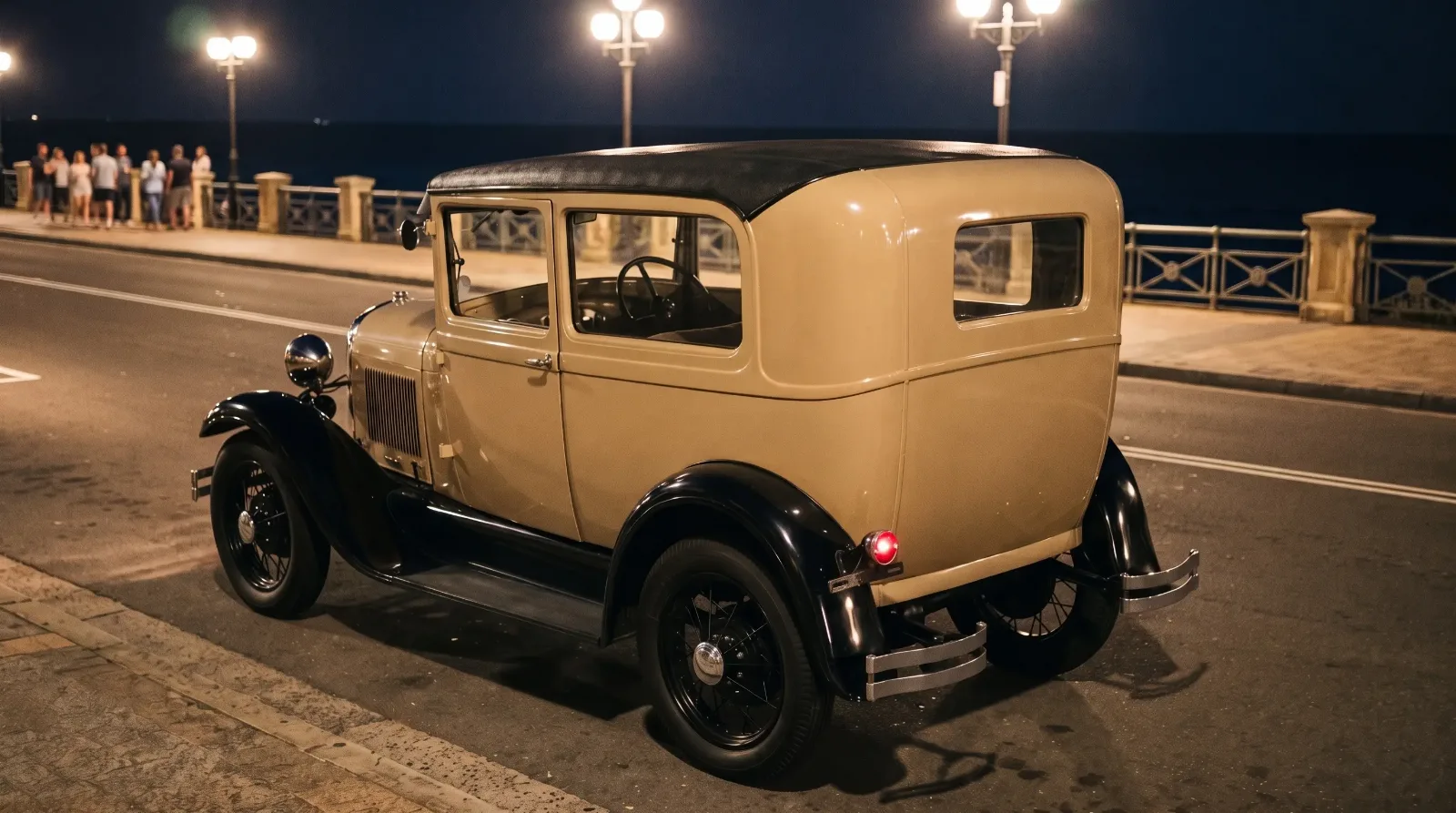
Where Ford stood before the Model A
The starting point matters, because the comeback is measured against it. Ford sold 1,817,891 cars in the US in 1923, the peak of the Model T. By 1927 that had fallen to 356,188. Chevrolet passed Ford that year on the strength of its Capitol Series AA, priced from $525 to $745 across seven body styles.
GM's bet, under president Alfred P. Sloan, was that Model T owners would trade up for comfort, features and style. The numbers say the bet was paying off. Ford freshened the T for 1926 and 1927, and the sales trend did not move.
Then the line stopped. Model T production ended in late May 1927 (Highland Park stopped on May 26; branch plants finished days later), and for months Ford had no new car in volume. Period trade press gives a snapshot: in one November 1927 week, Ford built 550 cars against 20,000 in the same week a year earlier. Chevrolet built 6,682 that week. For the engineering side of the switch, see the T to A chapter. Here the question is commercial: who was still willing to wait for Ford?
| Year | Ford US car production | Who led US sales |
|---|---|---|
| 1927 | 356,188 | Chevrolet |
| 1928 | 633,594 | Chevrolet |
| 1929 | 1,507,132 | Ford |
| 1930 | 1,155,162 | Ford |
| 1931 | 541,615 | Chevrolet |
Measuring the Model A 1928 reception
The first signal was attention. Ford's own estimate is that about 10 million people saw the new car in its first week, with police directing traffic in many cities. A hobby source puts dealer visits that week at more than 9 million. Treat both as estimates; neither is a turnstile count. What they agree on is the order of magnitude.
Local figures are firmer. At Kansas City's Convention Hall, a club account records 24,000 visitors over the Friday and Saturday of the launch, and 2,250 cars sold on announcement day. That is a single city, in a single weekend, before most buyers could take delivery.
Orders are the number everyone wants and nobody has nailed down. The figure repeated most often is about 400,000 orders within two weeks of the launch; another account speaks of half a million prepaid contracts. I have not found a Ford ledger behind either. "Several hundred thousand" is the honest version.
Price did a lot of the persuading. Ford's December 1927 announcement listed bodies from a $480 roadster to a $585 Fordor. The factory list prices that settled in for 1928 ran from $385 for the Roadster to $570 for the Fordor, f.o.b. Detroit. The 1928 Chevrolet National started at $495 for the Roadster and Touring, so the cheapest Model A undercut the cheapest Chevrolet by $110, with a 40 horsepower engine and a three speed transmission.
Demand ran ahead of supply
Here is the catch in the reception story. Demand showed up in December 1927. Cars did not. MAFCA sources agree that only about 5,000 vehicles were built from mid October to the end of 1927. Ford's own account concedes that production lagged behind enthusiasm, and buyers often waited months for delivery.
That shows up in the 1928 result. Ford built 633,594 cars that year, almost twice its 1927 total but still behind Chevrolet. A period report in TIME says Chevrolet's 1928 production exceeded Ford's, and Chevrolet's 1928 Series AB National alone reached 1,193,212 units, Canadian output included. So the Model A did not win back the lead in its first year. It won back the queue.
Waiting customers are a risk. Every month without a car is a month a buyer can walk across the street to a Chevrolet dealer. That most of them did not is the real measure of the reception. The engine count backs it up: by one account Ford reached 1,000,000 Model A engines by February 1929, about 16 months after the start of production.
"Launch crowds are a vanity metric. The number that matters is whether people who could have bought something else today chose to wait for you. In 1928, enough of them did."
David Mercer
1929: the lead comes back
By mid 1929 the Rouge line was at full capacity, about 9,000 units a day. With supply finally matching demand, the numbers moved fast. Ford built 1,507,132 cars in the US in 1929, the high point of the Model A run. Chevrolet's figure for the year was 1,328,605. Ford was first again.
Chevrolet did not stand still. On November 17, 1928, it introduced its six cylinder car: 194 cubic inches, 46 horsepower, priced from $525 to $725 and sold as "a six in the price range of a four." So the 1929 result was not won against a stale competitor. Ford regained the lead against a Chevrolet with six more horsepower and two more cylinders, at a similar price.
Ford also widened the range for 1929, with new body codes including a Cabriolet, a Town Sedan and the first factory built station wagon from a Big Three maker. More bodies gave more reasons to buy, which is what Sloan had been doing to Ford for years.
How long the win lasted
The recovery held into 1930, when Ford built 1,155,162 cars against about 641,000 Chevrolet sales, a clear lead in a shrinking market. Then the Depression took over. Ford's 1931 output fell to 541,615 cars, roughly half of 1930, while Chevrolet built about 627,000, and Chevrolet was back on top.
Read as a market case, the pattern is clear. The Model A won back Ford's buyers on value: a modern car, priced below the competition, from a brand people trusted. It held them for about two full years. It lost them when the whole market shrank and a four year old design faced a rival that kept changing. The V8 Ford of 1932 was the next answer, and a different story.
For collectors today, that history still shapes the market. The 1929 and 1930 cars were built in the largest numbers because those were the boom years. The early 1928 cars, built while buyers were still waiting, are the scarce ones. For what Ford kept from the old car when it built the new one, see what carried over.
Sources and notes
Related Reading

Have a
Ford Model A
for Sale?
Reach thousands of serious classic car collectors across the US.
Sell It Here →
Selling a classic? Here's how: where to sell your classic car online
Are You a Classic Car Dealer?
List your full inventory and connect with targeted classic car buyers.
Join as a Dealer →

About the author
David Mercer
Classic car market analyst with two decades of experience tracking collector car valuations, auction results, and investment trends.
Related Listings - Ford Model A


More in Car Features


Comments
Be the first to comment on this article.