
The Model T could run its whole life without a battery. The Model A could not run without one. That single difference sums up the change from the old Ford to the new one, and the Model A electrical system is where it shows most clearly: a 6-volt battery, a generator to keep it charged, one ignition coil and a breaker-point distributor, all replacing a flywheel magneto and a wooden box of buzzing coils. What follows compares the two systems on their own terms, explains why the magneto worked so well for so long, and why Ford finally gave it up for 1928.
Car Features
8 min read
Magneto to Battery: Model T vs Model A Electrics
The Model T made its spark at the flywheel; the Model A stored it in a 6-volt battery. How each system worked, and why Ford changed for 1928.
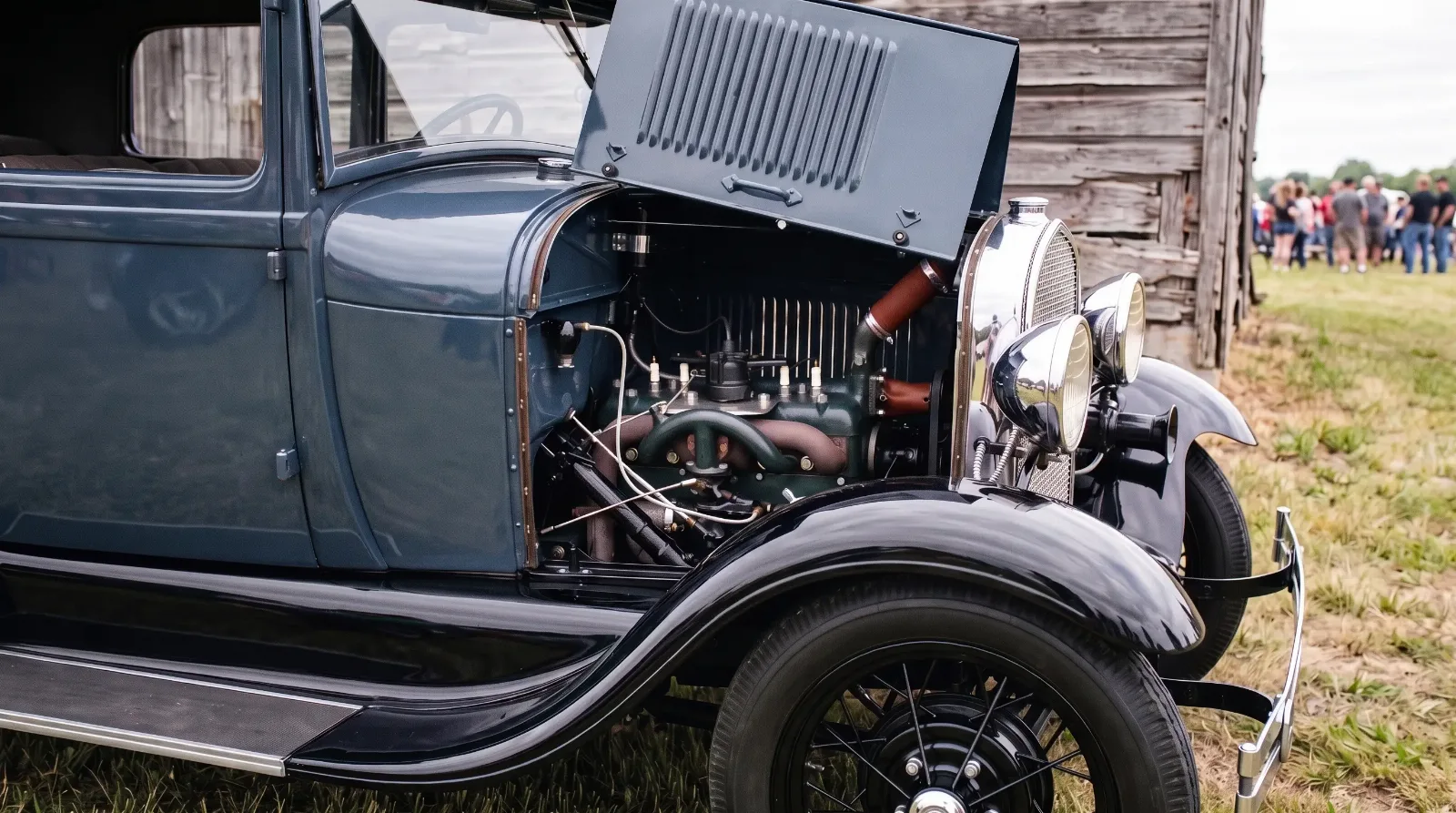
The Model T: electricity made by the flywheel
The Model T generated its own ignition current inside the engine. Sixteen V-shaped permanent magnets were bolted to the flywheel, and they spun past a ring of 16 stationary coils fixed to the engine, each one an iron core wound with copper ribbon. The coils were linked in a continuous series chain ending at the magneto post on top of the transmission cover. Every time a magnet swept past a coil, it induced a current.
That current was low-voltage alternating current, about 4 volts at low engine speed and over 30 volts at higher speeds, cycling 8 times per crankshaft revolution. It went to four trembler coils, one per cylinder, sealed with pitch in a wooden box on the dash. A four-segment timer on the front of the camshaft grounded each coil in turn, and while its contact was closed, the coil buzzed and produced a stream of sparks rather than a single one. The spark lever on the steering column rotated the timer case to advance or retard the spark.
It was a clever answer to a real problem. In 1908 batteries were expensive, heavy and unreliable, and a farmer miles from a garage could not count on recharging one. The magneto needed nothing but a turning engine. Its limits were electrical. Alternating current cannot charge a battery directly, so the magneto could run the ignition and, from 1915, the headlights, but nothing that needed stored energy. With the two headlight bulbs wired in series off the magneto, the lights were adequate at 30 mph and barely a glow at 10 mph. Light depended on engine speed, which is the wrong way round for a driver creeping along a dark road.
The battery arrives late on the Model T
The electric starter forced the issue. Cadillac introduced the Delco self-starter on its 1912 models, but Ford did not offer one on the Model T until the 1919 model year, first on the sedans. On open cars it was a $75 option. Adding it was not a matter of bolting on a motor: the starter needed a new engine block, a new transmission cover and a new flywheel, plus a generator and a battery to feed it.
Even then Ford kept the magneto. Starter-equipped Model Ts still fired through the magneto and trembler coils, and the coil box switch gained BAT and MAG positions. The battery helped with starting, and a driver could still hand-crank on the magneto alone. By 1926 the price gap told the story: an open car sold for about $290 without starter, generator and battery, or about $375 fully equipped with them. The T ended as a hybrid, a 1908 ignition system with a battery added on top of it.
How the Model A electrical system works
The Model A started over. Its system runs on a 6-volt battery with positive ground, charged by an engine-driven generator. The ignition uses a single coil and a breaker-point distributor, firing in the order 1-2-4-3, with a manual spark advance of 20 degrees worked by a lever on the steering column. The starter was standard on every model, operated by a floor button to the left of the gas pedal.
The principle is different from the Model T in every step. Instead of making ignition current at the flywheel, the Model A stores it. The battery supplies steady low-voltage direct current to the coil. The breaker points, opened by a cam in the distributor, interrupt that current; when the current stops, the collapsing magnetic field in the coil induces a high voltage in its secondary winding, and the distributor rotor sends that pulse to the right spark plug. One coil serves all four cylinders, and each firing gets a single, sharply timed spark.
Because everything draws from one stored supply, the lights no longer depend on engine speed. Headlights, the dash light and the stop and tail light, a single lamp at the left rear, all run off the battery. An ammeter on the instrument panel, with a 20-0-20 scale, shows whether the generator is charging or the battery is discharging, a reading a Model T owner never had. If you want the mechanical side of these engines, our early Ford engine guide covers both.
"The magneto was a power plant with no storage. The Model A was storage with a power plant attached. Once you see it that way, every other change in the wiring follows from it."
Emily Chen
Side by side: magneto against battery
| Item | Model T | Model A |
|---|---|---|
| Ignition current source | Low-voltage AC flywheel magneto (16 magnets, 16 coils) | 6-volt battery, charged by a generator |
| Coils | Four trembler coils in a dash box, one per cylinder | One coil |
| Spark timing | Four-segment timer on the camshaft | Breaker-point distributor, 20 degrees manual advance |
| Spark per firing | A stream of sparks | A single spark |
| Battery needed to run | No | Yes |
| Electric starter | From 1919, first on sedans; $75 option on open cars | Standard on all models |
| Electric headlights | From 1915, run from the magneto | Run from the battery |
| Charge indicator | None | Ammeter, 20-0-20 scale |
| Ground polarity | Not applicable to magneto ignition | Positive ground |
The trade-offs run both ways. The magneto never went flat, and a T with a dead battery could still be cranked into life. The Model A traded that independence for consistency: a spark of the same strength at cranking speed as at cruising speed, lights that did not dim at idle, and a starter on every car. For a driver in 1928, convenience won easily. It is worth reading this change as one part of the Model T to Model A story, where the transmission, brakes and body all moved forward at once.
Living with each system today
Owners of both cars still argue about which is easier to keep running, and the honest answer depends on what fails. Model T coils need periodic adjustment so all four fire evenly, and weak magnets or a contaminated magneto ring can leave the car hard to start on MAG. A Model A has the ordinary problems of any early battery car: worn points, a tired coil, a generator that stops charging, or a battery that loses its charge sitting in a garage.
Originality judging makes the point clearly. The Model A club's preliminary check expects original-type electrics with the battery under the floor, so a conversion that moves or replaces it is visible to a judge. Many owners who drive their cars regularly keep the 6-volt system. It rewards care: at 6 volts the same power needs twice the current it would at 12, so heavy cables and clean, tight connections matter more than on a modern car.
Electrics were one of the quieter reasons buyers came back to Ford after the T's long decline. A car that started at a button, lit the road at walking pace and told you whether it was charging was simply easier to own, and that helps explain how it won buyers back.
Sources and notes
Related Reading

Have a
Ford Model T
for Sale?
Reach thousands of serious classic car collectors across the US.
Sell It Here →
Selling a classic? Here's how: the best sites to sell a classic car
Are You a Classic Car Dealer?
List your full inventory and connect with targeted classic car buyers.
Join as a Dealer →

About the author
Emily Chen
Bay Area engineer with a deep focus on vintage Japanese and European performance cars. Approaches classic car research and restoration with an analytical eye.
Related Listings - Ford Model T



Comments
Be the first to comment on this article.