
Before there was a yellow school bus, there was a farm wagon with benches in it. Rural districts called them kid hacks, and the first ones were pulled by horses. When Ford put a one-ton truck on the market in 1917, people started bolting those wagon bodies onto it. The model t bus was not a product Ford designed. It was something dealers, body builders and school boards put together out of parts they could get, and one Georgia Ford dealer did it well enough that his bus is in a museum today.
Car Features
6 min read
Model T and TT School Buses: From Kid Hacks to Blue Bird No. 1
How rural kid hacks moved from horse wagons to Model TT chassis, and how a Georgia Ford dealer built Blue Bird No. 1, the oldest surviving US school bus.
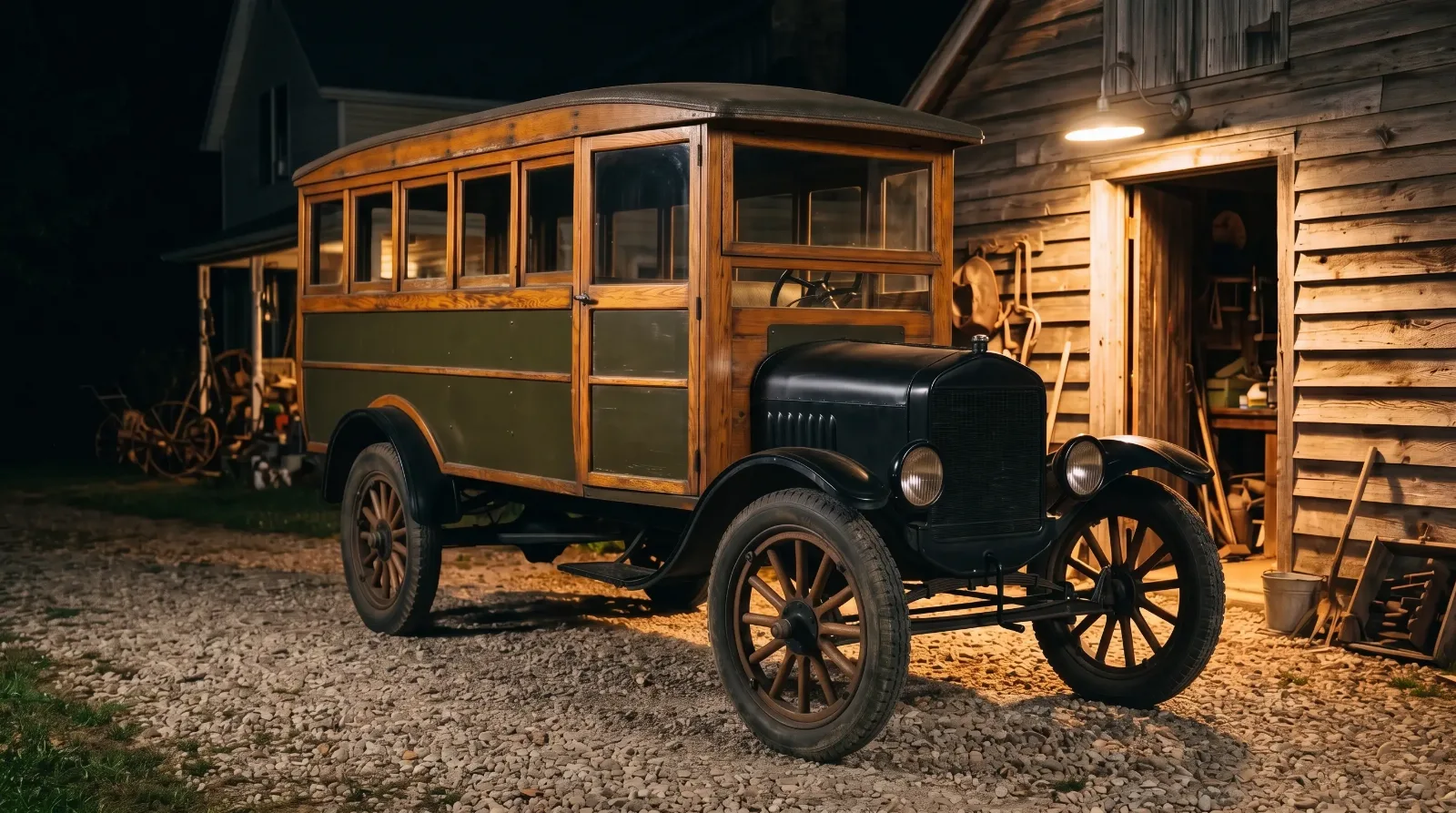
The trucks themselves, the TT and the AA, have their own history, and there is more on the trucks cars elsewhere. This piece is about what got built on top of them to carry kids.
Kid hacks: the wagon came first
The rural kid hack was usually a repurposed horse-drawn farm wagon. It had a wood body, benches down the sides, and a door at the back. Kids climbed in from the rear, sat facing each other, and rode to the schoolhouse at whatever pace the team could manage.
When motor trucks showed up, the body did not change much at first. Builders took the same idea, wood body, side benches, rear door, and set it on a truck frame. Some body makers built for both worlds at once. A Wayne Works catalog from around 1922 sold "School Car" bodies that could go on a motor chassis or on horse running gear. The school board picked the power and the body maker supplied the box.
That tells you something practical. A lot of early school bus bodies were not built for a Ford in particular. They were built for whatever chassis was cheap and available, and in the late 1910s and 1920s that was very often a Ford.
Building a Model T bus on the TT chassis
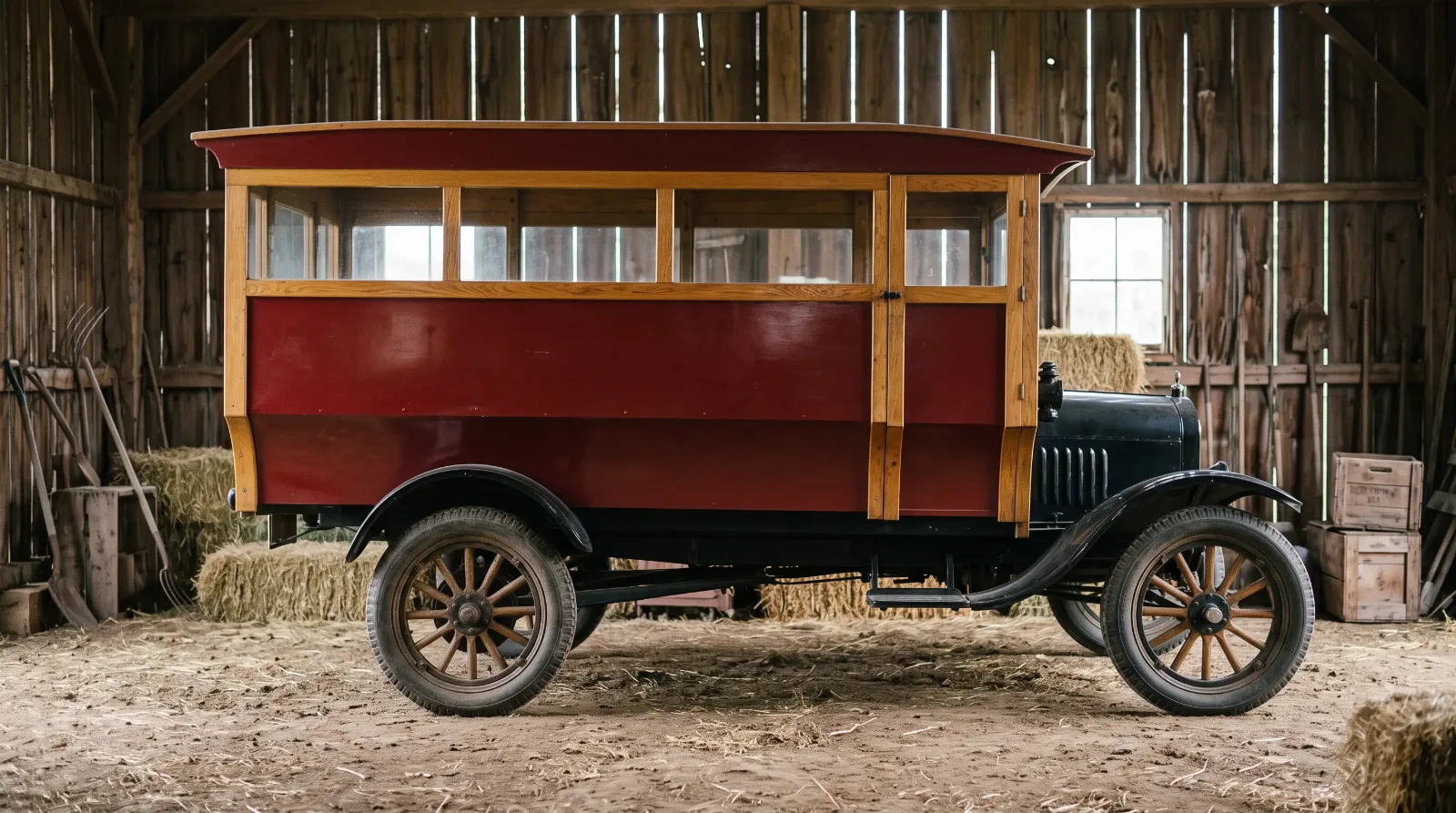
The Model T One-Ton Truck, the TT, came out in 1917 at $600 as a bare chassis. The buyer supplied the body. That was the whole point for a school district. You bought a running chassis from the Ford dealer and had a local shop or a body company build what you needed on it.
The TT carried school bus bodies among many other body styles, and the later Model AA listed bus bodies too. The chassis was the car's drivetrain stretched and geared down for work.
| Item | Model TT | Model T car |
|---|---|---|
| Rating | 1 short ton | Passenger car |
| Wheelbase | 124 to 125 in | 100 in |
| Final drive | Worm, 7.25:1 (5.17:1 optional) | Bevel, 3.63:1 |
| Top speed | Just under 20 mph (22 mph with special gearing) | About 40 to 42 mph |
| Price, bare chassis | $600 (1917), $325 (1926) | Sold as a complete car |
Read that top speed line twice if you plan to drive one. With standard gearing Ford recommended no more than 15 mph. A loaded bus on a TT was a slow, steady machine, which on a dirt road full of children is not the worst thing.
Ford offered a factory-built body for the TT from 1924 and a closed cab in 1925. School bus bodies still came from outside builders. Ford sold the chassis; somebody else built the part the kids sat in.
Albert Luce and Blue Bird No. 1
Albert L. Luce Sr. (1888 to 1962) was a Ford dealer in Fort Valley, Georgia. In 1925 a customer ordered a bus to carry workers. Luce bought a wooden bus body and mounted it on a Model TT, and according to The Henry Ford it began rattling apart before the customer had finished paying for it.
Anybody who has driven a wood-bodied vehicle on rough roads knows the problem. Wood joints work loose. Screws back out. A body that flexes on every rut will eventually shake itself to pieces, and a school bus covers the same rough road twice a day, every school day.
Luce's fix was to put a steel framework under the wood body. In 1927 he built what became Blue Bird No. 1 that way, on a 1927 Model TT chassis. The first buyer was Frank Slade of Marshallville, Georgia. Albert L. Luce Jr. later gave it to The Henry Ford.
"Luce didn't invent the school bus. He just got tired of watching one fall apart. Steel under the wood is a mechanic's answer, and it's the right one."
Robert Halloran
Some accounts, including the trade press report of the donation, call the chassis a Model T. The museum that holds the bus records it as a 1927 Model TT, and the TT is the chassis that makes sense for the load.
From wood bodies to steel
Steel under the wood was a step. All steel was the next one. Superior and Wayne both introduced all-steel buses in 1930, by which time the Model T was gone and the Model AA was the Ford truck on the dealer's lot.
The AA era also changed how Ford sold commercial trucks. Ford still mostly sold cab and chassis or bare chassis, with independent suppliers fitting the bodies. From late 1930 it began offering some AA trucks as complete units with dump, coal and garbage bodies. You can see the range of what went on that chassis in the AA commercial bodies.
School buses kept moving toward purpose-built steel bodies on heavier chassis. The wagon-on-a-truck idea that started with kid hacks faded out.
Restoring a Model T bus today
Very few early buses survive. School districts ran them hard, then sold them or scrapped them. Wood bodies rotted. If you find one, the chassis is the easy part. TT drivetrain parts are shared with the car or are well known to the Model T clubs, and there were about 1.5 million TTs built from 1917 to 1927.
The real value of these buses is the story they carry. A farm wagon, a Ford chassis, a local body and a dealer who would not quit is how rural kids got to school in the 1920s. Blue Bird No. 1 is the one that made it into a museum, but plenty like it did the work first.
Sources and notes
- 1927 Blue Bird School Bus (The Henry Ford)
- The Wayne School Car trade catalog, about 1922 (The Henry Ford)
- Blue Bird No. 1 donated to historical institution (School Bus Fleet)
- The truck that put American business on wheels: 1917-27 Ford Model TT (Mac's Motor City Garage)
- Ford Model TT (Wikipedia)
- School bus (Wikipedia)
Related Reading
Have a
Ford Model T
for Sale?
Reach thousands of serious classic car collectors across the US.
Sell It Here →
Selling a classic? Here's how: compare the places to sell classic cars
Are You a Classic Car Dealer?
List your full inventory and connect with targeted classic car buyers.
Join as a Dealer →

About the author
Robert Halloran
Texas-based classic truck enthusiast with decades of experience buying, restoring, and writing about American pickups from the 1940s through the 1980s.
Related Listings - Ford Model T
More in Car Features
Comments
Be the first to comment on this article.