
On August 16, 1962, Ford's design chiefs walked among full-size clay models that three rival studios had built for the same small car. Gene Bordinat had set the Ford, Lincoln-Mercury and Advanced studios against each other, and the winner came from the Ford studio under Joe Oros, drawn from a sketch by Gale Halderman. More than six decades later, the original Mustang design is still the shape people reach for when they want a car to say "Mustang," whether they are building one in a garage or drawing one in a corporate studio. The question worth asking is why that particular clay, out of all the clays, refused to go away.
Car Features
7 min read
Why the Original Mustang Shape Still Gets Copied
From the 1962 clay to the 1994 redesign: why the original Mustang shape kept pulling Ford back, and why builders still refuse to change it.
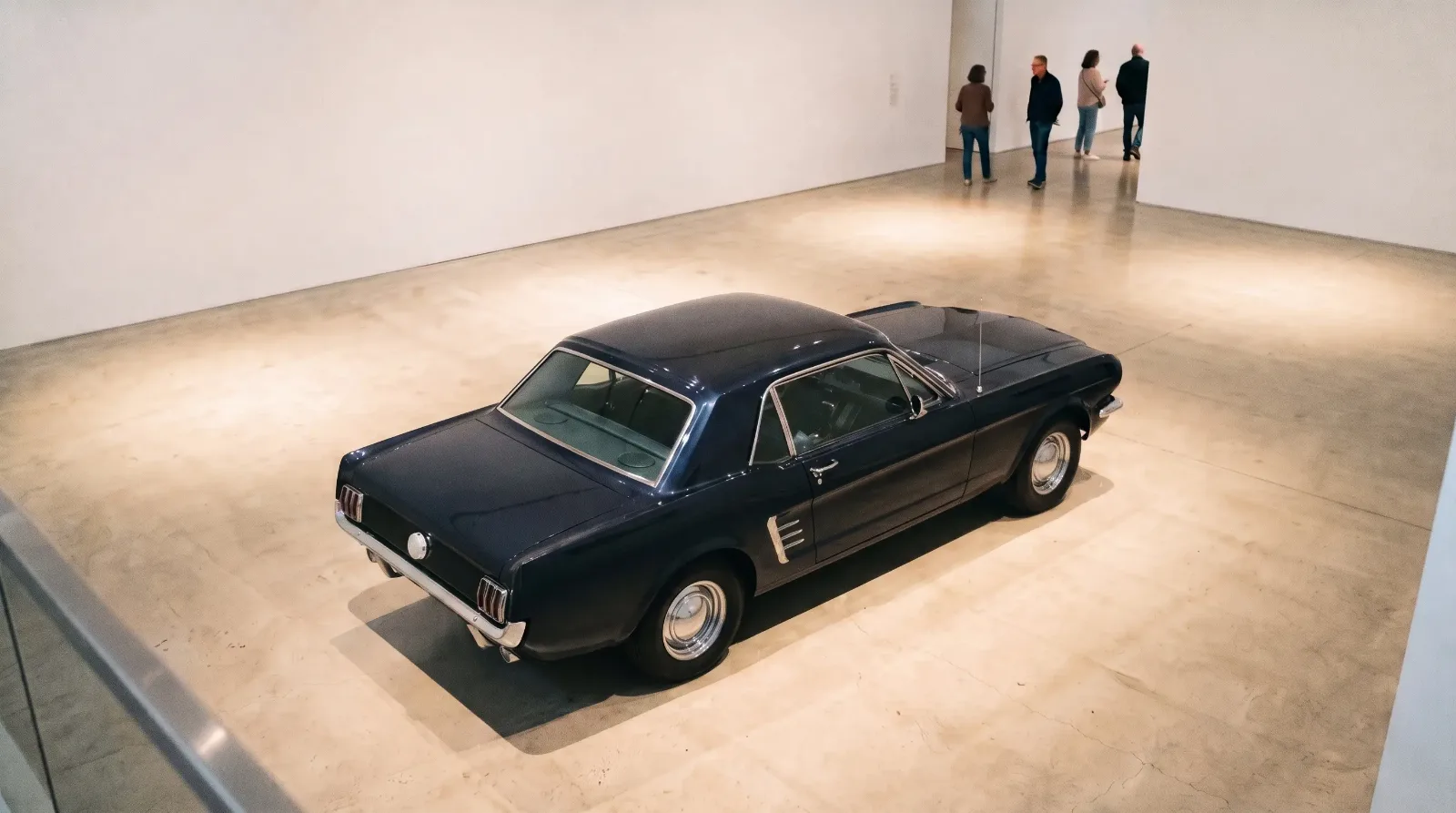
The individual details, from the grille to the taillights, are covered piece by piece in the shape and its details. This piece is about the pull of the whole: why the first shape kept coming back, even when Ford tried to move on.
The brief behind the original Mustang design
Good designs often start with hard limits, and this one had four. The car had to seat four, be no more than 180 inches long, weigh under 2,500 lb and cost under $2,500. Those numbers did a lot of the styling work before anyone picked up a pencil. A short car with four seats and a long hood leaves only so much room for a trunk, and the proportion that resulted, all nose and a short tail, became the signature.
The production car did not hit every target exactly, and that is part of its charm. Halderman's sketch had to become a real Falcon-based car with real bumpers.
| 1962 target | 1964½ to 1965 hardtop as built |
|---|---|
| Four seats | Four seats |
| No more than 180 in long | 181.6 in long, on a 108 in wheelbase |
| Under 2,500 lb | 2,445 lb base curb weight (2,556 lb in another published spec) |
| Under $2,500 | $2,368 at launch with the 170 six |
The team that refined the clay included Oros, Halderman, David Ash and John Foster, with Bordinat running the program. They called the winning model "Cougar." The name did not survive. The shape did.
What the 1964 shape got right
Stand beside an early car and you notice how few lines it uses. There is the long hood, the short deck, the crease that runs back along the side and dives into a scoop ahead of the rear wheel, the horse floating in the corral up front and three vertical bars on each taillight at the back. A child can draw it from memory. That simplicity is why it copies so well. A shape you can sketch in five strokes is a shape that survives being reinterpreted.
The details were also settled early, which is unusual. The tri-bar taillights were already on the 1963 Mustang II concept, built on a pre-production body and shown at Watkins Glen in October 1963, six months before launch. Ford's designers knew what the back of the car should look like before the public ever saw it. The public answered loudly: 418,812 Mustangs sold in the first twelve months, a 12-month sales record.
And the shape was honest about what it was. It looked sporting without pretending to be a European two-seater. It was, at heart, a dressed-up compact with a tailored suit, and buyers understood that. Car Life editor Dennis Shattuck coined a name for the class it started: the pony car. When rivals arrived, the new Camaro and Firebird among them, they were answering the Mustang's proportions as much as its price.
"You could spend a career trying to draw a better Mustang than that first clay. Ford did, more than once, and kept walking back to it."
Patrick Walsh
Why Ford drifted away and kept coming back
Here is the strange part. The people most willing to abandon the original shape worked at Ford. By 1971 the Mustang was 189.5 inches long and 74.1 inches wide, nearly eight inches longer and almost six inches wider than the 1964½ to 1966 car, with a base curb weight of 3,560 lb against 2,445. The design that had been built around a 180-inch brief had grown into something else, and Halderman himself headed the studio during its development.
Then came the smaller Mustang II and, in 1979, Jack Telnack's Fox. The Fox dropped the tri-bar taillights, and the running horse left the exterior, replaced by the Blue Oval from 1983 (the small grille pony on the 1993 Cobra was the exception). For fifteen model years the car sold well on its own terms without wearing the old cues. It is worth saying plainly: those cars were not failures. They simply did not look like the first one.
When Ford redrew the car for 1994, it went back. The pony returned to the grille, without its tri-bar surround, and the three-bar taillights came back too, laid horizontally for 1994 and turned vertical again for 1996. Nobody at Ford needed to explain why. Thirty years after launch, the fastest way to make a new Mustang feel like a Mustang was to borrow from 1964.
Who copies the shape today
The copying now happens in two places. One is the home garage, where builders put modern brakes, suspension and engines under early bodies precisely because the body is the part they cannot improve on. That world, and why it treats the first shape as sacred, is covered in our look at the restomod culture. The point for this story is simple: people modernize everything except the silhouette.
The other is Ford itself. The 1994 car proved the old cues still sold, and the company has leaned on them ever since; the 2005 Mustang made it explicit, with design led by J Mays under a "retro-futurism" banner and a press release listing C-scoops, three-element tail lamps, a centered galloping horse and a nose attitude "not seen since the 1967 model."
That is the real answer to why the original shape keeps getting copied. It was simple enough to remember, settled early enough to feel inevitable and tied so closely to the name that every attempt to replace it eventually turned back. The car's long road from the 1962 clay to the present is told in the full history of the Ford Mustang. The clay itself is the reason the road kept circling home.
Sources and notes
- Designer of original Mustang dies at 87, Gardner Web: Gale Halderman, the 1962 brief and the "Cougar" clay
- Along the Mustang trail: the 1962 Ford Stiletto, Mac's Motor City Garage: the August 1962 studio competition
- Mustang: the birth of an American icon, The Henry Ford: design targets and first-year sales
- Ford Mustang (first generation), Wikipedia: 1964 to 1973 dimensions and weights
- The evolution of the Mustang's pony emblem, FordMuscle: the horse off the Fox exterior and back in 1994
- 2005 Ford Mustang design release, The Auto Channel: the heritage cues Ford listed
Related Reading
Have a
Ford Mustang
for Sale?
Reach thousands of serious classic car collectors across the US.
Sell It Here →
Selling a classic? Here's how: sell my classic car
Are You a Classic Car Dealer?
List your full inventory and connect with targeted classic car buyers.
Join as a Dealer →
#pony car
#Ford Mustang
#first generation Mustang
#mustang design
#gale halderman
#joe oros
#tri-bar taillights

About the author
Patrick Walsh
Automotive journalist covering classic car shows, events, and the enthusiast community across North America.
Related Listings - Ford Mustang

More in Car Features
Comments
Be the first to comment on this article.