
The most interesting number in the history of Model T advertising is zero. From 1917 to 1923, the company that built half the cars in America bought no national advertising at all, and sales kept climbing. Anyone who collects vintage model t ads runs into that gap sooner or later: there are piles of material from before 1917 and after 1923, and a strange quiet in between. The gap says more about how Ford sold the car than any single ad does.
Car Features
7 min read
Model T Advertising: How Ford Sold the Car to America
Ford launched the Model T with magazine ads, then bought no national advertising from 1917 to 1923 while sales doubled. Here is what the ads reveal.

The nickname side of the story, and how "Tin Lizzie" stuck, belongs to the Tin Lizzie history. This piece follows the money Ford spent, and did not spend, on telling people to buy one.
1908: quality at a low price
Ford did not wait for the car to be finished before it started selling it. Newspaper promotion began in January 1908. On October 1, 1908, the day the Model T went public, Ford ran ads in Life and the Saturday Evening Post. The theme was "High Priced Quality in a Low Priced Car."
That line did a specific job. Most cars of the day cost $2,000 or more. The Model T Touring listed at $850 and the Runabout at $825. Ford had to convince buyers that cheap did not mean flimsy, and the ads leaned on materials and engineering rather than glamour.
The company had a habit of advertising its manufacturing. A 1906 ad, from the Model N era, claimed Ford kept 10,000 of every part on hand, all exactly alike. Interchangeable parts were a selling point before they were a household idea.
Ford also published its own magazine. Norval Hawkins, the sales and distribution manager from 1907 to 1918, started Ford Times in 1908. It went to owners and prospects and gave the company a channel it controlled completely.
Racing helped too. When a Model T crossed the finish line first in the 1909 New York to Seattle race, Ford advertised the result heavily, including in the Saturday Evening Post. About five months later, in November 1909, officials disqualified the car for an illegal engine change. The ads had already done their work.
Why Henry Ford stopped buying ads
Henry Ford thought paid advertising was mostly waste. His view, in his words: "If you really have a good thing, it will advertise itself." The company's habit was to drop national ads whenever demand ran ahead of production. By 1914 the Model T sold so well that Ford dropped most of its national magazine ads, and in 1917 it stopped paid advertising altogether. It did not buy ad space for the Model T again until 1923.
Look at what happened to volume while the ads were off. In calendar 1921 Ford built 903,814 US cars. In 1923 it built 1,817,891, the peak year for the Model T. By 1918, half of all cars in America were Model Ts. Price did the selling. The Runabout had dropped from $825 in 1909 to $345 for 1916. It rose to $500 for 1917 to 1919, then fell back to $325 for 1921 and $319 for 1922.
The company was quiet, but the dealers were not. Ford dealers kept advertising on their own, at about $3 million a year. So the Model T never really went dark. The voice just moved from Detroit to the local paper.
Vintage Model T ads after 1923: the Universal Car
The silence ended in early 1923 with a full-page ad that opened a national magazine campaign lasting several years. The theme was "Ford, the Universal Car." Edsel Ford ran the revived advertising department.
The timing tells you something. The 1923 peak was the high-water mark. Competition was getting sharper, and General Motors had a different pitch. Alfred Sloan's 1924 annual report described "a car for every purse and purpose," and GM used the line in a 1925 ad. Ford was selling one car for everyone. GM was selling a ladder. An ad budget became necessary once a price cut alone no longer won the argument.
Ford kept cutting anyway. A 1924 sales brochure offered a basic two-seat Runabout for as little as $265, and the 1925 Runabout listed at $260, with the Touring at $290.
| Period | What Ford did | Runabout price |
|---|---|---|
| 1908 to 1909 | Life and Saturday Evening Post launch ads, "High Priced Quality in a Low Priced Car" | $825 |
| 1909 | Advertised its New York to Seattle race result | $825 |
| 1917 to 1923 | No national ads; dealers spent about $3 million a year | $500 (1917) to $364 (1923) |
| 1923 onward | "Ford, the Universal Car" magazine campaign under Edsel Ford | $364 (1923) |
| 1924 to 1925 | Ads aimed at women; brochure Runabout from $265 | $265 to $260 |
Runabout prices are f.o.b. Detroit list prices by model year.
Selling to women, and selling the factory
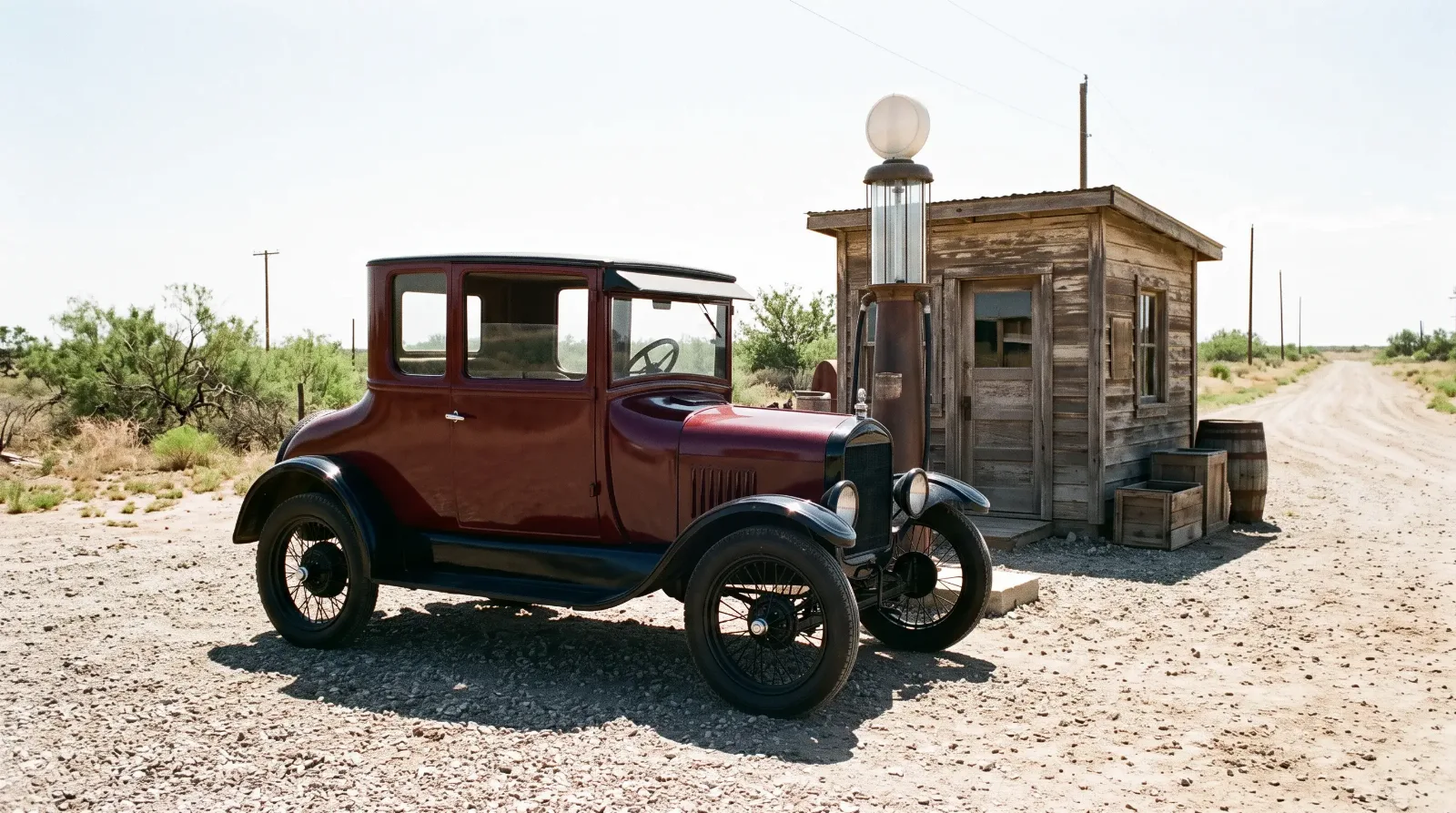
The most distinctive ads of the late Model T years were aimed at women. A 1924 Ladies' Home Journal ad pitched a car "that anyone could drive," stressing low cost and reliability. Ads in 1925 showed a woman driving to a golf outing or running errands on her own, with no man at the wheel, and talked about the car helping her "widen her sphere of interests." A 1926 Model T Coupe ad with a mother and daughter called it "an ideal car for a woman's personal use."
That was smart targeting. The closed cars cost more than the open ones, and a coupe sold as a personal car for a woman was a step up the price list.
Under Edsel, the ads also changed how they looked. The revived department used color illustrations and leaned on fashion and social standing, a long way from the text-heavy pages of 1908. Ford also sold the factory itself: a July 12, 1924 Saturday Evening Post ad put the Highland Park Plant in the spotlight. It was the same instinct as the 1906 parts ad. Show the scale, and let the reader draw the conclusion.
The other great publicity tool was free. The ten millionth Ford, a Model T built in June 1924, toured from New York to California on the Lincoln Highway, and Mary Pickford and Douglas Fairbanks rode in it. Plenty of other well-known names drove Model Ts for real, a story told in the piece on famous owners.
"The ad record lines up with the sales record better than Henry Ford would have liked. When price alone was winning, he spent nothing. When it stopped winning, Edsel got a budget."
David Mercer
What the advertising tells us now
Read as a data set, Model T advertising tracks the car's market position closely. The launch ads sold quality to buyers who doubted a cheap car. The pause matched a period when Ford could sell everything it built. The 1923 campaign arrived as the peak passed, and the women's ads and the color illustrations came as the car aged and rivals multiplied.
That makes the ads useful to anyone researching a specific car. A brochure or magazine page from the right year shows which body styles Ford was pushing, what it charged and who it thought the buyer was. For the collector, period ads are also the cheapest way to own a piece of the story. Prices for original paper vary too much by title, size and condition to quote one honest range, so treat any seller's "rare" label with the same caution you would bring to a car.
The plain lesson holds up. Henry Ford believed a good product advertised itself, and for six years he was right. Then the market changed, and Ford started buying pages again.
Sources and notes
- The Henry Ford: Advertising the Model T
- The Henry Ford online exhibit (archived): Model T ads, 1914, 1917 and 1923
- The Henry Ford: Ford advertisements and female consumers
- The Henry Ford: Mary Pickford and Douglas Fairbanks in the ten millionth Ford, 1924
- Farm Collector: the tractor conversion boom
- Wikipedia: Ford Model T (production and Runabout prices by year)
Related Reading
Have a
Ford Model T
for Sale?
Reach thousands of serious classic car collectors across the US.
Sell It Here →
Selling a classic? Here's how: the best sites to sell a classic car
Are You a Classic Car Dealer?
List your full inventory and connect with targeted classic car buyers.
Join as a Dealer →

About the author
David Mercer
Classic car market analyst with two decades of experience tracking collector car valuations, auction results, and investment trends.
Related Listings - Ford Model T
More in Car Features
Comments
Be the first to comment on this article.