
I get asked fairly often whether a 1970 Chevrolet Monte Carlo makes sense as a collection anchor, usually by someone who already owns a couple of muscle cars and is looking for something that rounds the group out rather than duplicates it. The short answer is yes, but the honest answer requires walking through why, because monte carlo 1970 collector appeal rests on a different set of fundamentals than the horsepower-first cars most collections already lean on.
Car Features
7 min read
Why the 1970 Monte Carlo Anchors Any Collection
A first-year Monte Carlo draws demand from three separate buyer pools, which is exactly what makes it work as a collection anchor, provided documentation backs up the claims on the car.
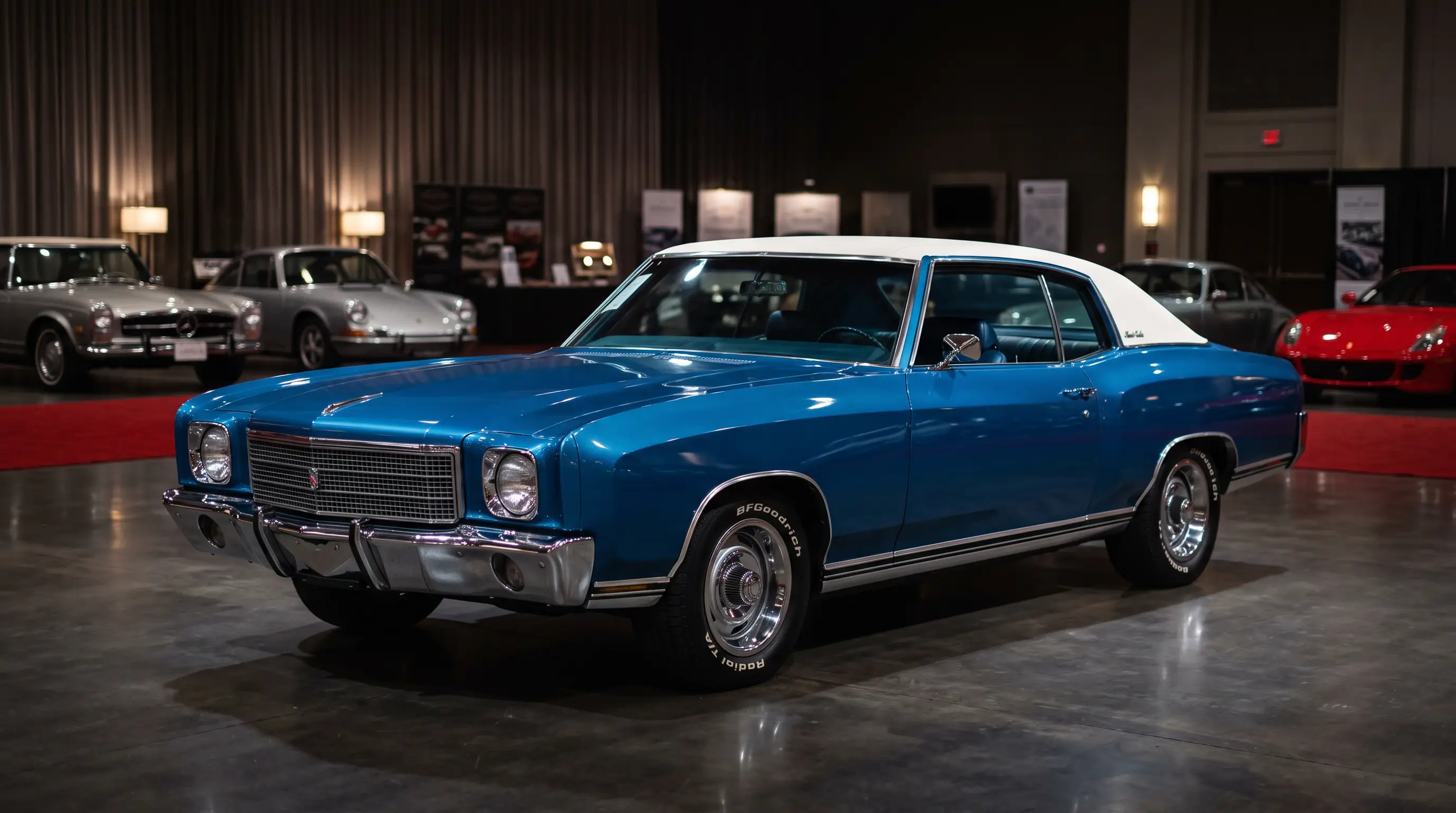
What "anchor" actually means in a collection
An anchor car is one that holds its position in a collection regardless of which way the broader market swings for any single segment. Pure muscle cars move together as a category, when interest in big block performance cools, values across that entire slice cool with it. A first-year Monte Carlo sits partly outside that category. It's cross-shopped by personal luxury car buyers, by GM completists chasing every A-body variant, and separately by SS 454 hunters who want the performance case without the more common Chevelle or Camaro badge. That gives the nameplate three overlapping demand pools instead of one, which is exactly the kind of diversification an anchor piece should provide.
It also helps that 1970 was the debut year. First-year cars in any long-running nameplate tend to carry a documentation and originality premium that later years in the same body style do not, because buyers specifically want the car that started the story rather than a mid-run refresh.
Condition and documentation, in that order
I will not soften this point. A rough SS 454 with no paperwork is worth meaningfully less than a documented, numbers-matching base car in genuinely good condition, and buyers who chase the SS 454 badge without confirming the drivetrain and cowl tag against a build sheet end up disappointed at resale. Originality documentation on these cars is not as widely available as it is for Camaro or Corvette, since the nameplate has a smaller dedicated research and registry community. That makes a surviving build sheet, dealer invoice, or period photograph disproportionately valuable when it does turn up with a car, because it closes a documentation gap that's harder to fill after the fact than on better-tracked models.
Condition matters in the usual ways, but pay particular attention to the console and bucket seat option if the car has it, since interior parts specific to that configuration are thinner in the reproduction market than exterior trim, and a car missing or with damaged console components can be a genuinely expensive repair relative to the car's overall value.
Liquidity, and where the downside sits
Liquidity on a 1970 Monte Carlo is honest but not instant. It is a recognizable, well-loved first-year car with real collector demand, but it does not move at Chevelle SS or Camaro speed when you need to sell. Expect a longer selling window than you would budget for a more mainstream muscle nameplate, and price accordingly if liquidity matters to your plans for the car. The upside is that this same dynamic means the Monte Carlo has not been chased into the kind of speculative pricing spikes some more famous nameplates have seen and then corrected from.
The clearest downside risk is buying a car marketed as an SS 454 that isn't one, or a console car that's been retrofitted rather than original. Both mistakes are avoidable with the same discipline, verify the cowl tag and build sheet against the car in front of you before price gets attached to a claim nobody can back up. A base six-cylinder or small-block Monte Carlo misrepresented as something more is not a rare problem in this segment, it's a common one, and it's entirely preventable at the inspection stage.
| Factor | Assessment |
|---|---|
| Demand pools | Personal luxury buyers, A-body completists, SS 454 performance buyers |
| Documentation availability | Thinner than Camaro/Corvette, premium for surviving paperwork |
| Liquidity | Real but slower than mainstream muscle nameplates |
| Main downside risk | Misrepresented SS 454 or retrofitted console option |
Where it sits relative to the rest of a collection
If a collection already leans heavily toward pure performance, a well-documented 1970 Monte Carlo, particularly an SS 454, adds a car with genuine straight-line credibility inside a body most people underestimate. If a collection is thinner on personal luxury and design-era GM cars, a base or mid-trim Monte Carlo with the Strato bucket and console option tells a different, equally legitimate story about the same model year without competing for the same buyer attention as the performance piece. Either way, the nameplate earns its place on its own terms rather than as a discount alternative to something more famous.
I'd also flag the maintenance and ownership cost side of this decision, since it factors into any honest appraisal of collector appeal. Mechanical parts for the Monte Carlo's drivetrains overlap heavily with Chevelle and full-size Chevrolet applications from the same era, which keeps day-to-day mechanical ownership costs reasonable and comparable to better-known nameplates. Where costs diverge is on model-specific trim and interior components, particularly anything tied to the Strato bucket and console option, where a damaged or missing part can mean a genuinely difficult and sometimes expensive search rather than a quick order from a mainstream parts catalog. Anyone budgeting for long-term ownership should weigh that asymmetry rather than assuming parts availability tracks evenly across every part of the car.
Insurance and valuation for collector purposes also deserve a mention, since agreed-value policies depend heavily on documentation quality. A car with a verified build sheet, clear ownership history, and professional appraisal photographs will generally secure a more favorable agreed value than an equivalent car lacking that paper trail, even when the two cars are mechanically and cosmetically similar. That's one more reason documentation sits at the top of my list whenever this nameplate comes up in a collection planning conversation.
Storage and use patterns matter too, and I'd rather a buyer hear this from an appraiser than learn it the expensive way. A 1970 Monte Carlo bought as a genuine anchor piece tends to hold its value better under limited, deliberate use, occasional shows, the odd weekend drive, rather than daily or even weekly service. That's true of most collector cars from this era, but it matters more here specifically because the parts supply chain for anything beyond common mechanical wear items is thinner than for a Camaro or Corvette. A car driven hard and often simply consumes originality-relevant parts faster than the market can comfortably replace them, and every worn console switch or faded trim piece chips away at the very documentation-and-condition case that makes the car worth anchoring a collection around in the first place.
Anyone weighing this decision should start with the car's own history before worrying about market timing. The full story of how the nameplate launched explains why 1970 specifically carries the premium it does relative to later years in the same body style, which matters more to long-term value than any single month's auction result.
"Value in this hobby is condition plus documentation plus how fast you could actually sell if you had to. A 1970 Monte Carlo scores honestly on all three, it just doesn't score fastest on the third one."
- Marcus Feld
For collectors ready to act on that assessment, the practical next step is comparing documented, correctly represented examples rather than reading further theory. Classic Monte Carlo for sale listings are the place to start testing everything above against real cars, real paperwork, and real asking prices.
Sources and notes
Related Reading
Have a
Chevrolet Monte Carlo
for Sale?
Reach thousands of serious classic car collectors across the US.
Sell It Here →
Are You a Classic Car Dealer?
List your full inventory and connect with targeted classic car buyers.
Join as a Dealer →
#collector cars
#car appraisal
#classic car investing
#chevrolet monte carlo
#ss 454
#1970 monte carlo

About the author
Marcus Feld
Accredited collector-car appraiser who reads the market through hammer prices, condition tiers and risk.
Related Listings - Chevrolet Monte Carlo
Comments
Be the first to comment on this article.