
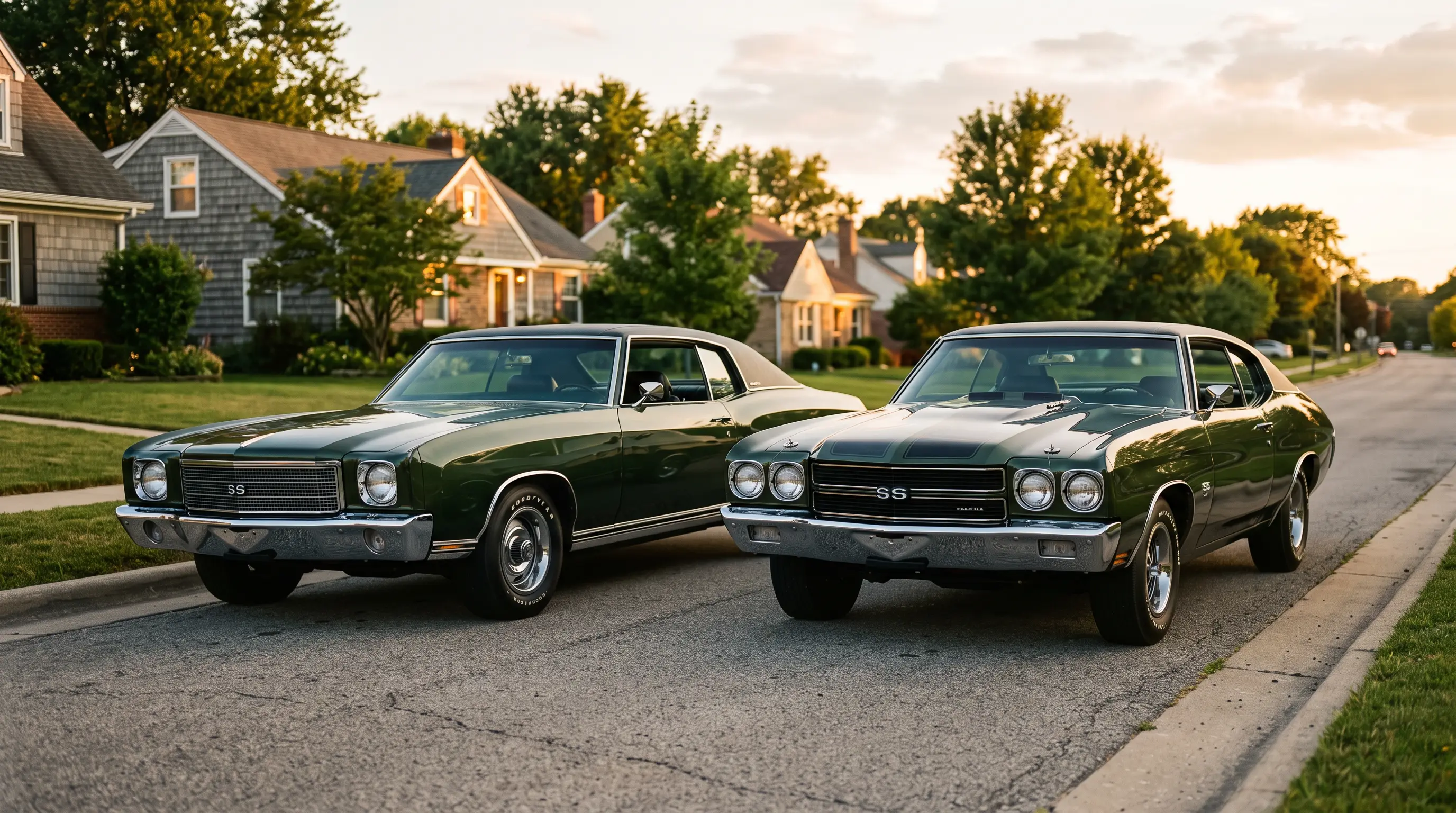
Park a 1970 Chevrolet Monte Carlo next to a 1970 Chevelle and the family resemblance is obvious within a second, the same basic greenhouse proportions, the same era of GM design language across the flanks. Spend ten more seconds looking and the differences start explaining themselves. The monte carlo 1970 vs chevelle sibling question comes up constantly among people cataloguing this period of Chevrolet's lineup, because these two cars shared engineering underneath while being built to sell to almost entirely different buyers.
Car Features
7 min read
1970 Monte Carlo vs Chevelle - Same Bones, Different Soul
The 1970 Monte Carlo and Chevelle shared A-body engineering but were built for entirely different buyers, and the SS 454 is where those two identities blur together.
Shared bones, different intent
Both cars rode on GM's A-body platform for 1970, and Chevrolet was open about the Monte Carlo's chassis being derived from the Chevelle's engineering. The Monte Carlo, however, used a 116-inch wheelbase against the Chevelle's 112 inches, all four extra inches placed forward of the firewall to stretch the hood and set the cowl further back. That single dimensional change did more to separate the two cars visually than any trim decision Chevrolet made afterward. The Chevelle reads as a compact muscle coupe with its wheels tucked close to the body. The Monte Carlo reads as something longer and more composed, a car built to look expensive standing still.
Underneath, both cars could be ordered with a genuinely wide spread of Chevrolet's small block and big block V8s, and a well-optioned Chevelle SS and a well-optioned Monte Carlo SS 454 were not far apart in outright power. The difference was never really about what an engine could do. It was about what Chevrolet wanted each car to communicate while doing it.
Two different sales pitches from the same division
Chevrolet marketed the Chevelle SS squarely at buyers who wanted a muscle car, quarter mile times, aggressive styling cues, a car that looked ready to prove something at a stoplight. The Monte Carlo was pitched as a personal luxury coupe, a segment Pontiac's Grand Prix had already staked out and one Chevrolet clearly wanted a piece of. That meant a softer suspension tune as standard, more sound insulation, available buckets and console rather than a mandatory sport package, and an interior finished with simulated wood trim and plusher upholstery choices than the Chevelle typically offered.
The result is a car that drives noticeably different from its sibling even when the engine bay is nearly identical. A Chevelle SS wants to be pushed. A Monte Carlo, even one carrying the same big block, is happier being cruised, its longer wheelbase and softer springs smoothing out the kind of road irregularities that a Chevelle would transmit straight into the seat.
Where the SS 454 blurs the line
The one place these two nameplates genuinely converge is the Monte Carlo SS 454, Chevrolet's answer to buyers who wanted the personal luxury body but weren't willing to give up serious power to get it. Fitted with the LS5 454 cubic inch V8, the SS 454 Monte Carlo could embarrass plenty of muscle cars that looked far more the part, all while riding on that longer wheelbase and wearing the Monte Carlo's more restrained exterior. It's the car that proves the Chevelle-versus-Monte-Carlo distinction was about marketing position and chassis tuning rather than any hard ceiling on performance.
Collectors chasing an SS 454 today are effectively buying the quickest possible expression of the Monte Carlo nameplate, and its rarity relative to the far more common Chevelle SS 396 and SS 454 models has kept demand for well-documented examples strong.
It's worth noting that even within the SS 454 comparison, the two cars still drive like siblings raised in different households. The Chevelle's stiffer springs and shorter wheelbase telegraph road imperfections straight into the cabin in a way enthusiasts of the era generally read as sportier feedback. The Monte Carlo SS 454 absorbs the same road surface with noticeably more composure, trading some of that immediacy for a ride that stays comfortable at sustained highway speed. Neither approach is wrong, they simply reflect two different answers to the same underlying engineering question of how a big block V8 should feel installed in a mid-size GM coupe.
Chevrolet's engineers also made different choices about steering feel and brake feedback between the two nameplates, tuning the Chevelle for a more direct, athletic response and giving the Monte Carlo a lighter, more isolated setup consistent with its personal luxury mission. Buyers who drove both back to back at a dealership in 1970 would have noticed the difference immediately, and it's a distinction that still holds up when comparing well-sorted examples of each car today.
Interior presentation followed the same divide. A well-optioned Chevelle still communicated performance intent through its cabin, gauge-heavy dashboards, available bucket seats treated almost as standard equipment on SS trims, and door panels finished in simpler, harder-wearing materials suited to a car expected to see regular hard use. The Monte Carlo's cabin, by contrast, pushed further toward comfort even at its sportiest, with softer trim materials, more extensive use of simulated wood accents, and standard appointments that a Chevelle buyer would have needed to option up to match. Sitting in both cars today, decades removed from their original showroom rivalry, that difference in ambition is often more obvious than the mechanical similarities underneath.
| Spec | 1970 Chevelle | 1970 Monte Carlo |
|---|---|---|
| Wheelbase | 112 in | 116 in |
| Market position | Muscle car / performance coupe | Personal luxury coupe |
| Standard front seat | Bench, sport options available | Bench, Strato bucket and console optional |
| Top performance option | SS 396 / SS 454 | SS 454 |
Why the comparison still matters to buyers
Anyone shopping this era of Chevrolet should understand that choosing between a Chevelle and a Monte Carlo from 1970 is not really a question of which car is "better." It's a question of which experience you actually want behind the wheel. The Chevelle rewards a driver who wants immediacy and a harder edge. The Monte Carlo rewards someone who wants to arrive somewhere looking composed, in a car that still has real muscle underneath if the SS 454 box was checked on the original order sheet. Values for both have moved independently over the years, with the Chevelle SS carrying broader brand recognition and the Monte Carlo increasingly appreciated as a distinct, less common alternative from the same showroom floor.
For the fuller account of how Chevrolet built and launched the Monte Carlo as its own nameplate rather than a Chevelle variant, the 1970 monte carlo story covers that first season in detail, and the broader arc across every generation is laid out in the full story of the nameplate from 1970 through its final years.
"These two cars came off adjacent points on the same assembly system, and yet they were built to convince two completely different people they'd made the right choice."
- Sarah Whitfield
If the comparison has you leaning toward the Monte Carlo side of the family, there's no substitute for seeing the proportions in person against a Chevelle parked nearby. You can browse classic Monte Carlos on the market and judge for yourself how much that extra four inches of wheelbase changes the way the whole car reads, long before you ever get to comparing horsepower figures on paper.
Sources and notes
Related Reading
Have a
Chevrolet Monte Carlo
for Sale?
Reach thousands of serious classic car collectors across the US.
Sell It Here →
Are You a Classic Car Dealer?
List your full inventory and connect with targeted classic car buyers.
Join as a Dealer →

About the author
Sarah Whitfield
Third-generation classic car collector specializing in pre-war American and European coachbuilt automobiles. Researcher and concours enthusiast.
Related Listings - Chevrolet Monte Carlo
Comments
Be the first to comment on this article.