
Every corner of the classic car hobby has a community that forms around it, and the monte carlo 1970 restoration scene has its own particular character, smaller and quieter than the Camaro or Chevelle crowds, but no less committed to getting the details right. Talk to enough people who have brought a first-year Monte Carlo back from a barn find or a decades-long driveway sit, and the same themes come up again and again, patience, parts scarcity turned into a kind of shared research project, and a real pride in cars that don't get the mainstream attention muscle car siblings receive.
Car Features
6 min read
Restoring a 1970 Monte Carlo - Stories From the Scene
The small, tight-knit community that restores first-year Monte Carlos trades hard-won knowledge and swap-meet stories in a way bigger, noisier fandoms rarely manage.
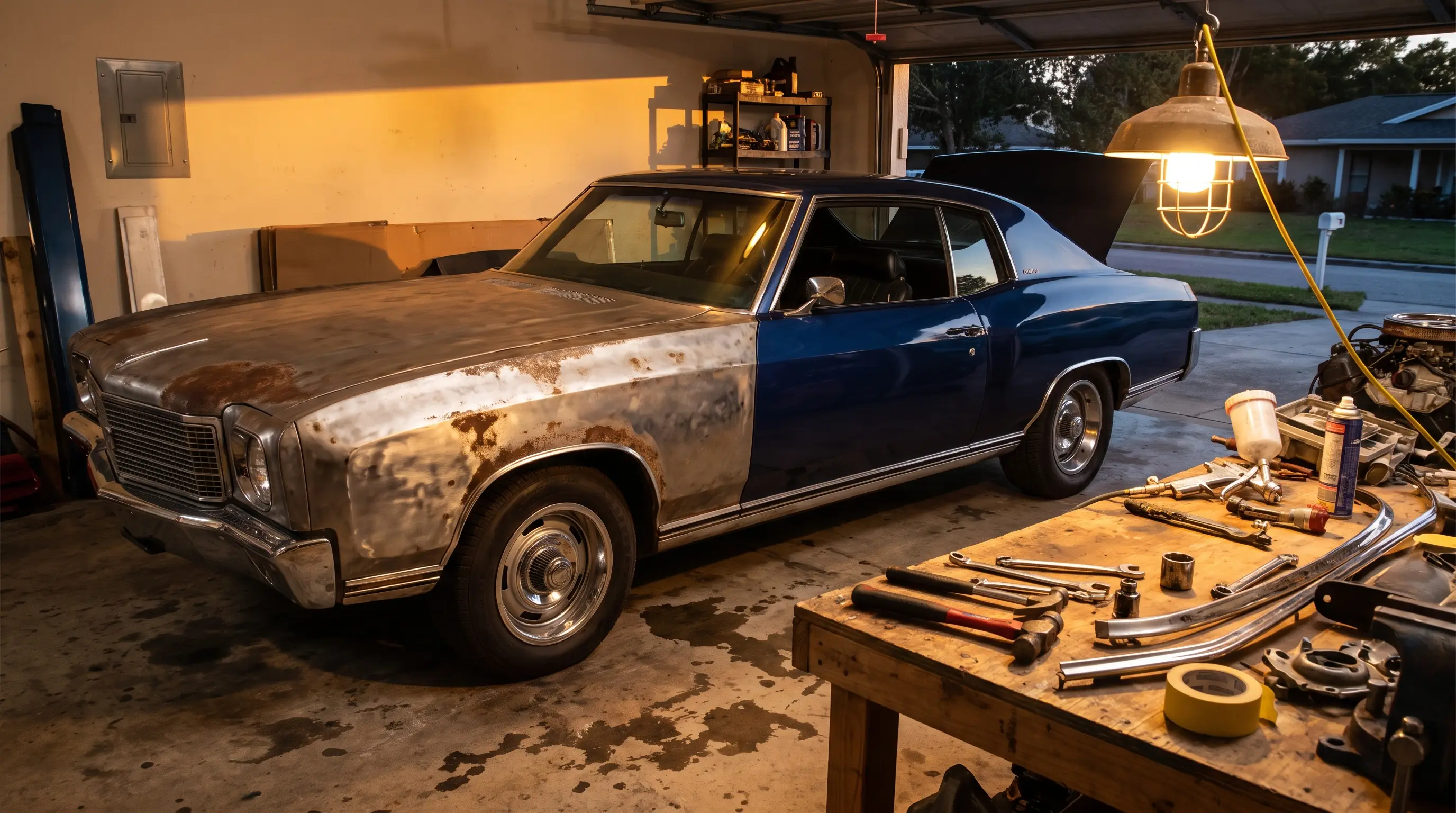
A smaller club, a tighter network
Because the Monte Carlo has historically lived in the shadow of the Chevelle SS and the Camaro within Chevrolet's 1970 lineup, the people who restore them tend to know each other, directly or through a couple of degrees of separation. Regional clubs built around GM's A-body platform often welcome Monte Carlo owners alongside Chevelle and even Malibu people, and it's inside those mixed gatherings that a lot of first-year Monte Carlo knowledge actually circulates. Someone who spent a year tracking down a correct console assembly becomes the person everyone calls when the next console question comes up. Someone who cracked the cowl tag codes for their own car ends up decoding a stranger's tag over email a year later, just because they enjoy the puzzle.
That tight-knit quality means information travels slower than it does for more heavily documented models, but it also travels with more care. A tip that circulates through a small, engaged Monte Carlo group has usually been checked against more than one real car before it gets repeated as fact.
What people actually chase, and what they give up on
Owners bringing a 1970 Monte Carlo back tend to prioritize the same handful of things: getting the body and paint right, sourcing a correct interior if the car has lost its original one, and confirming whatever drivetrain claims came with the car against the cowl tag before spending money assuming an SS 454 badge means an SS 454 engine. What people give up on, more often than they'd like, is chasing every last trim piece to absolute originality. Some interior and trim parts for this specific model year simply aren't reproduced at the volume Camaro parts are, and there's a point in most projects where an owner accepts a very close, well-sourced used original piece rather than holding the whole restoration hostage to one perfect part.
There's a kind of honesty in that compromise that the scene generally respects. Nobody in this particular corner of the hobby pretends every car is concours-perfect. What earns respect is knowing exactly where your own car deviates from stock and why, and being straight about it with anyone who asks.
Stories that stick around the campfire
Every long-time Monte Carlo owner seems to have one story that gets retold at shows and swap meets. A car found under a tarp behind a barn, running when it went in decades earlier and somehow still turning over when the key finally went back in. A cowl tag that turned up in a glove box decades after the car had already changed hands twice, settling an argument about whether the car had ever actually carried the SS 454 package. A console assembly tracked down at a swap meet three states away after two years of looking, purchased from someone who had no idea what they were sitting on. These stories aren't unique to the Monte Carlo, every marque has them, but the smaller scale of this particular community means the stories get passed around by name rather than fading into internet forum anonymity.
Why the community matters as much as the parts
Anyone starting a 1970 Monte Carlo project today benefits more from finding this network early than from any single parts source. The people who've already solved a given problem, whether that's a correct paint code, a console originality question, or simply where to find a trustworthy set of NOS trim pieces, are typically happy to share what they know with someone who shows genuine interest in getting the car right rather than just getting it done. That generosity is part of what keeps a smaller, less commercially obvious restoration scene alive across decades.
Regional car shows play a bigger role in this particular scene than they do in bigger, more commercially saturated hobbies. A Monte Carlo owner is far more likely to have their questions answered by a knowledgeable stranger walking the show field on a Saturday morning than by scrolling through a forum thread, simply because the total pool of dedicated owners is small enough that word of mouth still functions the way it did decades ago. That same dynamic shows up at swap meets, where a vendor selling A-body parts often knows exactly which of the few regular Monte Carlo buyers to flag down when something specific to the model turns up in a box of otherwise unsorted trim.
There's also a generational handoff happening inside this community right now that's worth noting. A lot of the people who bought these cars new, or who restored them during the first serious wave of muscle car nostalgia in the 1980s and 1990s, are getting older, and the knowledge they carry about specific parts sources, correct finishes, and known-good vendors doesn't automatically transfer to newer owners unless someone makes a point of writing it down or passing it along in person. The healthiest corners of this scene are the ones actively working on that handoff, pairing newer owners with people who've already solved the same problems once before.
Understanding this community also means understanding the car it's built around. For readers new to the nameplate, our complete history of that first model year fills in the context every long-time owner already carries in their head, why the car looked the way it did, what buyers wanted from it, and what made it different enough from its Chevrolet siblings to earn its own devoted following decades later.
"The Monte Carlo crowd is small enough that everyone eventually hears everyone else's car's whole story, which is exactly why the good information holds up better than what circulates in bigger, noisier forums."
- Sarah Whitfield
Whether the goal is joining that network before starting a project or simply finding a car that someone else has already brought back with care, the market for these first-year cars keeps turning over examples worth a look. Anyone ready to start comparing can browse classic Monte Carlo listings and see what condition and documentation currently looks like across the field.
Sources and notes
Related Reading
Have a
Chevrolet Monte Carlo
for Sale?
Reach thousands of serious classic car collectors across the US.
Sell It Here →
Are You a Classic Car Dealer?
List your full inventory and connect with targeted classic car buyers.
Join as a Dealer →
#A-body
#classic car clubs
#chevrolet monte carlo
#1970 monte carlo
#restoration community
#car collectors

About the author
Sarah Whitfield
Third-generation classic car collector specializing in pre-war American and European coachbuilt automobiles. Researcher and concours enthusiast.
Related Listings - Chevrolet Monte Carlo




Comments
Be the first to comment on this article.