
Two transmissions handled big-block torque behind an LS6 or LS5 Chevelle, and they made the car behave in almost opposite ways. The Muncie M22, nicknamed the Rock Crusher for the gear whine it made in the lower ratios, and the Turbo 400 three-speed automatic. Both were genuinely heavy-duty pieces. Neither was the "easy" choice. The difference was what kind of driver each one rewarded.
Car Features
6 min read
Muncie M22 "Rock Crusher" vs Turbo 400 in the big-block Chevelle
The M22 four-speed and Turbo 400 automatic handled big-block torque in very different ways. Here's how each transmission actually drove and launched.

The numbers here matter more than the folklore, so let's start with what each transmission actually was before we get to how it drove.
The M22: built to survive, not built quiet
The M22 was Muncie's heavy-duty close-ratio four-speed, the top of a three-tier lineup that also included the M20 wide-ratio and M21 close-ratio boxes. What separated the M22 wasn't gear spacing so much as internal construction, a much shallower first-gear helix angle (14.5 degrees versus 26.4 degrees on the M20 and M21) that's commonly described as a straight-cut gearset. That flatter angle cuts thrust loading on the case and reduces parasitic loss, but it also whines noticeably in the lower gears, which is exactly where the Rock Crusher nickname comes from. It's not a defect. It's the sound of a gearset designed to survive abuse rather than run silent.
That durability wasn't originally a drag-strip fix, either. The M22 traces back to a heavy-duty version of the M21 built for the 1963 Corvette Grand Sport road-racing program, where sustained high-rpm loading, not a single hard launch, was the real stress test. Chevrolet carried that heavy-duty gearset forward as the M22 option for street and strip use behind its biggest engines because the same durability that worked at a road course held up just as well behind a big block making repeated hard launches at the drag strip.
The Turbo 400: torque converter math changes everything
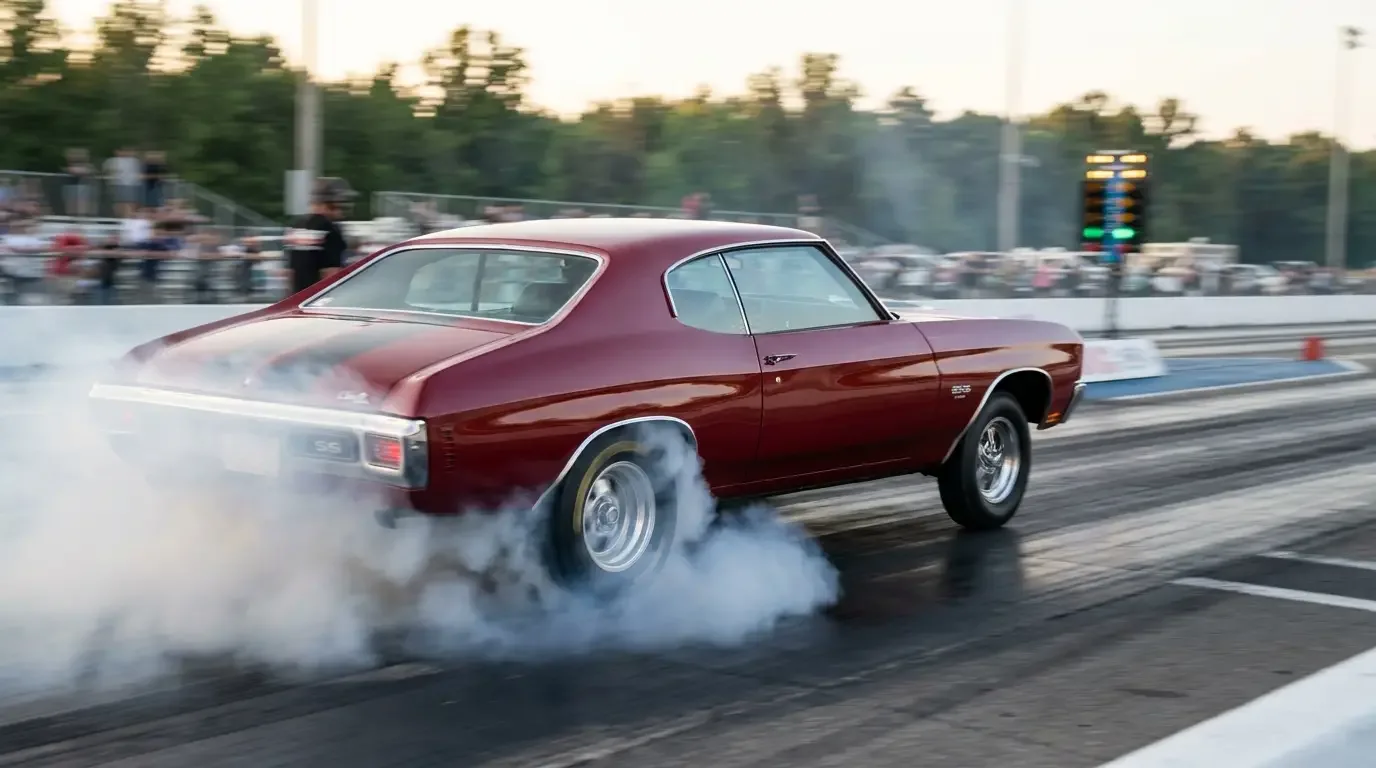
The TH400 automatic ran a torque converter that multiplied engine torque at launch in a way a manual transmission simply can't. A driver who wasn't confident on a clutch, or who wanted the most consistent 60-foot times without worrying about bogging the engine off the line, often got quicker, more repeatable runs out of the Turbo 400 than out of the M22, especially with a driver who wasn't an experienced four-speed racer behind the wheel.
The TH400 was also simply tougher in raw abuse terms for a lot of owners, since there's no clutch to overheat and no shift technique to master. Slip the throttle down, let the converter do its job, and the transmission handled the rest. That made it the more forgiving option for a street car that occasionally saw the strip, rather than a dedicated race car.
| Transmission | Type | Gear cut | Best suited for |
|---|---|---|---|
| Muncie M22 "Rock Crusher" | 4-speed manual, close-ratio | Straight-cut | Experienced driver, repeated hard launches |
| Turbo 400 (TH400) | 3-speed automatic | N/A, torque converter | Consistent launches, street/strip duty |
Which one actually launched quicker
This is where the bench racing gets loud, and honestly the honest answer is "it depends on the driver." A skilled clutch foot with good shift timing could beat a Turbo 400 car off the line in a well-sorted M22 Chevelle. A less experienced driver, or one running the car on a Sunday afternoon rather than at a sanctioned event, usually posted more consistent times behind the Turbo 400's converter multiplication. Period road tests and modern comparisons alike tend to favor the automatic for outright consistency, not necessarily outright peak numbers.
What actually decided most buyers' choice at the dealership wasn't the quarter-mile spreadsheet, it was how they wanted to drive the car day to day. The M22 demanded engagement. You had to work it, feel the clutch, know when to shift for the powerband. The Turbo 400 asked nothing of the driver beyond picking a gear and mashing the pedal. Both were legitimate performance transmissions. They just served different definitions of performance.
What to check if you're buying one today
A correctly matched M22 or Turbo 400 behind a big block should show consistent casing date codes and stampings that align with the car's build date, and the M22 in particular commands a real premium over a swapped-in M20 or M21, so verify the internals if the seller is asking top dollar for a "factory M22" car. It's not hard to install a Rock Crusher case around a lesser internal gearset, and it's been done plenty of times over fifty years of parts swapping.
If you're shopping specifically for a manual-transmission big block, the smartest move is to find a 4-speed big-block Chevelle with documentation rather than trusting a badge or a shifter alone.
Living with each one fifty years later
Parts support looks different for the two today, and it matters if you're planning to drive the car regularly rather than trailer it to shows. Muncie four-speed internals, including M22-spec gearsets, are well supported by the aftermarket, so a worn synchro or a chipped gear tooth isn't a car-ending problem the way it might have been for an owner in 1985 hunting a junkyard for the exact right part. The clutch linkage and pedal assembly on these cars is old-school and mechanical, which some owners genuinely prefer for the direct feel, and others find tiring in stop-and-go traffic decades after the fact.
The Turbo 400 has arguably even better parts support, since GM used it across such a wide range of trucks and cars for so many years that rebuild kits, torque converters, and internal components are inexpensive and easy to source almost anywhere. That ubiquity cuts against the transmission's collector-car glamour a little, since a Turbo 400 doesn't carry the same enthusiast mystique as a four-speed, but it's the more practical choice for anyone who wants to drive a big-block Chevelle as a daily cruiser instead of a trailer queen. Neither transmission is the wrong answer. They're just answers to different questions about how you actually plan to use the car.
"The Rock Crusher didn't earn its name from being fragile. It earned it from being loud about surviving abuse the standard box couldn't handle. That whine is the sound of a gearset doing exactly what it was built to do."
Dan Reeves
Whichever transmission got the power down, none of it mattered without the axle behind it holding up to that torque launch after launch. Next: next: The 12-Bolt Rear.
Sources and notes
- Why Was the Muncie M22 Nicknamed the Rock Crusher?: Jalopnik
- Muncie 4-Speed: The Complete History: Chevy DIY
- Muncie 4 Speed Transmissions, 5speeds.com
- All About the Legendary Muncie 4-Speed Transmission: CarBuzz
- Muncie M22 Rockcrusher, Borg Warner Super T10 or Turbo 400: NastyZ28.com
- 1970-1972 Chevrolet Chevelle SS 454: Specs, History, Performance: MotoGallery
Related Reading
Have a
Chevrolet Chevelle
for Sale?
Reach thousands of serious classic car collectors across the US.
Sell It Here →
Are You a Classic Car Dealer?
List your full inventory and connect with targeted classic car buyers.
Join as a Dealer →

About the author
Dan Reeves
Performance engine builder from North Carolina's motorsports corridor, focused on swaps, forced induction and making real, repeatable power.
Related Listings - Chevrolet Chevelle

Comments
Be the first to comment on this article.