
Every first-generation Mustang tells you where it was built in the second character of its VIN. It is one letter, F, R or T, and it gets less attention than the engine code three places to its right. That is a mistake. The Mustang assembly plants were three very different places, two of them on opposite coasts, and the letter is often the first clue to how a car was ordered, which special editions it could have been, and where its paperwork trail should start.
Car Features
9 min read
Dearborn, Metuchen, San Jose: Mustang Assembly Plants and Their Codes
F, R or T: the second VIN character names the plant. Dearborn, San Jose and Metuchen, what each built, and what the plant letter can prove.
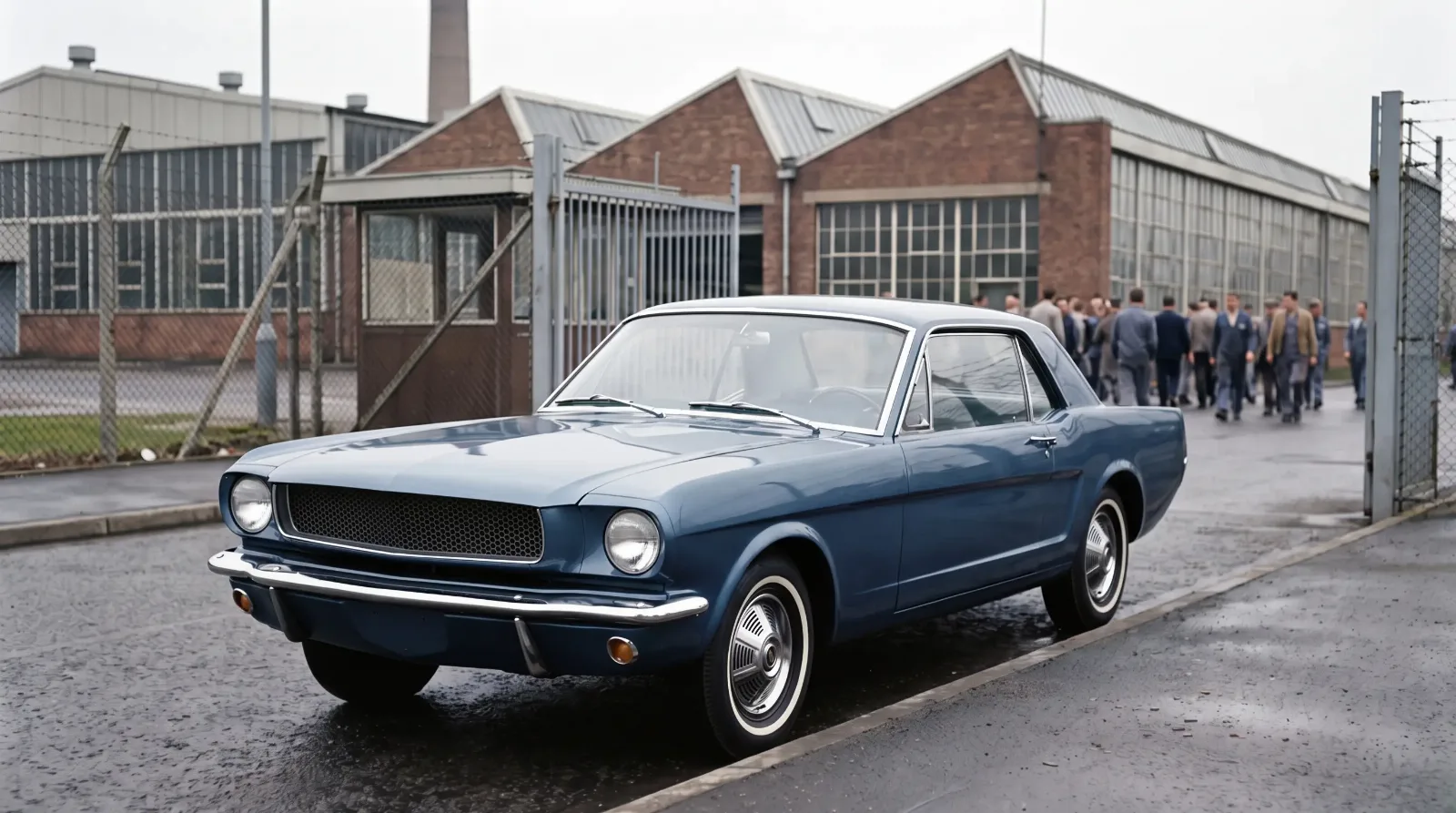
This piece sticks to the plants themselves and what their codes can and cannot prove. The full VIN and data plate work belongs to the wider identification guide; more on that here.
The three Mustang assembly plants and their letters
The first-generation VIN runs 11 characters: a year digit, a plant letter, a two-digit body code, an engine letter and a six-digit serial. Take 7T02C164054. The 7 is 1967, the T is Metuchen, 02 is the fastback body and C is the 289 two-barrel. The plant letters held for the whole first generation, 1965 through 1973: F for Dearborn, Michigan, R for San Jose, California, and T for Metuchen, New Jersey. Not every letter appears in every year, though, as the plant sections below show.
Ford needed all three almost from the start. The car that launched the pony car idea sold so fast that a single plant could never have kept up, and between them the three built almost 1.3 million Mustangs in the first two years. San Jose had its Mustang line set up by July 1964, only a few months after the public introduction.
| Plant | VIN letter | Location | Plant dates | Mustangs built (to 2000) |
|---|---|---|---|---|
| Dearborn | F | Dearborn Assembly, River Rouge complex, Michigan | Mustang production March 1964 to May 2004 | Every generation, 1964½ to 2000 |
| San Jose | R | Milpitas, California | Opened May 17, 1955; closed May 20, 1983 | 1964½ to 1970; Mustang II 1974 to 1978; Fox 1979 to 1983 |
| Metuchen | T | 939 US Route 1, Edison, New Jersey | Opened 1948; production ended February 27, 2004 | 1965 to 1971 (last cars built December 1970) |
Dearborn: the home plant
Dearborn Assembly sits inside the Ford River Rouge complex, and it is where the Mustang began. The first pre-production cars left the Rouge line on February 10, 1964, and regular production started on March 9. Serial Number One, 5F08F100001, a Wimbledon White convertible, was one of those early Rouge cars.
Dearborn is also the plant that never stopped. Ford's own count puts it at about 6.7 million Mustangs over 40 years, ending with a red 2004 GT convertible in May 2004. From about 1984 it was the only American plant building the Fox Mustang, and every SN95 from 1994 on carries an F. Some regional specials are Dearborn cars too. The 1970 Twister Special Mach 1s were built there in early to mid October 1969, with VINs in the 118,000 series, before their stripes went on at the Kansas City plant lot.
San Jose, which was really Milpitas
Here is the first correction. Ford's San Jose Assembly Plant was not in San Jose. It stood in Milpitas, it opened on May 17, 1955 as the replacement for Ford's Richmond plant, and it built the West Coast's Mustangs. In 1964½ both Dearborn and San Jose started their serials at 100001, so the same low serial exists at both plants and only the letter tells them apart. The first San Jose Mustang came off the line on July 10, 1964.
The R cars include some of the most interesting Mustangs of the decade. In the last week of 1964, Ford San Jose shipped 110 Wimbledon White fastbacks to Shelby to meet the SCCA's 100-car requirement for the GT350. The 1968 GT/CS California Special was built at San Jose only, with VINs starting 8R01. The High Country Special was a San Jose car shipped by rail to the Denver district for dealers in Colorado, Wyoming and Nebraska. And the two Highland Green 1968 GT fastbacks from Bullitt carried VINs 8R02S125558 and 8R02S125559: R for San Jose, S for the 390.
San Jose's first-generation run ended with the 1970 model. The decoder tables drop the R from 1971 on, and the 1971 to 1973 registry people say flatly that no 1971 Mustang, not even a test car, was built there. Then the plant came back to the Mustang more than once. US Mustang II VINs show only F and R, so San Jose built the 1974 to 1978 cars alongside Dearborn. It built Fox Mustangs from 1979 as well, and it closed on May 20, 1983. One reference gives July 5, 1993 instead, but that date appears to belong to the site, not the plant. The land reopened in 1994 as the Great Mall of the Bay Area, and one of its roads is called Mustang Drive.
"The plant letter is the one part of the VIN nobody bothers to fake, because nobody thinks it matters. That is exactly why I read it first. When the R or the T disagrees with the story that comes with the car, the story is usually what needs fixing."
Tom Ramirez
Metuchen, which was really Edison
The second correction mirrors the first. The plant every Mustang owner calls Metuchen had its address at 939 US Route 1 in Edison, New Jersey. It opened in 1948 and kept building cars until February 27, 2004.
Metuchen was the late arrival. The VIN decoder tables list 1964½ serial starts only for Dearborn and San Jose; for 1965, Dearborn starts at 250001, San Jose at 125001 and Metuchen at 100001. The 1964½ section of those tables lists only F and R, with no T at all. That pattern says Metuchen did not build 1964½ cars, and I would want to see a T-coded 1964½ before I believed one existed. Once it started, it mattered. The 1968 Shelby base cars were built at Metuchen, with a T in the VIN, and shipped by rail to A.O. Smith in Ionia, Michigan, where the fiberglass, roll bar, gauges and the Shelby VIN plate went on.
Metuchen did outlast San Jose, but only just. It built early 1971 Mustangs, with VINs starting 1T and a serial run that began at 100101 rather than 100001, and its last Mustangs came off the line in December 1970, on the 23rd by the account of the 1971 to 1973 enthusiasts who have tracked those cars. From then on Dearborn was the only Mustang plant, and every 1972 and 1973 car carries an F. One popular decoder still lists a T for 1972; I have not seen a 1972 Metuchen car, and the registry people say there were none. So 1971 is Metuchen's last Mustang model year, and a 1T car is the rarer find. How many Mustangs the plant built in total is a number I have not seen in a source I would put my name to, so I am leaving it out.
What the plant letter proves, and what it does not
The plant letter tells you where the car was assembled. It does not tell you where the car was sold. That job belongs to the DSO, the district sales office code on the data plate. The High Country Special is the textbook case: built in San Jose, sold in Denver, and the DSO is what ties it to the Denver district.
The letter also cannot make a car something it was not. The 1965 data plate carries body, color, trim, date, DSO, axle and transmission, and nothing that says GT. A Dearborn F or a San Jose R in the right place tells you the car is consistent with its paperwork, but whether you are looking at a real GT or a clone is settled by other evidence. The plant code is the opening question, not the verdict.
And then there is the R that is not a plant. In the fifth position, R is an engine code: the 428 Cobra Jet Ram Air in 1969 and 1970, the Boss 351 in 1971 and the 351 HO in 1972. A 1970 VIN with an R in both the second and fifth places is a San Jose car with the Ram Air 428. Such cars exist: 0R05R100045, a 1970 Mach 1 with the R-code 428 Cobra Jet Ram Air, was delivered new to a Ford dealer in Compton, California. Two R's with nothing in common but the letter.
By the mid-1980s the three-plant arrangement was over. San Jose had closed, and Dearborn was the only American Mustang plant through the end of the classic era; the Fox cars built at Cuautitlan Izcalli, Mexico from 1979 to 1984 and at Valencia, Venezuela are a separate study. Production left Dearborn for the AutoAlliance plant at Flat Rock, Michigan in the fall of 2004, for the 2005 model.
If you want the rest of the car's life laid out in order, our classic Mustang guide covers the generations one by one. But start with the letter. One character, stamped in before the car ever reached a dealer, and it already knows where the story begins.
Sources and notes
- Classic Industries: 1964 to 1973 Mustang VIN decoder (plant letters and serial starts by year)
- 7173Mustangs.com: Serial one for 1971 to 1973 (Metuchen 1971 run, Dearborn only for 1972 and 1973)
- 7173Mustangs.com: 1971 to 1973 assembly plants (Metuchen to December 23, 1970; no 1971 San Jose cars)
- MustangSpecs: 1964 Mustang production at Ford's San Jose plant (first car July 10, 1964)
- Ford: Why Mustang production moved out of Dearborn
- Wikipedia: San Jose Assembly Plant
Related Reading
Have a
Ford Mustang
for Sale?
Reach thousands of serious classic car collectors across the US.
Sell It Here →
Selling a classic? Here's how: where to sell your classic car online
Are You a Classic Car Dealer?
List your full inventory and connect with targeted classic car buyers.
Join as a Dealer →
#mustang identification
#Ford Mustang
#Mustang VIN
#Mustang assembly plants
#Dearborn Assembly
#San Jose Assembly
#Metuchen

About the author
Tom Ramirez
Corvette researcher and historian based in Bowling Green, Kentucky. Two decades documenting Corvette production history from original factory records.
Related Listings - Ford Mustang
Comments
Be the first to comment on this article.